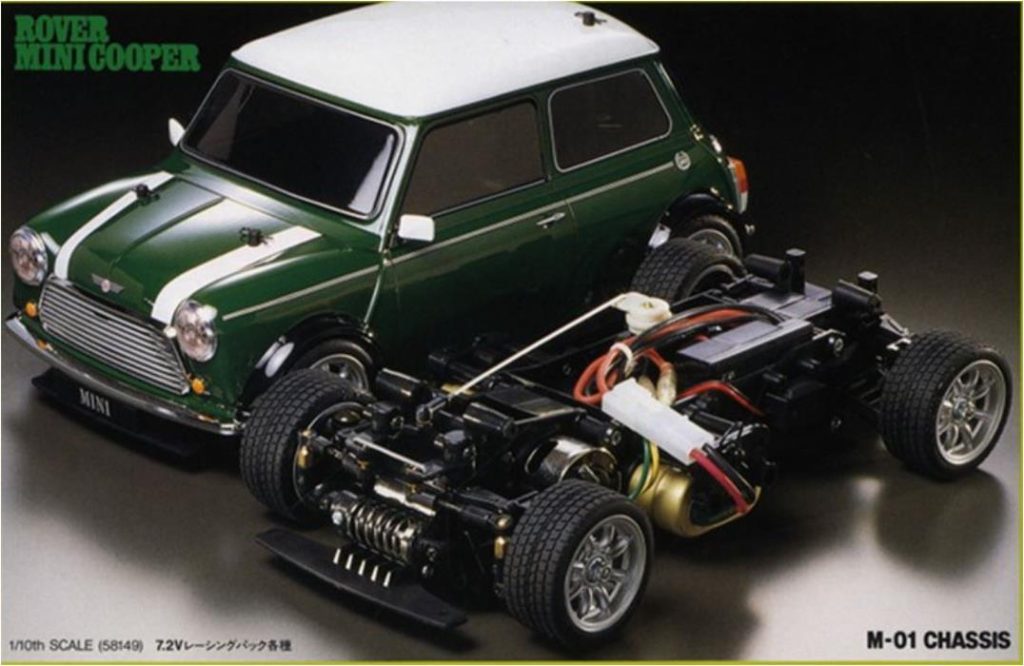
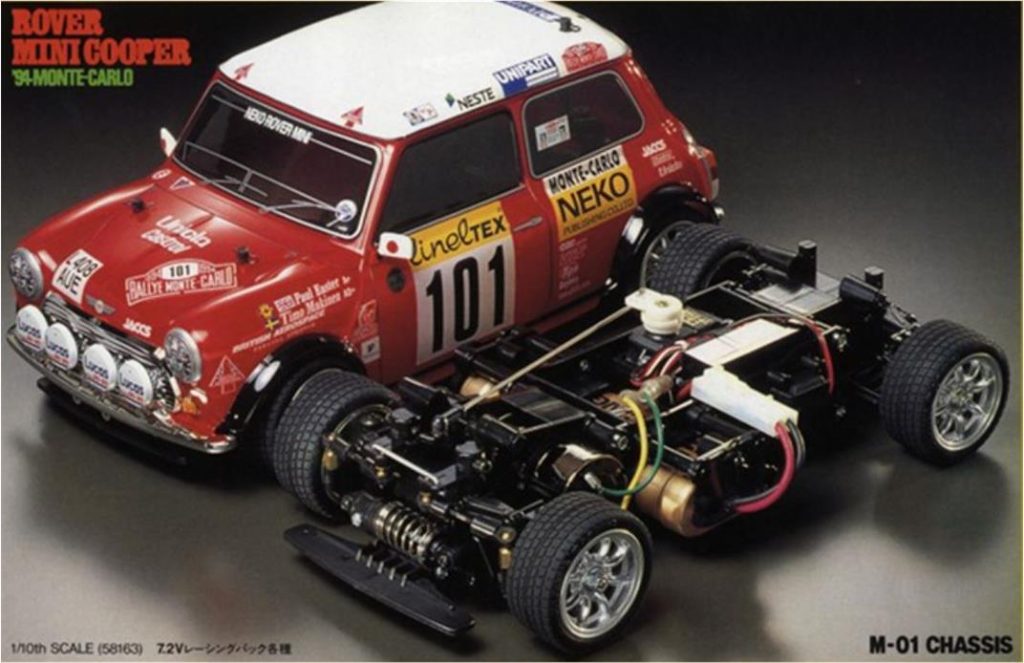
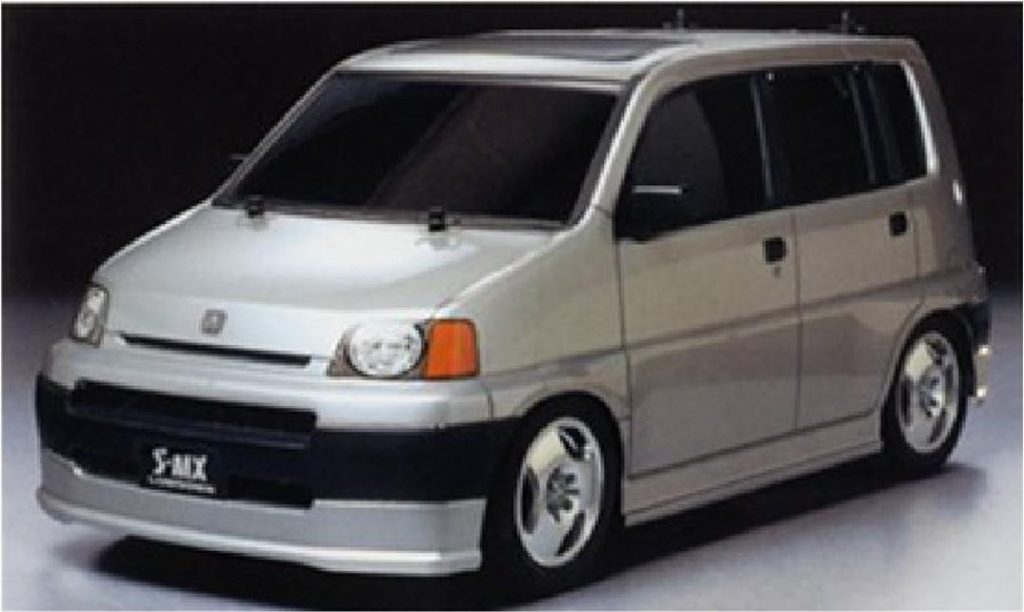
The M-01 chassis represents one of Tamiya’s milestones in the production of two-wheel-drive road chassis. Included in the M-01 family are the following models:
– Rover Mini Cooper: Model number 58149, released in 1994 and available on the market until 1999. It features the short wheelbase M-01 chassis of 210 mm. – Rover Mini Cooper ’94 Monte Carlo Edition: Model number 58163, released in 1995 and available until 2000. It also has the short wheelbase M-01 chassis of 210 mm. – Honda S-MX Lowdown: Model number 58196, launched in 1997 and available until 2000. It comes with the M-01M medium wheelbase chassis of 225 mm.
There are two versions of the chassis within the M-01 family, differentiated by wheelbase length: the standard wheelbase chassis, identified by the code M-01 and the intermediate wheelbase chassis, marked by the code M-01M.
The M-01 chassis is the front-wheel-drive version of the M-02 chassis, which features rear-wheel drive. Both M-01 and M-02 share all components. It is possible to switch a chassis from M-01 to M-02 and vice versa simply by swapping the suspension parts between the front and rear. When reversing the drive configuration, it is necessary to reverse the electric motor’s direction as well—the forward drive on the front-wheel-drive chassis corresponds to the reverse drive on the rear-wheel-drive chassis.
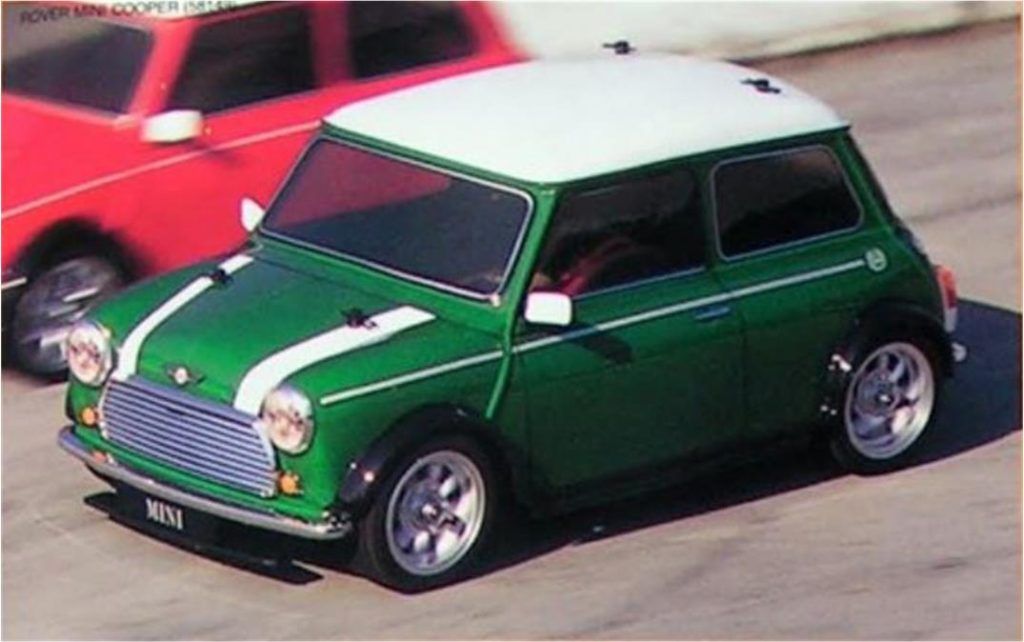
The M-01 and M-02 chassis are the first in a long series of chassis released by Tamiya that adhere to a numbering logic: odd numbers after the M- designation (e.g., M-01, M-03) represent front-wheel-drive chassis, while even numbers (e.g., M-02, M-04) correspond to rear-wheel-drive chassis. Starting with the M-03 generation, the odd-numbered chassis and their subsequent even-numbered counterparts only partially share components. For instance, the suspension arms of the M-03 chassis are identical to those of the M-05. Additionally, the M-03/M-04/M-05/M-06 chassis share gears, available in “standard” (white) and “reinforced” (black) versions. Tamiya has evidently pursued a continuous evolution, improving the chassis over time. From 1996, the M-02 chassis became available with a long wheelbase of 239 mm. The M-01 and M-02 chassis share the same dual-shell central monocoque structure but offer different driving experiences. Rear-wheel-drive chassis provide more precise handling in curves. This technical difference is attributed to the steering system components: when both traction and steering are on the front axle, the play between the steering links and levers is amplified, resulting in imprecise steering. This issue is mitigated with rear-wheel drive and front steering. The standard M-01 chassis is notably famous for accommodating the Mini Cooper body, both in its road-going version and the version that competed in the Monte Carlo Rally in 1994.
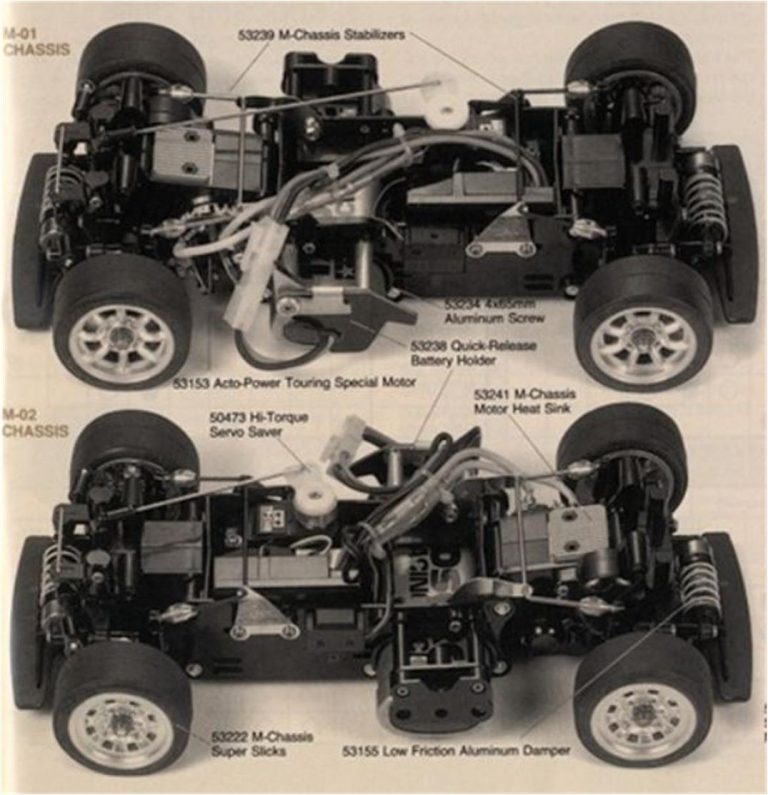
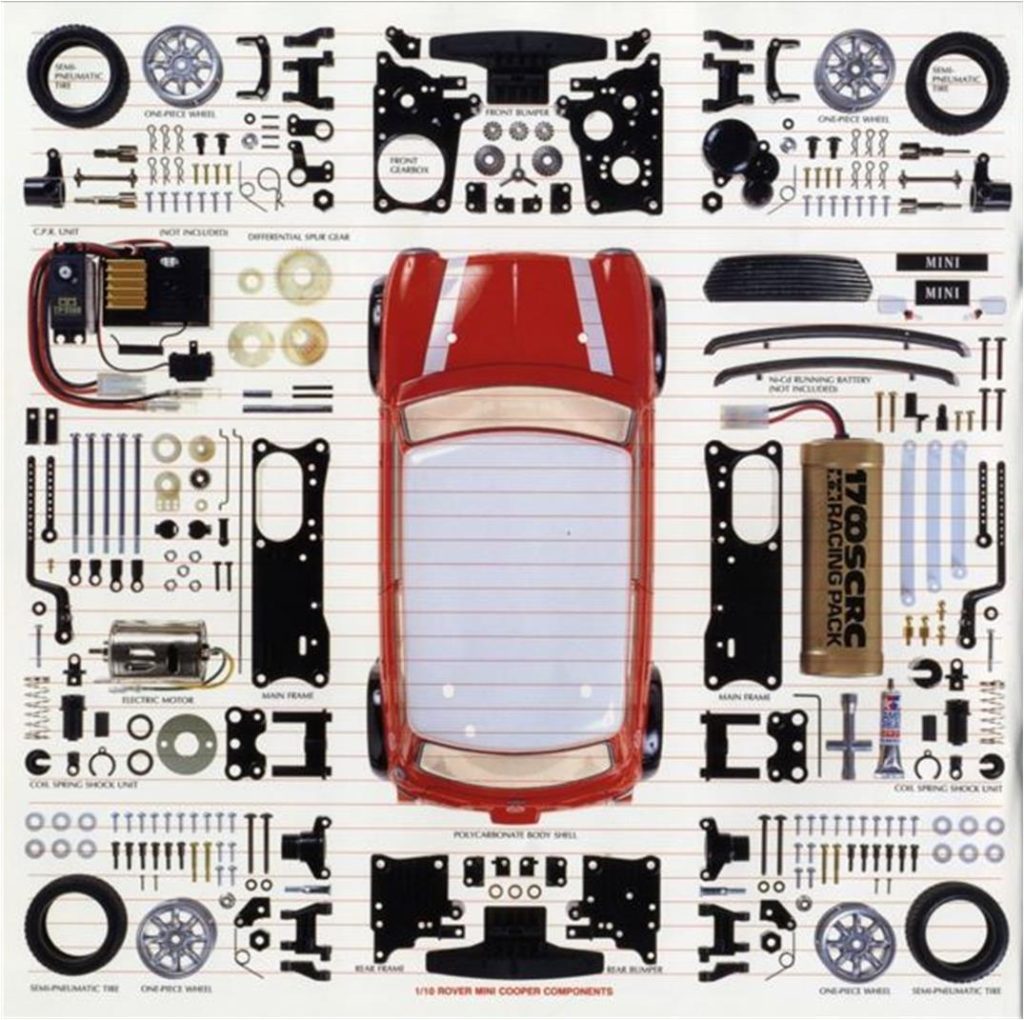
Front-wheel-drive models marked a significant innovation for Tamiya, drawing considerable attention worldwide. Many advertisements from Tamiya and its international distributors appeared in specialized magazines, showcasing this breakthrough. The exploded view of the M-01 Rover Mini Cooper chassis featured prominently in Tamiya’s guidebook, emphasizing the ingenuity of its design. Tamiya releases several versions of the Mini Cooper body; guide that highlights the differences between the street, rally and racing versions.
The M-01 chassis is a front-wheel-drive vehicle with the following key characteristics:
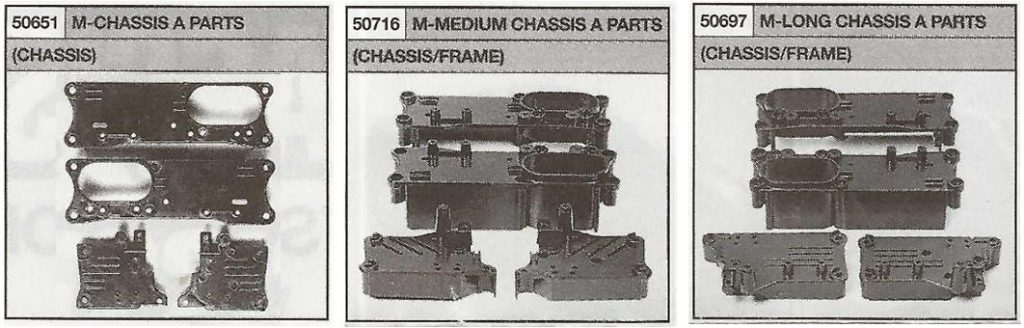
– A plastic chassis composed of two shells forming a central structure. Onto this structure, the following are installed: the front motor and gear assembly, rear suspension unit, battery, electronics and all four suspensions. – Tamiya achieves three different wheelbase lengths by modifying the subframe, which alters the overall dimensions of the model. The relevant part is the “A” piece, identified by the following codes: Standard wheelbase – Code 50651, Medium wheelbase – Code 50716 and only for the M-02 version, there is a long wheelbase option – Code 50697. – The central unit houses the battery and electronics, which remain unchanged across all three configurations, while the rear spacer length varies to achieve the different wheelbases.
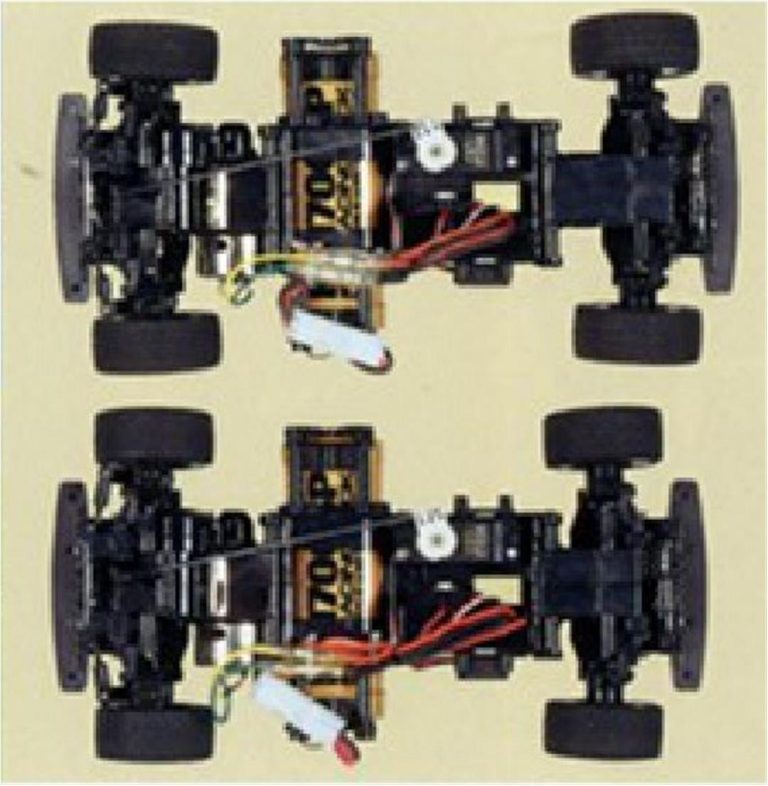
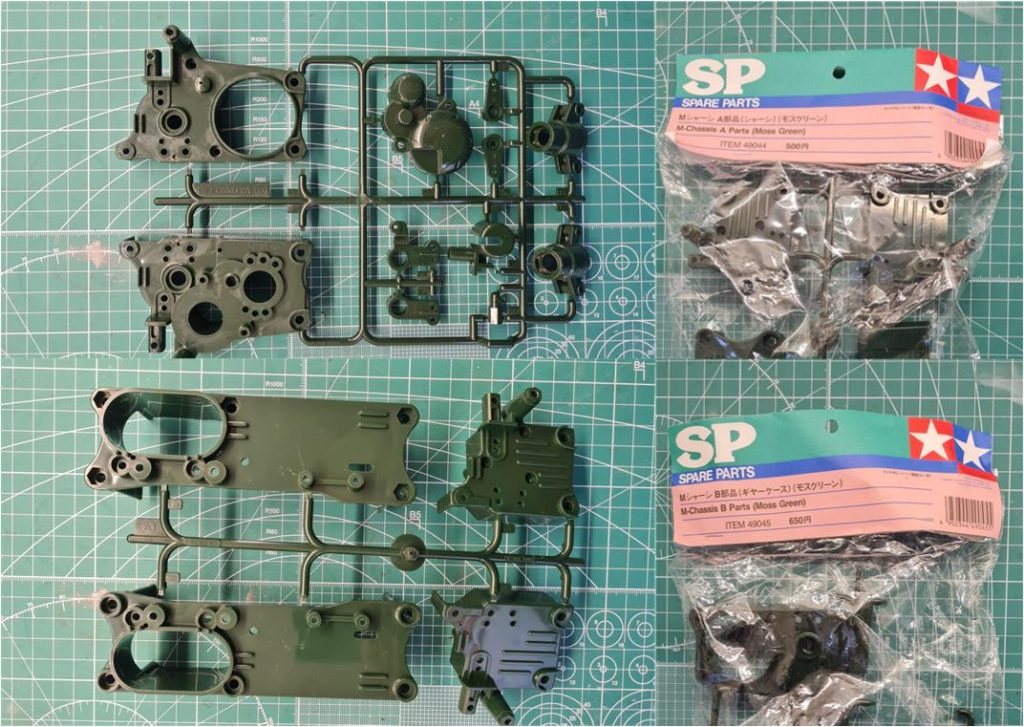
There is a special accessory released in a limited edition: a chassis in dark green color. It consists of two parts:
– Code 49044, defined as “M-Chassis, A Part, Moss Green”, shown on the firts line in the image below. – Code 49045, defined as “M-Chassis, B Part, Moss Green”, shown on the second line in the image below.
It is available only in the short-wheelbase version.
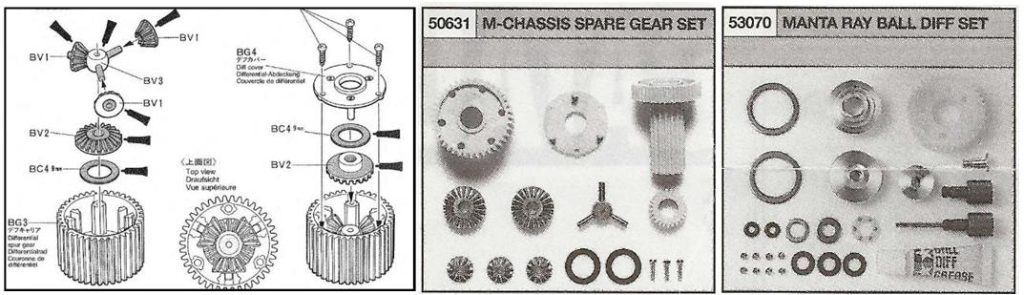
– Motor 540 installed at the front of the chassis. – Gear differential featuring three satellite gears; there is also a ball differential available as an accessory to enhance performance. The accessory is identified by code 53070, labeled as the “Manta Ray Ball Differential Set.”
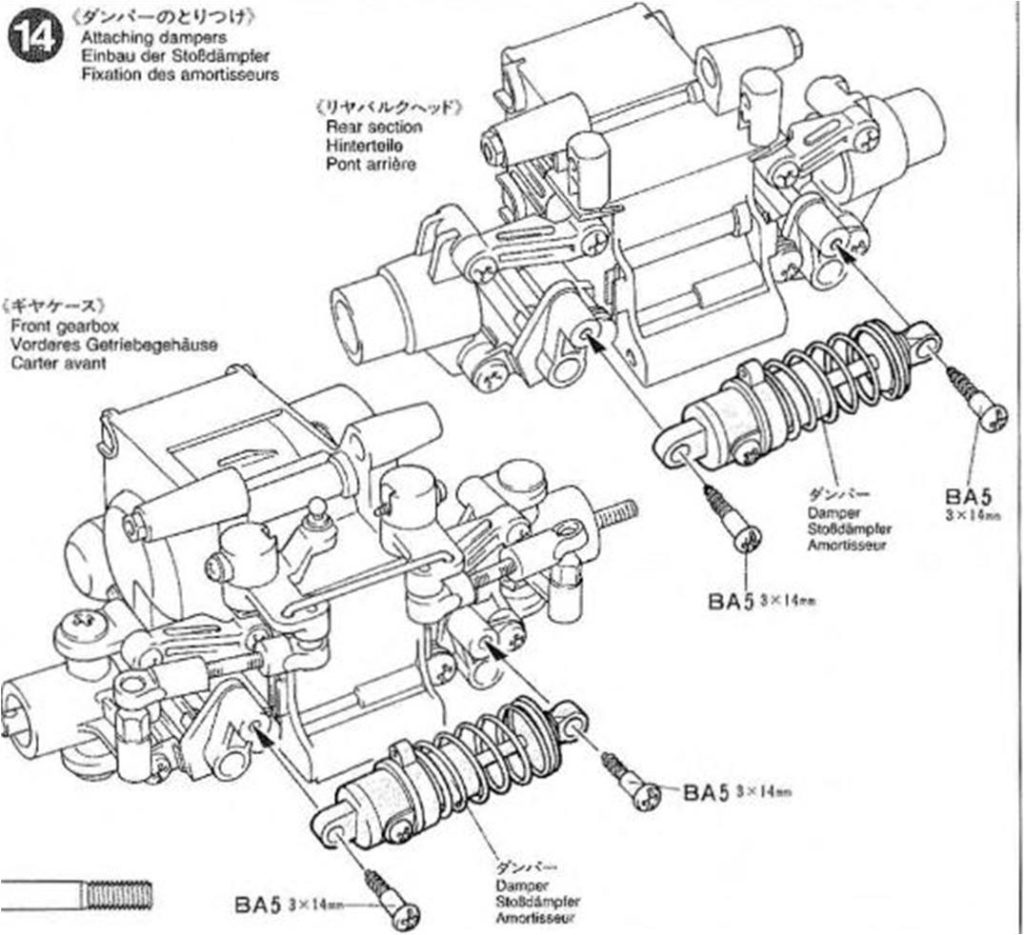
– Four independent suspensions featuring single horizontal shock absorbers at the front and rear.
– Option to reverse the position of the battery and electronics by rotating the central shell; this modification changes the weight distribution and therefore the handling of the vehicle. – Option to reverse the drive from front to rear by moving the steering components from the front suspension to the rear suspension. To execute this modification, it is necessary to adjust the length of the servo motor arm that controls the steering.
To improve performance, several accessories are available:
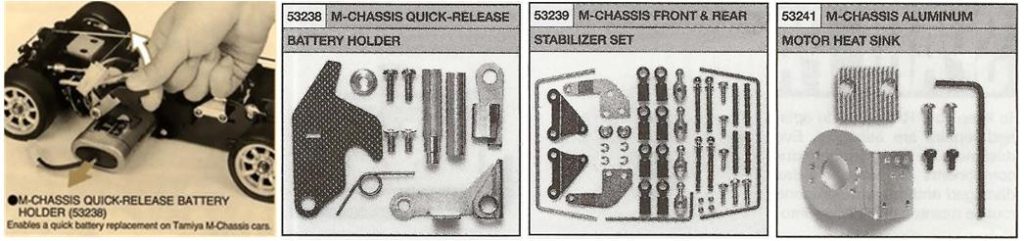
– To speed up battery replacement, there is the quick-release set with code 53238, described as the “M-Chassis quick release battery holder.” – The M-01 chassis is characterized by its high level of body roll, which can make fast driving difficult. To reduce body roll, there is a double stabilizer bar set for the front and rear with code 53239, described as the “M-Chassis front and rear stabilizer set.” – To quickly cool the motor, there is an aluminum L-shaped plate set with finned heatsinks with code 53241, described as the “M-Chassis Aluminium motor heat sink.”
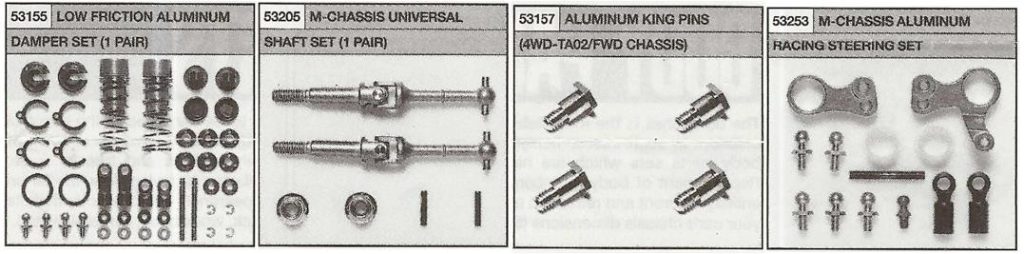
– To improve road holding, the high-performance damper set, code 53155, is released, described as “Low friction aluminium damper set (1 pair – 2pcs)”. – To enhance traction, the drive shafts with integrated universal joints set, code 53205, is released, described as “M-chassis universal shaft set (1 pair – 2pcs)”. – To reduce suspension play, the aluminium suspension joints set, code 53157, is released, described as “Aluminium king pins (4WD- TA02/FWD – RWD, 4 pcs)”. – To minimize steering linkage play, the aluminium steering linkage set, code 53253, is released, described as “M-chassis aluminium racing steering set”.
The best setup for a front-wheel-drive car is as follows: – Very stiff front suspension to manage both traction and steering. Ideally, only the rear anti-roll bar should be installed, which is available in the set with code 53239 described as “M-Chassis front and rear stabilizer set.” – Soft rear suspension so that the car can follow the trajectory in the curve without lifting the inner wheel and losing grip.
Re-release
Tamiya has released some reissues in other families:
– Rover Mini, model number 49082, released in 1999 and available on the market until 2000, M-01 chassis version with a short wheelbase of 210 mm. – Honda S-MX Lowdown, model number 49084, released in 1999 and available on the market until 2000, M-01M chassis version with a medium wheelbase of 225 mm.
Condensed Catalogue
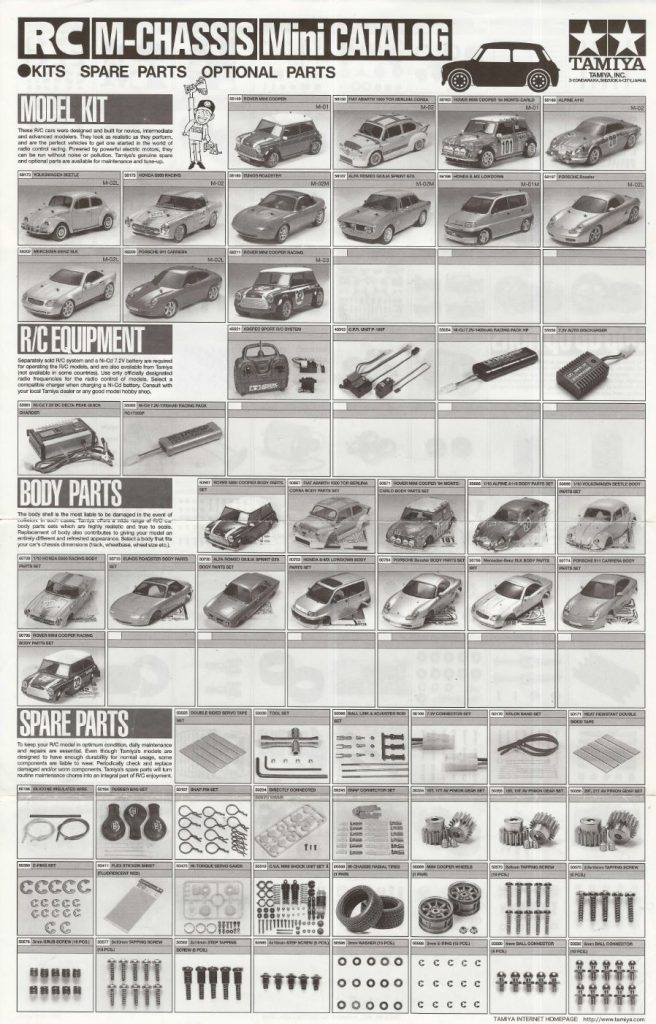
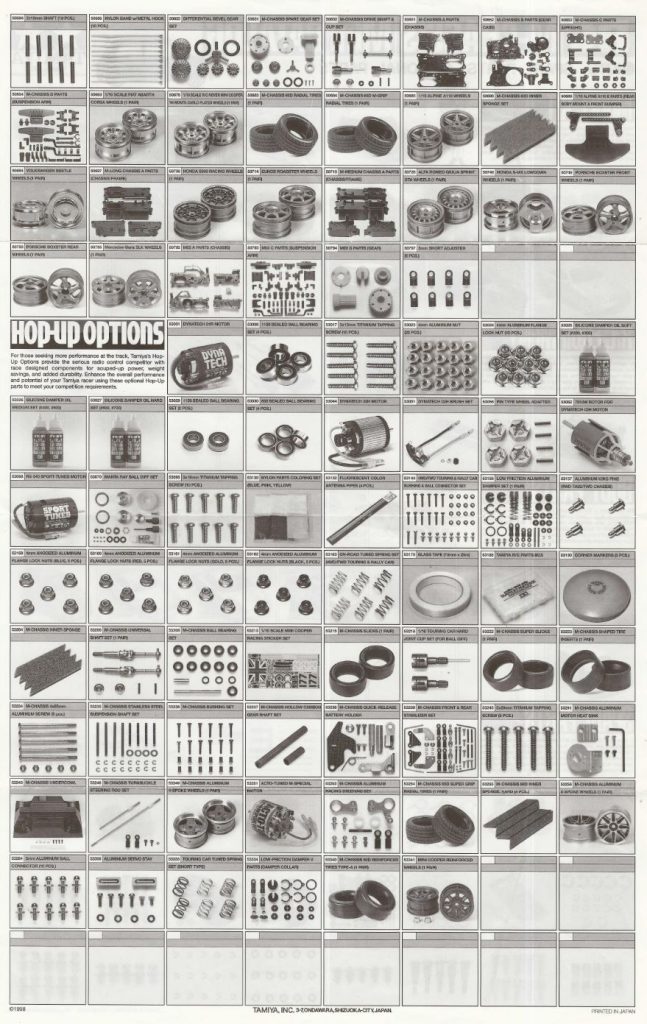
In 1998, a catalogue is available listing all spare parts and accessories to enhance performance.
Tamiya, original figure, box art, guide book and catalogue are of TAMIYA INC, which does not endose or sponsor www.tamiyaclassic.com. Any brands, logos and trademarks represented on this website are the copyright of their respective owners.