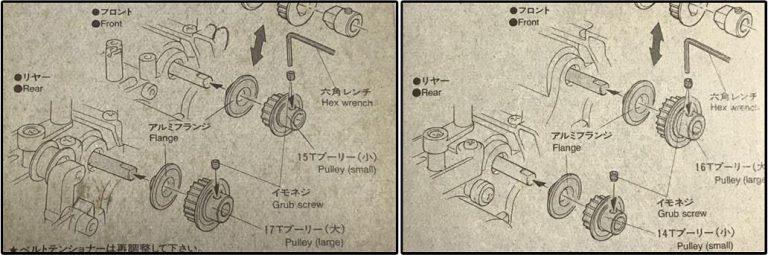
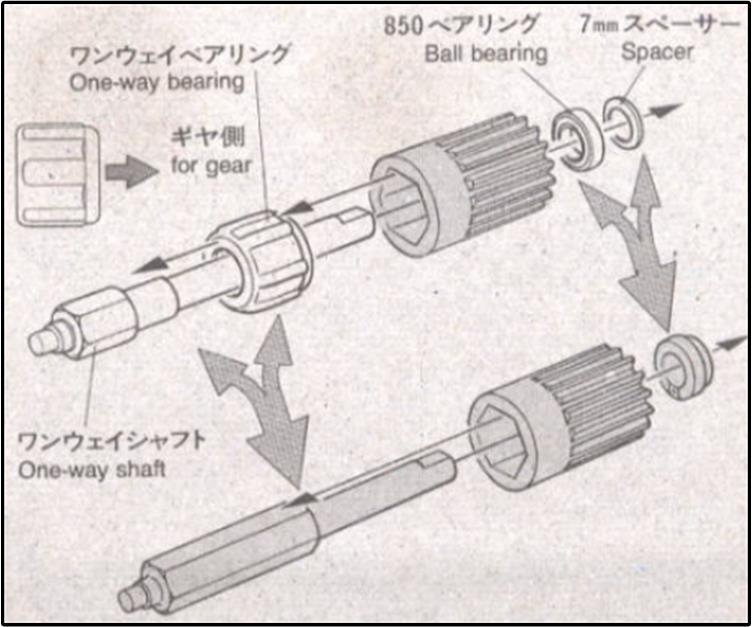
Among the accessories to enhance performance, Tamiya releases a set for sale that includes a unidirectional bearing and a pair of pulleys with a different number of teeth between the front and rear axles:
– Code 53298 TA03F defined as a torque control unit with a 15T pulley at the front and a 17T pulley at the rear – Code 53299 TA03R defined as a torque control unit with a 16T pulley at the front and a 14T pulley at the rear
This solution is an evolution of the equivalent design developed for the DF-01, TA01 and TA02 chassis.
The one-way bearing is a highly recommended accessory for all four-wheel-drive models without a center differential. The one-way action allows optimal management of the speed difference between the front axle wheels and the rear axle wheels; for this reason, the one-way bearing is available as a standalone accessory: part number 53279. It is possible to install the one-way bearing on either the front axle or the rear axle; the installation changes the vehicle’s behavior. The one-way bearing no longer allows braking on all four wheels, but only on the front wheels or the rear wheels.
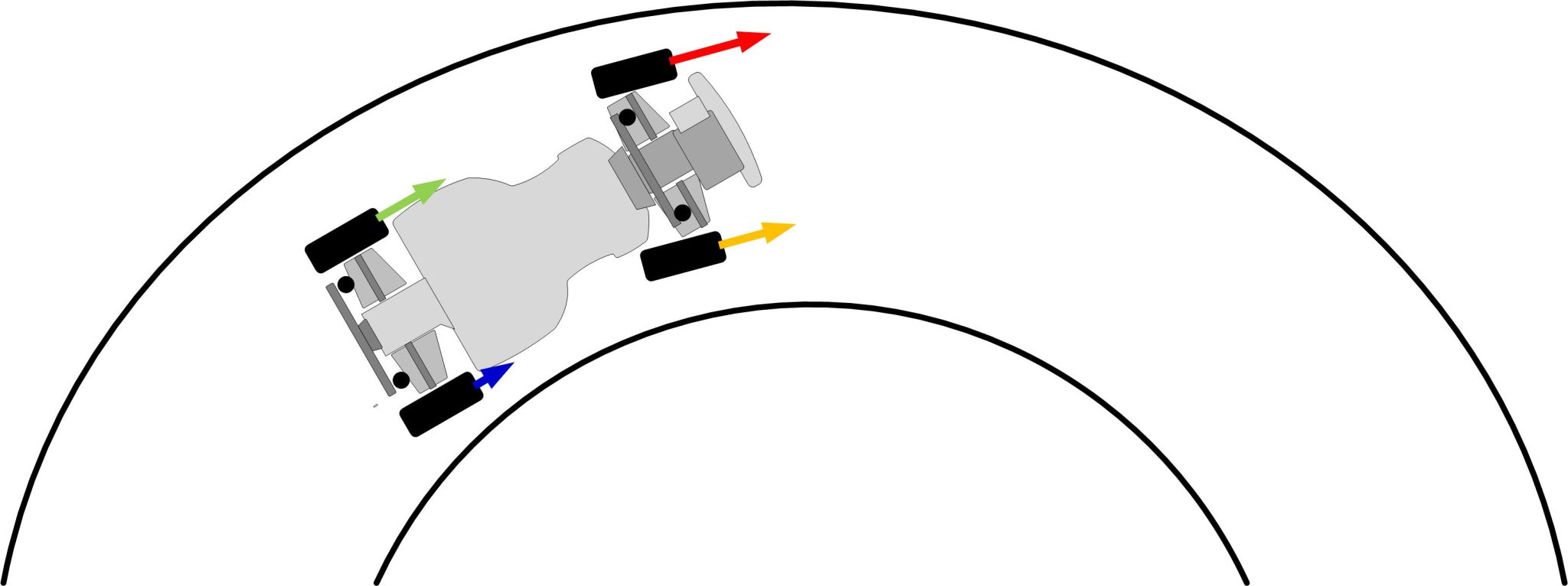
By installing the unidirectional bearing on the front, during braking, the brake acts only on the rear wheels, making it easier to take tight corners. This is the best solution for smoother and easier driving, but it increases braking distances. In this configuration, the model becomes understeering. By installing the unidirectional bearing on the rear, during braking, the brake acts only on the front wheels, making it easier to handle fast turns. However, this setup makes it more challenging to control the constant oversteering in medium to tight corners. To further improve the cornering behavior of the TA03 chassis, it is possible to adjust the number of teeth on the front and rear pulleys, diversifying the speed of the two axles. Codes 53298 and 53299 include the unidirectional bearing and two pulleys with different numbers of teeth between the front and rear. Pulleys with different tooth counts allow the front wheels to achieve a higher number of rotations without changing the speed of the rear wheels. This adjustment is necessary to improve cornering performance, where all four wheels rotate at different speeds. To understand how this works, consider the illustration below. It highlights the speed of each wheel for a car at the center of a curve using four arrows, with lengths proportional to the rotational speed:
– The front-right wheel needs to cover a greater distance than the rear-right wheel. – The front-left wheel needs to cover a greater distance than the rear-left wheel. – The outer rear-left wheel on the curve travels a longer distance than the inner rear-right wheel.
The different speed between the inner and outer wheels on the same axle is managed by the differential. Without the differential, the model would struggle more to navigate turns. The different speed between the axles is managed by the unidirectional bearing, while the optimal traction speed of the two axles is regulated by the different number of teeth between the front and rear axles.
Tamiya, original figure, box art, guide book and catalogue are of TAMIYA INC, which does not endose or sponsor www.tamiyaclassic.com. Any brands, logos and trademarks represented on this website are the copyright of their respective owners.