Tamiya Porsche 911 GT1 98 LM Winner, article number 58230 put on sale in 1999 and available on the market until 2002 Lexan body Chassis F103RS
Analysis of the model to be restored
The model has two original Lexan bodies. The first body has a colour scheme that does not respect the original livery of the car that won at Le Mans in 1998. The original livery is the one that is provided by Tamiya in the manual. Starting from the front going towards the rear, the analysis of the body reveals that
– the body is intact without any breaks; however, it does have scratches, – the colour scheme does not correspond to the official one; it fades from white at the front to red at the rear. The livery proposed on this model does not reflect any car that has taken to the track in reality to race, – the stickers are the original ones; however, they have not been applied correctly, – the two rear view mirrors are missing and – rear wing is present and intact. This is a good sign because it is a part that is easily damaged, especially the attachment of the two towers that support it. The body has certainly been used to run the model, probably in a fairly unobstructed place because it does not show any particular cracks and the rear wing is intact; although it shows signs of wear it will not undergo restoration.
The second body in the purchase has a colour scheme that respects the original livery of the car that triumphed at Le Mans in 1998. Starting from the front going towards the rear, the analysis of the body reveals that
– the body is perfectly intact without any cracks or scratches, – the colouring corresponds to the official one, – the stickers have been applied correctly, – the two rear view mirrors are missing. These are often not installed because they are locked to the body with a metal clip and tend to come off. Moreover, being locked to the body in one place they rotate on themselves assuming unnatural positions and – rear wing is present and intact. The body was definitely not used to turn the model; it was probably used to display the model on a shelf.
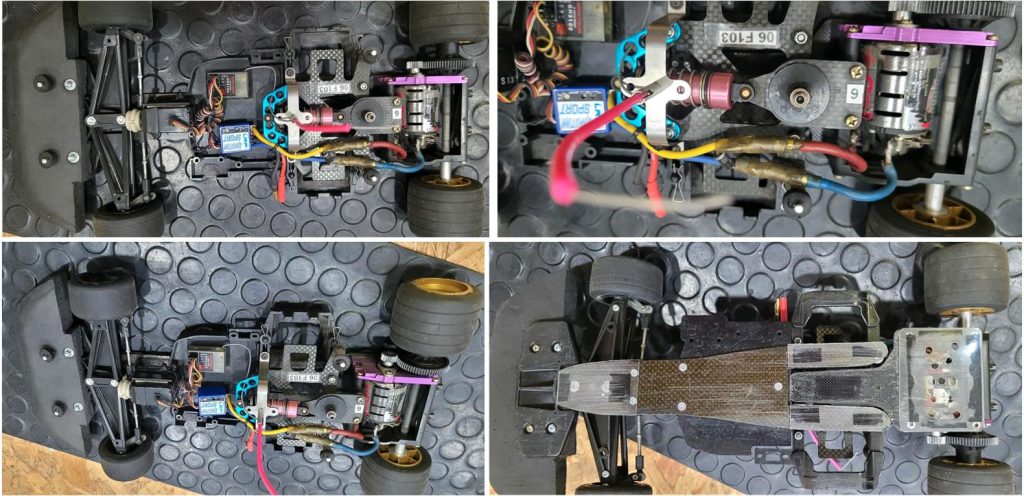
Starting from the front going towards the rear, the chassis analysis reveals that:
– the soft rubber front bumper is installed, which has several marks caused by impacts against obstacles, – the front steering arms are in the aluminium version with double screws; PopUp accessory code number 53150. This allows better adjustment of the toe-in of the front wheels and better adjustment of the turning radius. Being an almost compulsory upgrade if you want to adjust the chassis in the best possible way, this accessory will also be retained during restoration. The steering servo is present and has already been modified by cutting off the side wings. This modification is necessary in order to install the servo vertically, – the electronics tray housing the receiver and electronic motor speed controller is installed, – a light pink aluminium damper mount is installed (PopUp accessory code number 53155); the damper mount plate is not the one provided inside the package code number 14305371, but is made of aluminium anodised in light blue, – in the rear frame that houses the motor and axle there is a pink aluminium plate for the electric motor (PopUp accessory code number 53277). Compared to the version provided in the pack, which is made of plastic, this solution is more robust and disperses the heat of the electric motor better, – the FRP frame is well fitted, but there are evident marks left by debris from the surface of the road surface where the car has run touching the ground. A very thin transparent plastic sheet was installed to prevent the chassis from being damaged more than it should by crawling on the road surface. Nevertheless, marks are also present on the bottom plate as the protection was not complete and left some parts uncovered and – the electric motor is not the standard one.
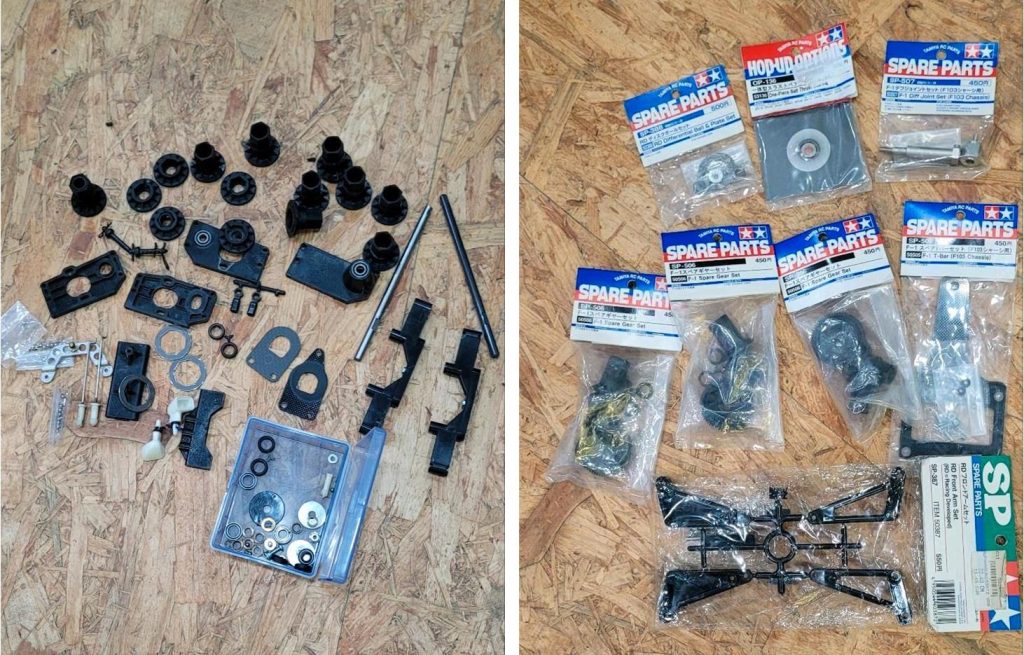
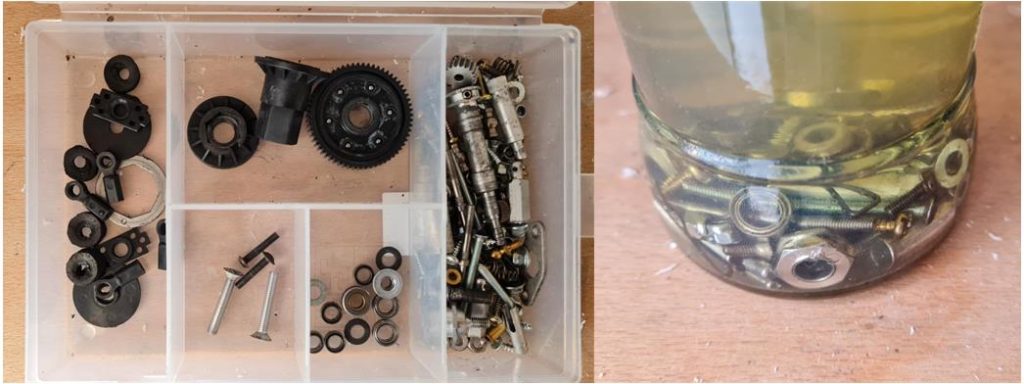
Along with the model came many spare parts no longer in the box, but at first glance never used: – two steering arms from the model’s first factory fitting; these are probably the original parts, – two rear view mirrors; these are the ones missing from both bodies, – an aluminium axle from the model’s original factory equipment and a titane axle which is a PopUp accessory part number 54127, – several plastic parts of the differential, – several plastic parts of the motor chassis – rear axle and – various parts Along with the model came some unopened bags of HopUp: – front suspension code number 50387, – rear T-chassis code number 50505, – rear differential gears code number 50506, – aluminium rear axle pins part number 50507, – one-piece differential bearing part number 50136 and – balls with plates for differential code number 50388
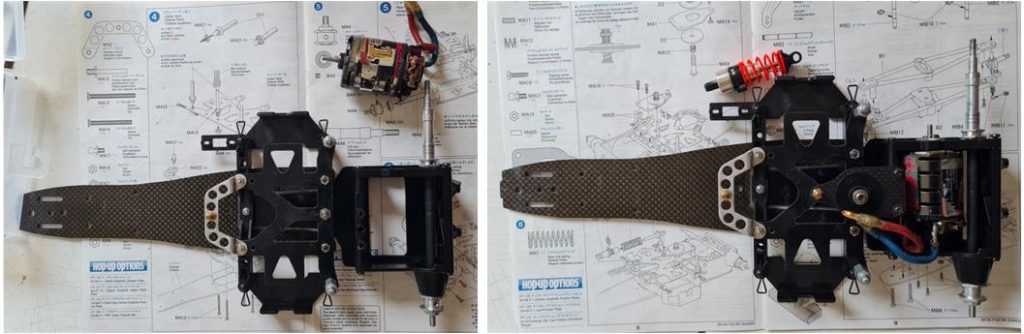
Given the excellent condition of the body and the availability of various spare parts, it makes sense to consider a restoration of the chassis alone using the parts that arrived with the model and looking for what is missing from the current market offer. Today (2024) all the spare parts to build an F103 chassis are available on the market. The chassis restored in this way will be in the right condition to then join it in marriage with the second body in this purchase, which was the one for display.
Chassis restoration
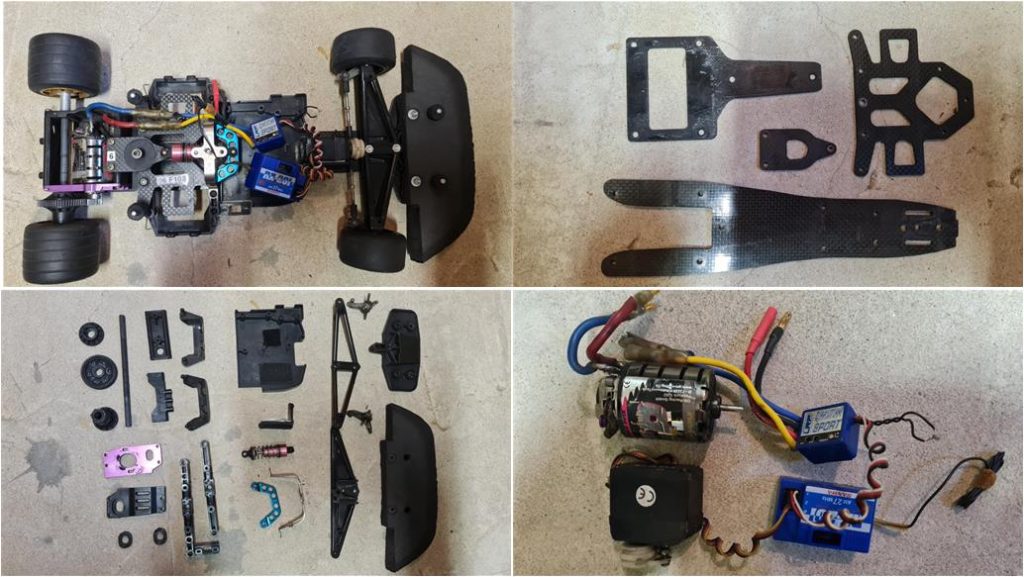
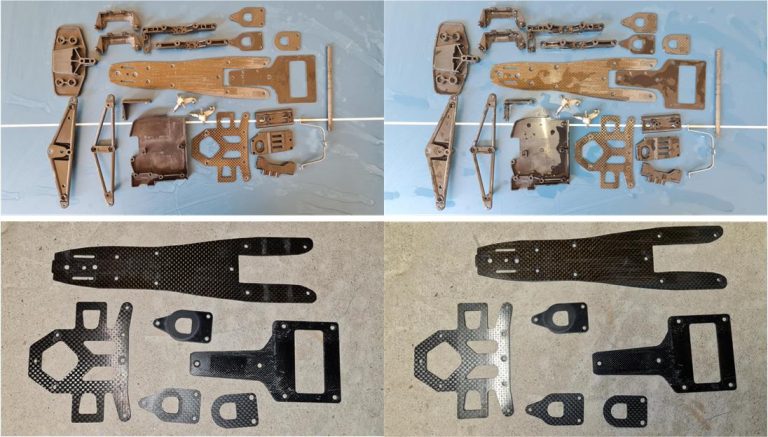
The first operation to be performed is to disassemble the chassis in its entirety in search of parts that are missing, permanently broken, damaged or do not correspond to the model in question. In the pictures you can see the fibre parts of the chassis (picture on the right of the first line), the plastic parts (picture on the left of the second line) and electronics (picture on the right of the second line).
In addition to the parts shown above that were in the package received with the model, other new spare parts are available, including two axles, one steel and one titane (see picture below). With these additional parts it is possible to restore the chassis to a condition that is at least comparable to the condition of the body that has never seen the track. The model thus restored will look as if it has been assembled from a box that has just come out of the factory.
Once the model was disassembled into its individual parts, these were divided into plastic and metal parts. The metal parts were immersed for six to seven days in diesel (image below right); diesel has the property of degreasing the parts, removing rust and oxidation. After treatment, metal parts remain shiny and covered with a thin film of oil that preserves them from oxidation for a long time. If the metal parts are not too oxidised or dirty, the diesel treatment is better than the ultrasonic washing machine.
Operation sequence for the restoration of larger plastic and fibre parts:
– wash surfaces with kitchen soap using a medium or hard bristle brush to reach the most hidden places, – polish surfaces with toothpaste or polish, – for carbon parts only, treat the parts with black shoe polish
The first two pictures in the first row are the parts seen from above and below before treatment and the last two pictures in the second row are the fibre parts seen from above and below after treatment
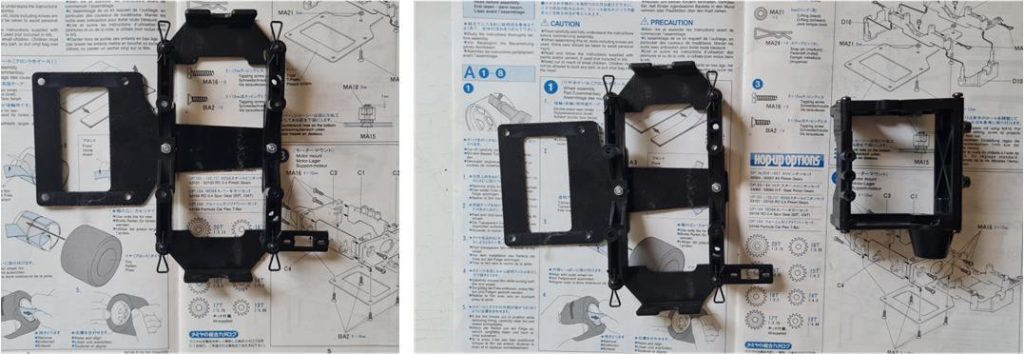
At this point all parts are ready to be assembled, among the spares there were also 2 front wheels and 2 rear wheels complete with tyres and black rims. The assembly phase starts with the rear T-fibre semi-frame complete with the section for the battery, the rear system for the motor was restored to factory condition using only the plastic parts.
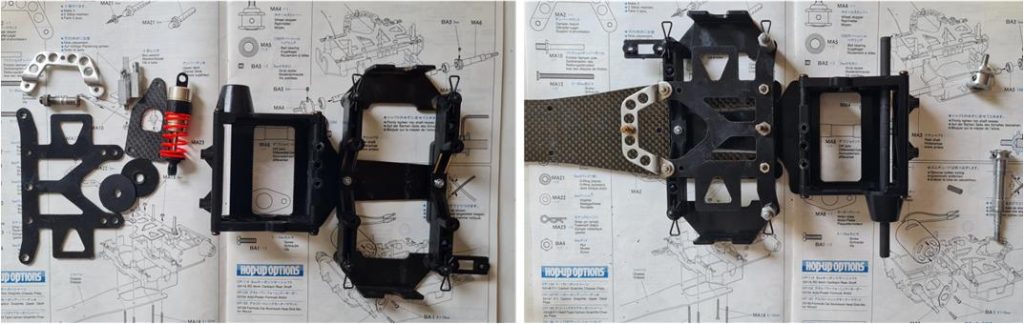
Complete the rear with the upper fibre plate and assemble the single shock absorber system consisting of the aluminium plate provided by the factory, code number 14305371. Series 53155 shock absorber has been replaced by series 53280 shock absorber which is the one provided as an accessory by Tamiya. Anyone who intends to use the model on the track performs this modification because the standard plastic shock absorber is too inefficient.
The standard axle is aluminium, but the titane axle saves more than half the weight with the same efficiency. Anyone who intends to use the model on the track makes this modification. The motor that arrived with the model has been installed and is certainly more powerful than the 53068 Sport Tuned Motor provided for in the manual.
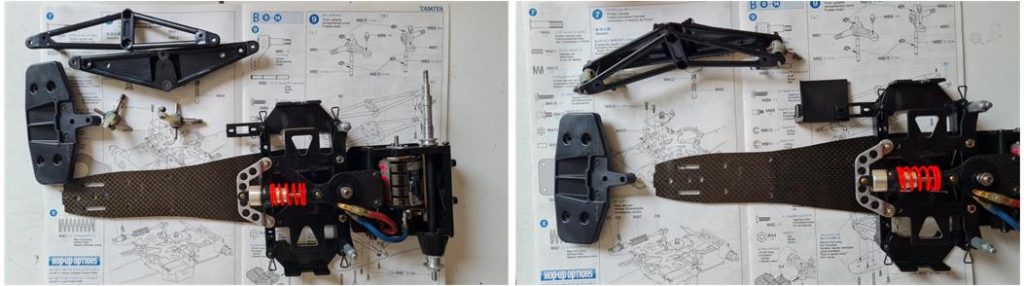
Now it is time to move on to the front suspension complete with shock absorbers and steering system. The hard plastic front bumper that characterises the F103RS chassis is too damaged and scarred by debris encountered on the track and has been replaced with a new equivalent.
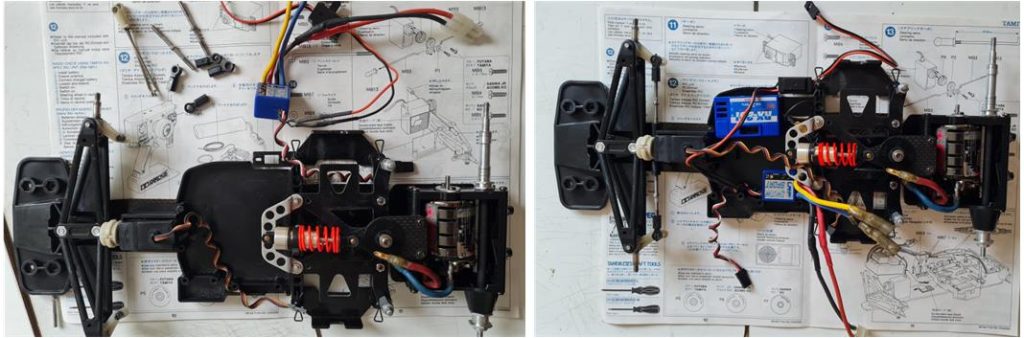
The time has now come to install the steering arms, again leaving the double-threaded adjustable arms that are a HopUp part number 53150. Anyone who intends to use the model on the track makes this modification because the double threaded arms allow optimum adjustment of the toe-in of the front wheels and better steering angle adjustment. As for the front bumper, the electronics box is too damaged and marked by debris encountered on the track and has been replaced with a new equivalent.
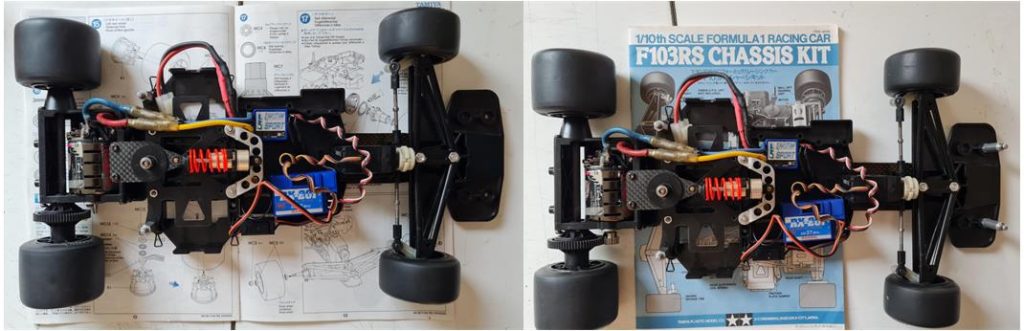
The chassis is now ready to receive the body in marriage, but first install the four wheels, the two central body towers and the two front body towers.
Restored model
Images showing the finished model.
Tamiya, original figure, box art, guide book and catalogue are of TAMIYA INC, which does not endose or sponsor www.tamiyaclassic.com. Any brands, logos and trademarks represented on this website are the copyright of their respective owners.