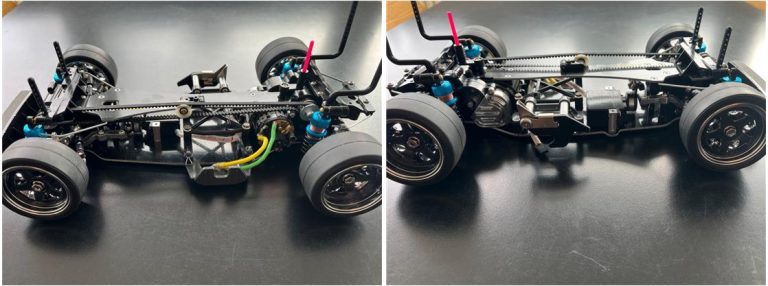
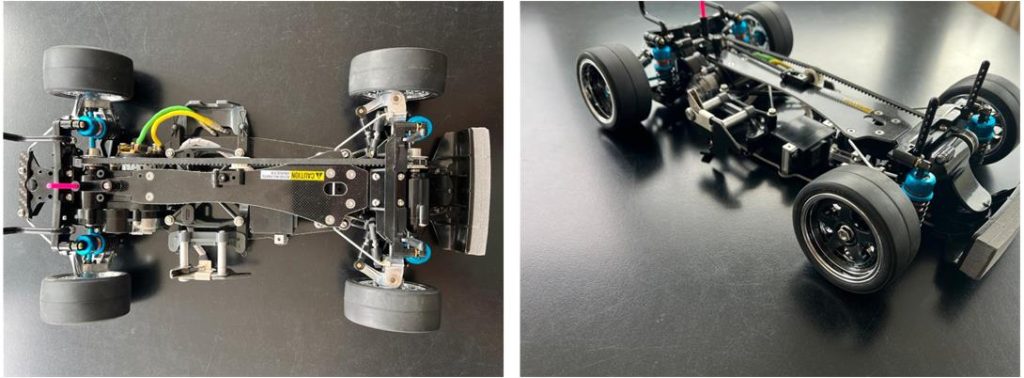
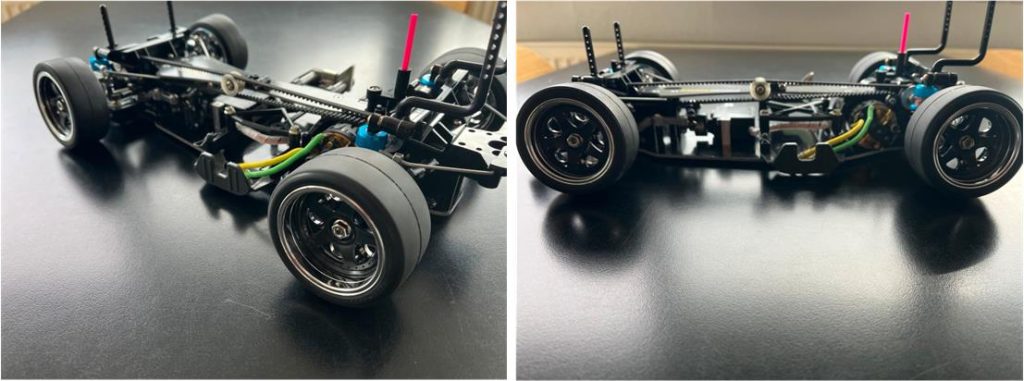
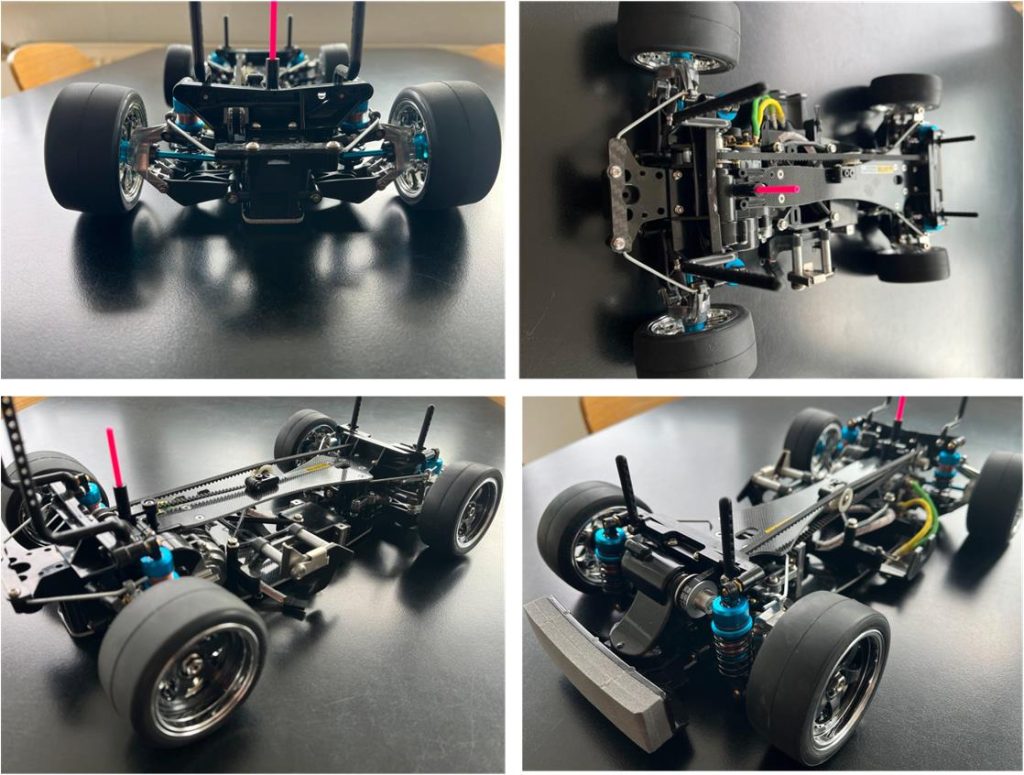
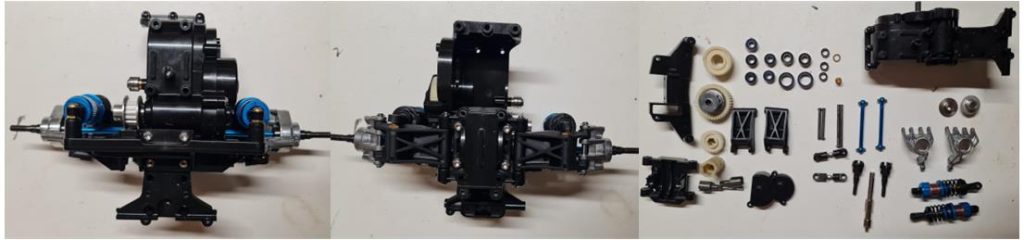
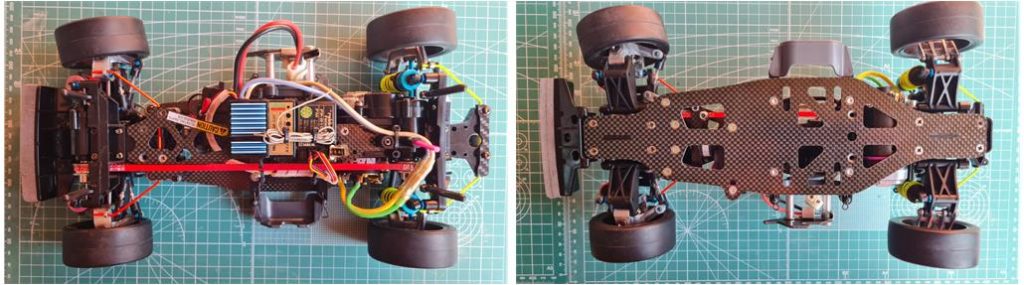
Tamiya TA03R-S TRF Special Chassis Kit, item number 58243, released in 1999 and available on the market until 2001. Body shell not included, as this is a chassis-only kit. TA03R-S TRF chassis.
Model analysis for restoration
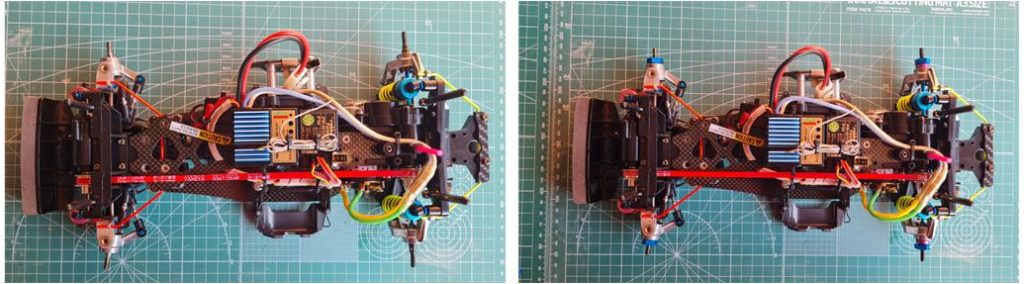
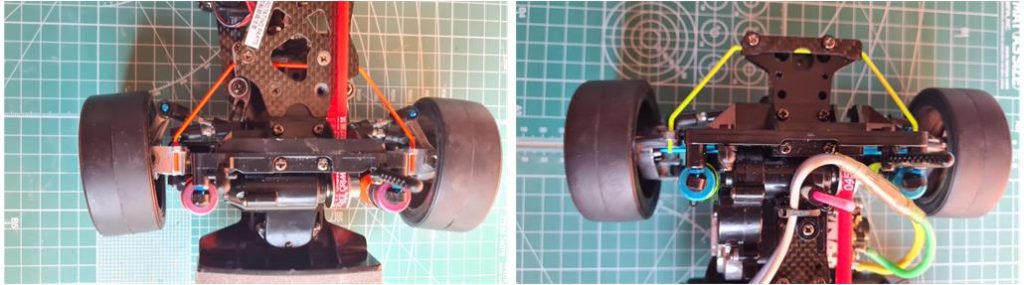
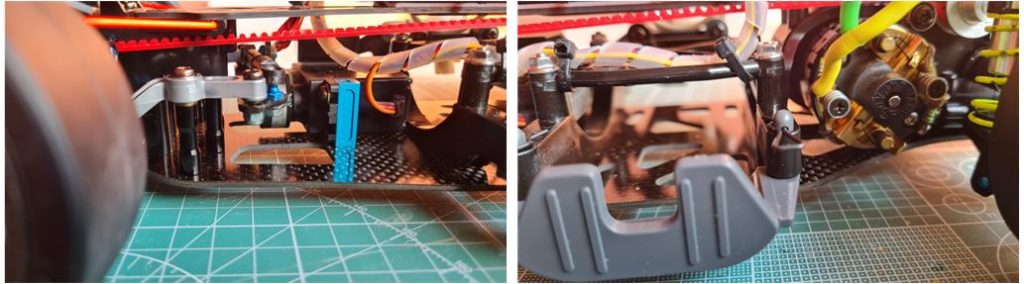
It is possible to visually assess the images from the online listing to evaluate the chassis condition; at first glance, it appears to be in excellent shape, with the underside showing no signs of damage—this strongly suggests it has never been used on a track. At the same time, several aftermarket accessories are clearly visible, which have modified the factory setup. The goal of the restoration is to return the model as close as possible to its original factory configuration by incorporating key accessories listed among the Hop-Up options at the end of the instruction manual.
In its standard factory setup, the TA03R-S TRF chassis is enhanced with several performance-oriented accessories. From the images, it is evident that these base accessories are installed on the listed model:
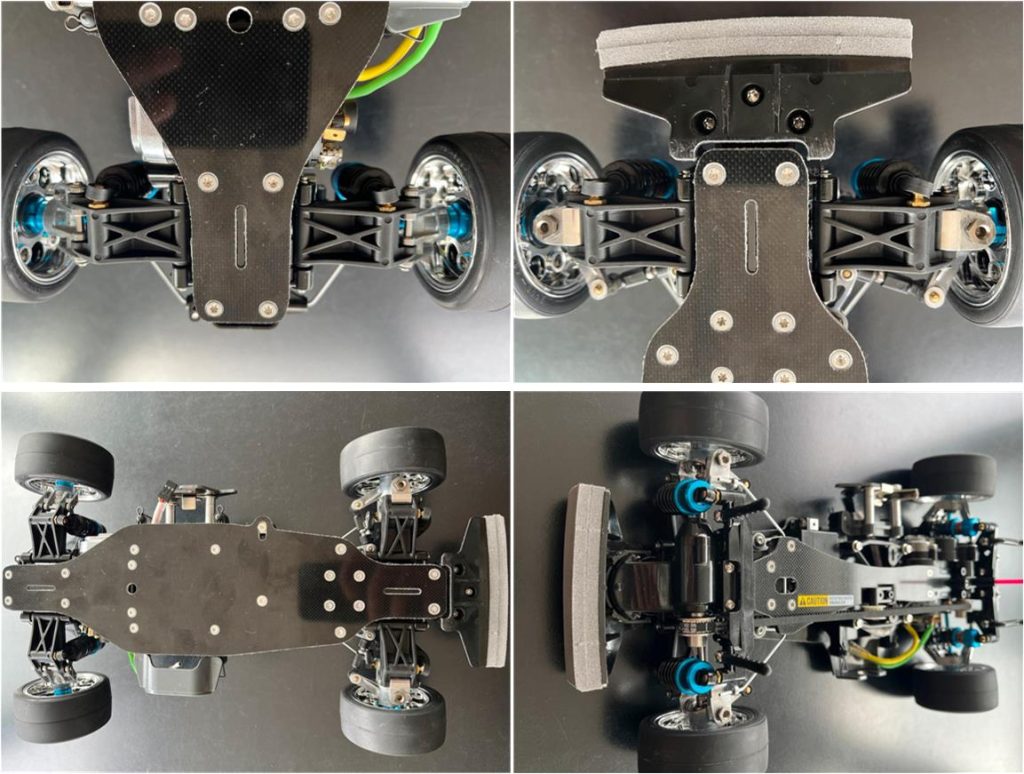
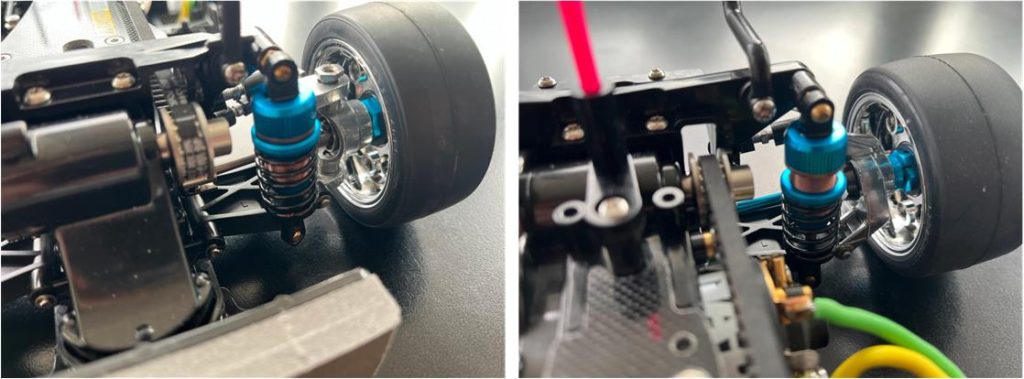
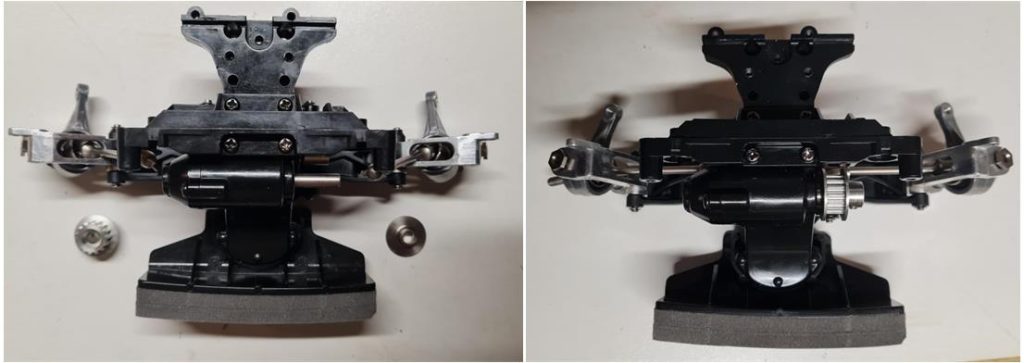
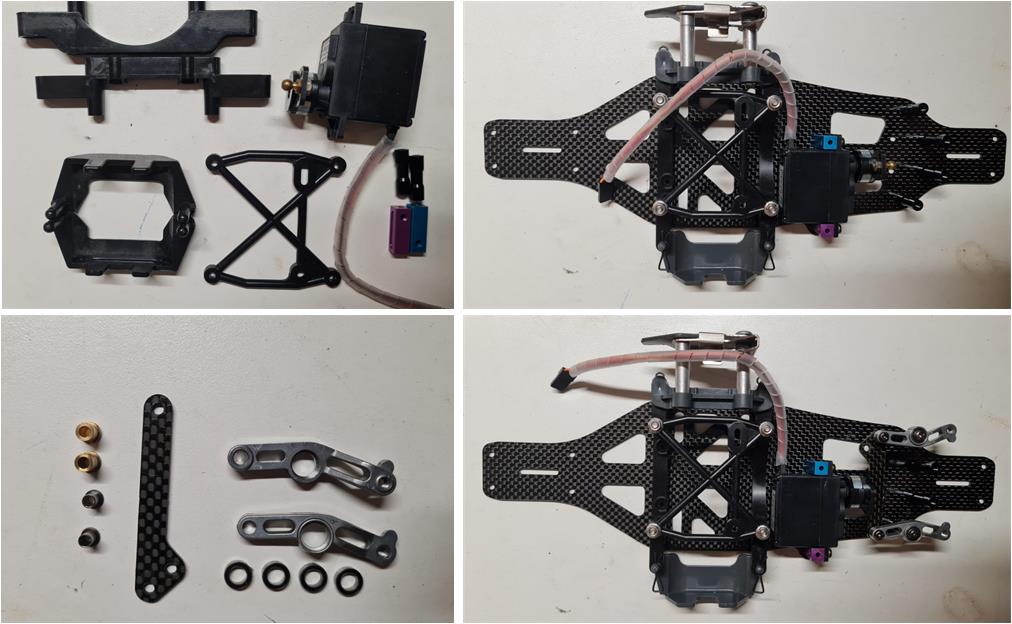
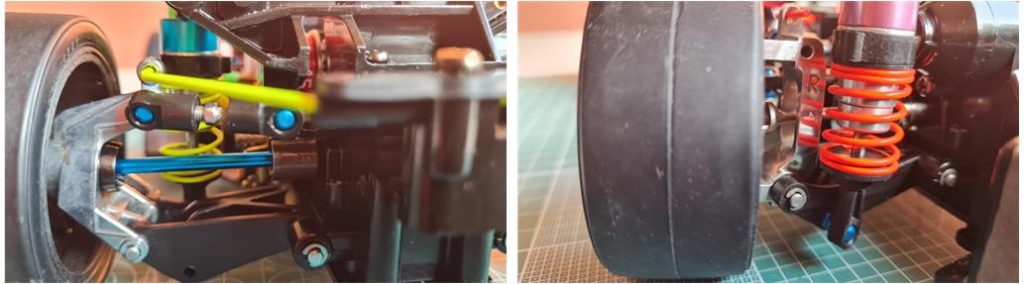
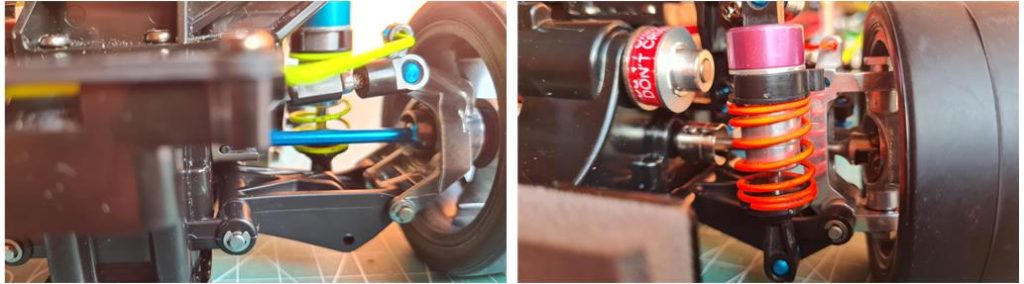
– Dual bellcrank steering system (left in the image below), made of aluminum, accessory number 53326, described as “TA03 Aluminium Racing Steering Set.” – Aluminum gear cover and pinion guard (right in the image below), accessory number 53275, described as “TA03 Aluminium Motor Heat Sink.” – Aluminum C-hub for the front steering system (right image), accessory number 53316, described as “TA03 Aluminium Front Hub Carrier 2 pcs.” Tamiya released several equivalent options: part number 49097 described as “TA03 Aluminium Front Hub Carrier 2 pcs blue.” The installed version is the factory-installed grey version. – Rear aluminum uprights, accessory number 53288, described as “TA03 Aluminium Rear Upright 2 pcs.” – Front and rear aluminum belt pulleys. Tamiya released several 15-tooth pulley versions equivalent to the factory-installed ones: the grey version corresponds to item number 53286 and the red version corresponds to item number 49074, described as “TAMIYA TA03 ALUM Pulley 15T Red.” The installed version is the factory-installed grey one.
From the images, it is possible to identify several Tamiya-manufactured accessories installed on the model that are not part of the factory base configuration. Some of these accessories are upgrades that do not enhance performance compared to the factory components, while others offer better performance than the original parts. Based on an initial visual inspection, here is a list of accessories installed that do not improve performance over the factory-supplied components:
– Upper and lower chassis plates made of F.R.P. (Fiber Reinforced Polymer), accessory number 53387 described as “TA03R-S / F-S FRP Conversion Set.” The factory configuration includes a dual carbon fiber chassis, accessory number 53386, described as “TA03R-S / F-S FRP Carbon Chassis Kit.” Carbon fiber is stiffer and lighter than the corresponding FRP chassis. – Brass ball connectors. The factory version features 5 mm anodized aluminum ball connectors, which are lighter than the brass equivalents.
Based on an initial visual inspection, here is a list of installed accessories that offer improved performance compared to the factory-supplied components:
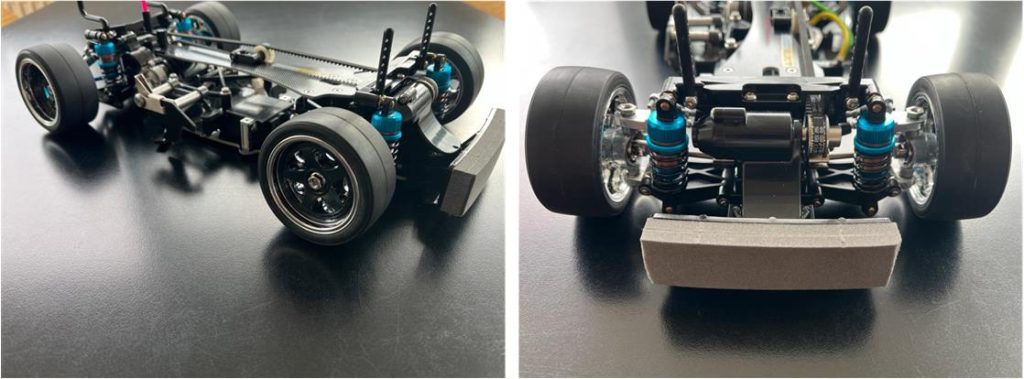
– Front urethane bumper, accessory number 53304, described as “TA03R Urethane Bumper Set.” Provides better protection against frontal impacts. – Aluminum steering knuckle (right image), accessory number 53325, described as “TA03 Aluminium Knuckle Arm 2 pcs.” The factory version includes black plastic knuckles, while the aluminum version is more durable.
– Four adjustable upper suspension arms, accessory number 53192, described as “4WD/FWD Upper Arm.” The standard setup includes non-adjustable arms that do not allow for camber adjustment. – Quick-release battery holder, accessory number 53346, described as “Quick Release Battery Holder.” To install it, grey-colored plastic components were used, whereas the TA03R-S TRF model originally features black plastic parts. This accessory is commonly used in endurance races to minimize pit stop times.
– Dual aluminum servo mount (left in the image below), non-anodized, part number 53308, described as “Aluminium Servo Stay.” The chassis is originally equipped with purple-anodized mounts. Tamiya released several equivalent versions, including part number 49092, described as “Aluminium Servo Stay Blue.” – Two-piece wheel rims with a grey outer section and black inner section. In the standard configuration, the wheels are one-piece solid black.
Based on the images, it is evident that the following non-Tamiya aftermarket accessories are installed on the listed model:
– Four shock absorbers from Yeah Racing (front shock shown on the left in the image below, rear shock on the right). – 2+2 aluminum posts from Yeah Racing that replace the plastic mounts for the dual steering system levers, originally part number 50703, component J5.
– Stainless steel Torx screws. Torx screws feature a six-point star-shaped head that allows for better torque transmission compared to slotted or Phillips-head screws. They are ideal for precise and secure fastening. These screws are not included in the factory standard setup for this Tamiya model, which uses crosshead screws—with the sole exception of the two motor screws, which are hex-head. – Front and rear silver anti-roll bars from Yeah Racing (see image below).
Chassis restoration
The visual analysis based solely on the images allows for the identification of which accessories are needed to restore the chassis to a condition as close as possible to the factory standard or to the configuration typically used for these chassis while respecting factory specifications. In addition to the standard equipment, the following installed accessories are consistent with the required condition:
– Accessory number 53304 described as “TA03R Urethane Bumper.” This is a common modification used to prevent damage to the chassis in the event of frontal impacts. – Accessory number 53325 described as “TA03 Aluminium Knuckle Arm 2 pcs.” This is a popular upgrade due to its increased durability compared to the factory-supplied plastic version. – Accessory number 53192 described as “4WD/FWD Upper Arm.” This is a widely adopted modification to improve suspension setup adjustability. – 2+2 aluminum posts from Yeah Racing for the dual bellcrank steering system. This is a performance-oriented upgrade; keeping it would not compromise the final result, even though it is not listed among the Hop-Up options. – Accessory number 53346 described as “Quick Release Battery Holder” with grey plastic parts. This is a common modification to improve pit stop efficiency; retaining it does not compromise the final result, even though all other plastic components on the TA03R-S TRF model are black.
List of accessories to be replaced due to non-compliance with factory specifications, along with the parts that will be installed to restore the chassis to its original factory condition:
– Accessory number 53387 described as “TA03R-S / F-S FRP Conversion Set” will be replaced with part number 53386 described as “TA03R-S / F-S FRP Carbon Chassis Kit.” – Torx-head hardware will be replaced with crosshead screws, except for the two motor screws, which are hex-head as per factory specification. – Yeah Racing shock absorbers will be replaced with original low-friction aluminum dampers. – Dual non-anodized aluminum servo mounts will be replaced with identical anodized versions. – Two-piece wheel rims with grey outer and black inner sections will be replaced with the original one-piece rims supplied in the Tamiya factory kit.
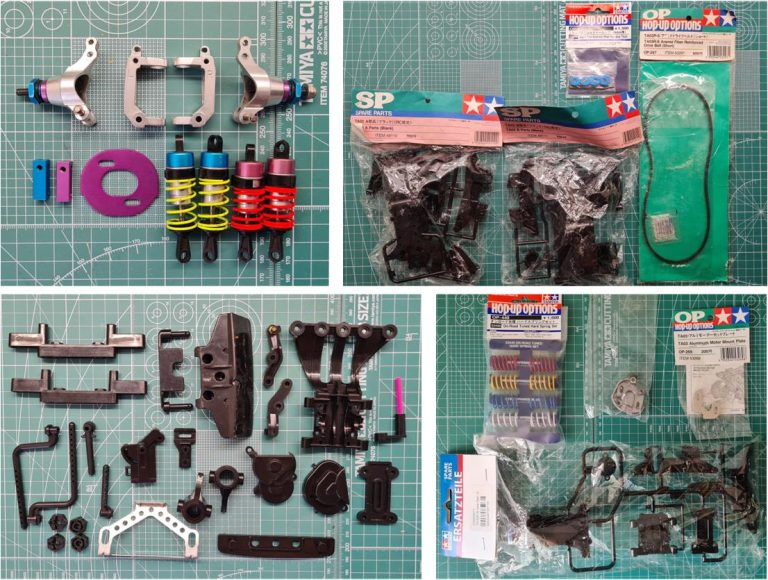
To carry out the replacement of parts that deviate significantly from the model’s original bill of materials, the following components have been sourced (see image below).
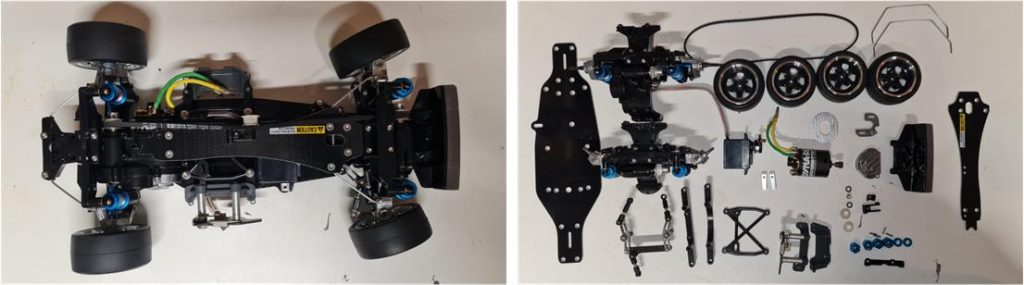
Once the chassis has arrived, the restoration process can begin by disassembling the model to better inspect the hidden components not visible in the online listing photos. This operation helps determine whether additional replacement parts are needed and whether there are any hidden issues that would not be apparent with the model fully assembled. There may be damages or missing components. The first step is to separate the model into its main subassemblies:
– Upper and lower FRP chassis plates – Front gearbox – Rear gearbox – Dual bellcrank steering system – Four tires complete with rims – Electronics consisting of the electric motor and steering servo. It can now be confirmed that the installed servo saver is the high-performance version included in the standard factory equipment – Small parts such as the motor heat sink, front bumper, two anti-roll bars, battery tray and wheel hex hubs
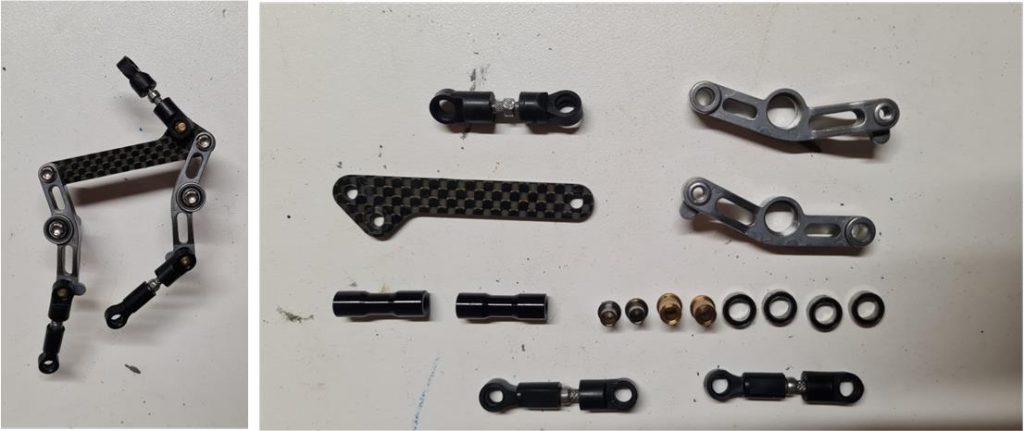
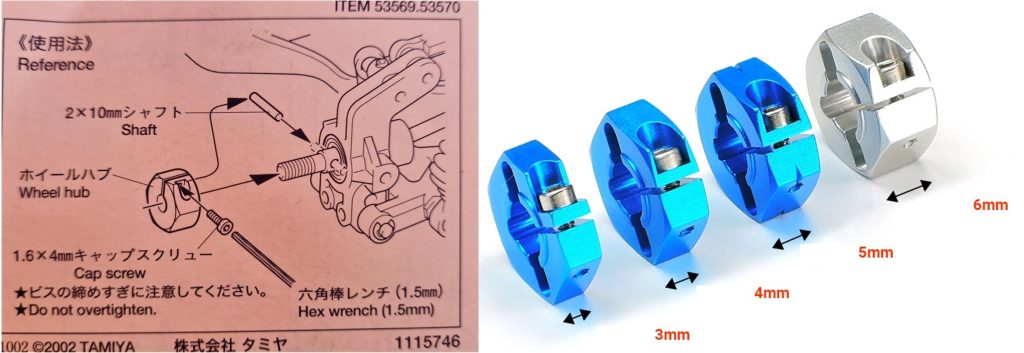
The first components typically removed are the wheels and it is evident that the four hex hubs are manufactured by Yeah Racing. The accessory is described as “Aluminum Wheel Hex Hub For Touring Chassis.” To restore the model to its original factory condition, these should be replaced with accessory number 53570, described as “Clamp Type Aluminium Hub 4 pcs.” Proceed by focusing on each major subassembly and disassembling them down to individual components. Starting with the dual bellcrank steering system, no unexpected issues are found: all four ball bearings are present, along with the carbon fiber link and the three adjustable arms. In the right-hand image, the two aluminum posts are visible, replacing the equivalent plastic J5 components.
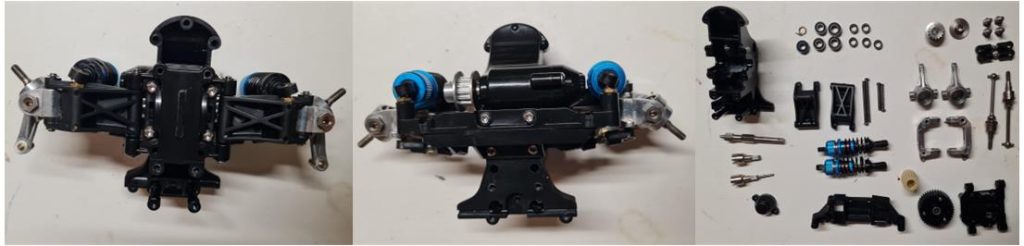
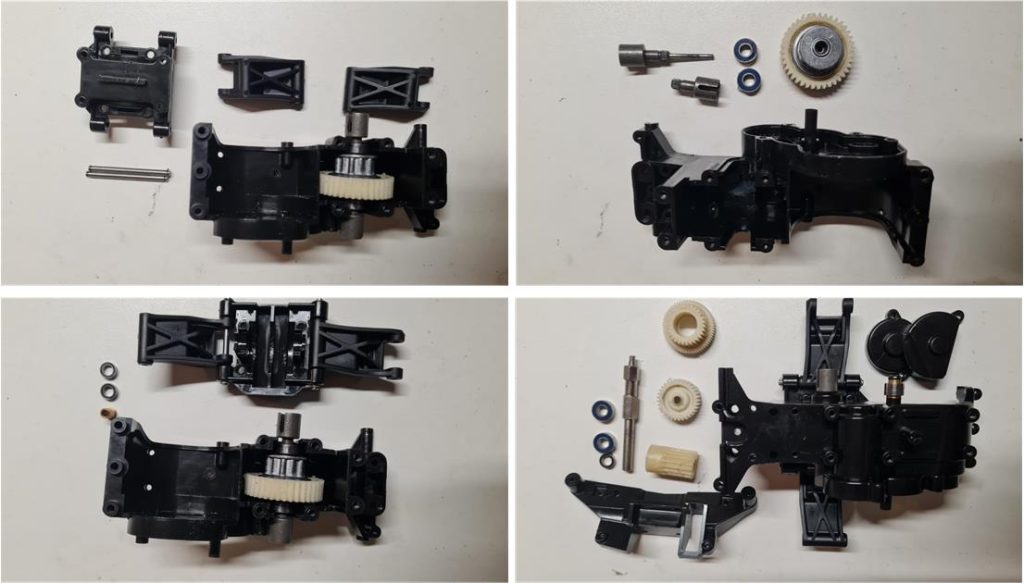
Based on the disassembled components shown in the images—from left to right: bottom view, top view and exploded view of the front gearbox—it is possible to identify a discrepancy not visible in the original online listing. The collars on the two front drive shafts are not purple-anodized as per factory specification. This is a common aftermarket modification. If replacement is desired, Tamiya offers several equivalent versions of the “4WD & FWD Universal Shaft,” differentiated by collar color:
– Part number 53172: grey collar – Part number 53310: blue collar – Part number 58177: purple collar (factory standard for this model)
The standard TA03 chassis uses black plastic gears, whereas the TA03R-S TRF model is equipped with white nylon gears. These gears feature finer pitch sizes: module 0.6 for the drivetrain and module 0.4 for the spur gear. This finer spur gear allows for a wider range of motor pinion options. In general, Teflon gears reduce friction but are less durable than the standard TA03 plastic gear set. The front differential is a black plastic unit with a one-way gear mechanism. This setup improves cornering by engaging the front axles during forward motion but compromises braking performance, as the front axles disengage under braking or reverse. Also present are the two smooth steel suspension pins with E-clips, which are standard factory components on all TA03R-S TRF chassis.
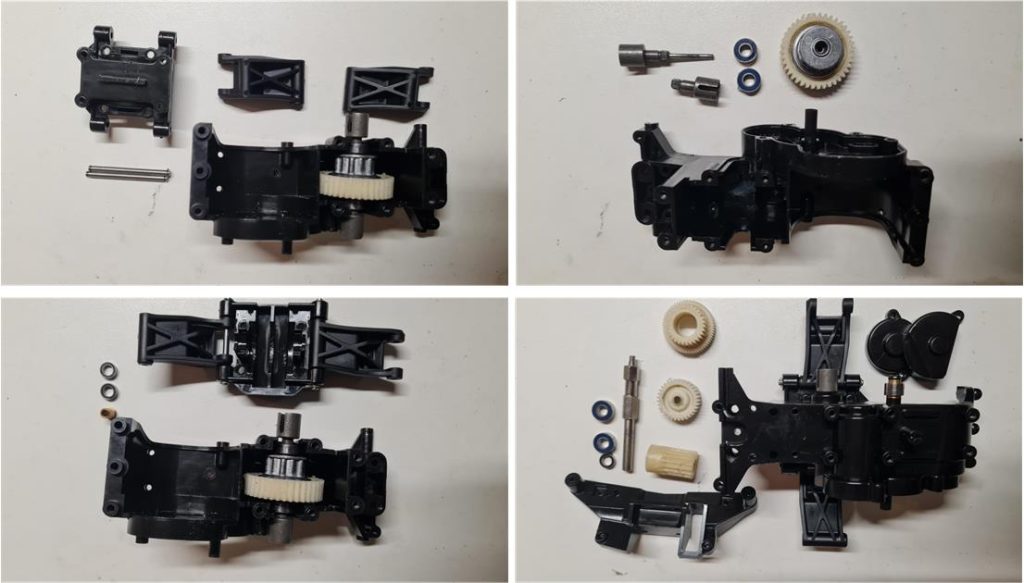
In the images below—from left to right: bottom view, top view and exploded view of the rear gearbox—it is possible to confirm a discrepancy with the standard factory configuration that was not visible in the online listing photos. The two rear drive shafts are blue-anodized rather than the factory-standard purple. If replacement is desired, Tamiya offers several equivalent options that differ only in color:
– “FWD – 4WD Touring Car Drive Shaft Bag” part number 50643 and the newer 51216 for grey-collar shafts – “TA03 Lightweight Drive Shaft blue – 44mm/Aluminum/TA02/FF01/49091” part number 53305 for blue-collar shafts
The version installed on the chassis is the blue-anodized 53305, which is compliant with factory specifications. All Teflon gears are present, along with the rear ball differential and the two smooth steel suspension pins with E-clips. These pins are a standard factory feature on all TA03R-S TRF chassis.
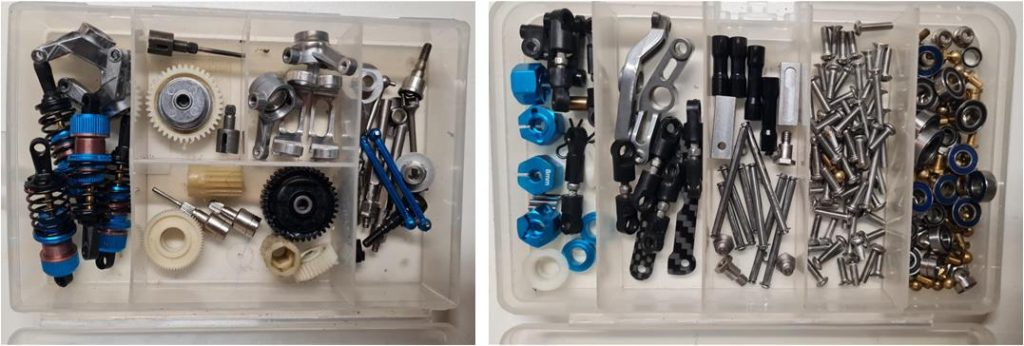
In the image below, all hardware components are gathered and sorted by type: ball bearings, differentials, gears, smooth pins, ball joints, hex pins and adjustable tie rods.
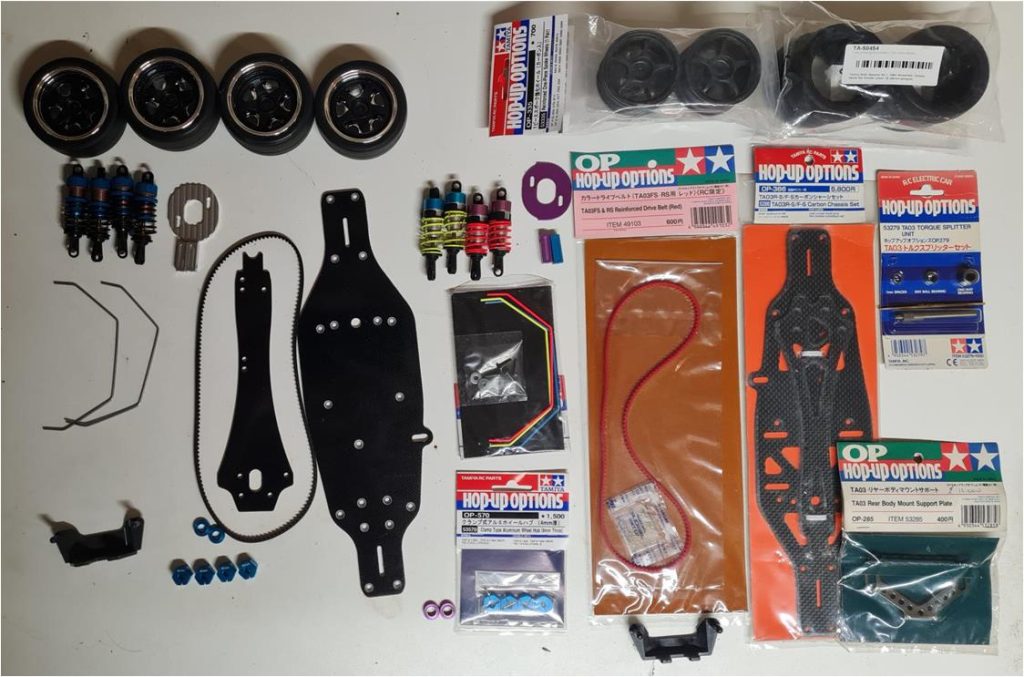
Once the technical analysis of each individual component is complete, the search for parts on the market begins in order to restore the model to its original factory condition or as close as possible to a configuration upgraded with the Hop-Up parts listed on the final page of the instruction manual. In the image below, the parts to be replaced are shown on the left and the replacement parts are shown on the right:
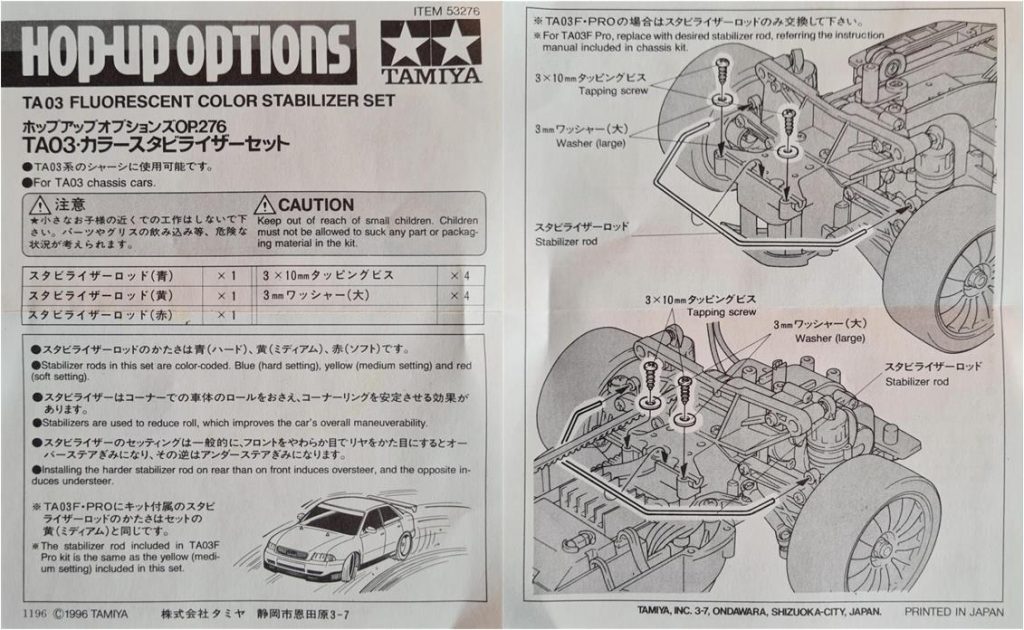
– Four wheels with grey-black two-piece rims replaced by accessory 53335 described as “Reinforced One-Piece Spoke Wheels 2 pcs” along with slick tires – Four Yeah Racing dampers replaced with factory-identical Tamiya aluminum dampers – F.R.P. chassis replaced with accessory number 53386 described as “TA03R-S / F-S FRP Carbon Chassis Kit” – Black belt replaced with accessory number 49103 described as “TA03FS & RS Reinforced Drive Belt (Red)” – Grey motor plate replaced with a purple anodized aluminum plate – Two servo mount towers for the steering system replaced with one blue-anodized and one purple-anodized tower – Stabilizer bars replaced with accessory number 53276 described as “TA03 Fluorescent Stabilizer” – Four wheel hex hubs replaced with accessory 53570 described as “Clamp Type Aluminium Wheel Hub 4 pcs blue”; alternatively, accessory 53056 described as “Pin Type Wheel Adapter” can be installed – Two rear spacers for widening the track replaced with two equivalent purple-anodized spacers – Battery holder replaced with two identical black plastic parts
In the image on the right, two additional optional Hop-Up parts are also shown to further complete the chassis:
– Accessory number 53285 described as “Rear Mount Body Support Plate”; this part is not compatible with all body shells, so feasibility must be verified – Accessory number 53279 described as “TA03 Torque Splitter Unit,” which functions similarly to the one-way front differential; both improve cornering performance by decoupling the front wheels under braking or reverse motion
The motor installed on the chassis is the “Dyna-Run Super Touring Motor,” part number 53263, recommended as a Hop-Up in the instruction manual for model 58243. The restoration process has reached the stage where all components have been cleaned, modified parts have been restored to factory condition, all missing parts have been sourced from the market and only modifications compliant with the factory specifications listed in the model’s manual have been retained. One substantial modification has been preserved: the four aluminum posts from Yeah Racing that replace part J5. The chassis can now be reassembled, starting with the front gearbox housing, which accommodates the one-way differential.
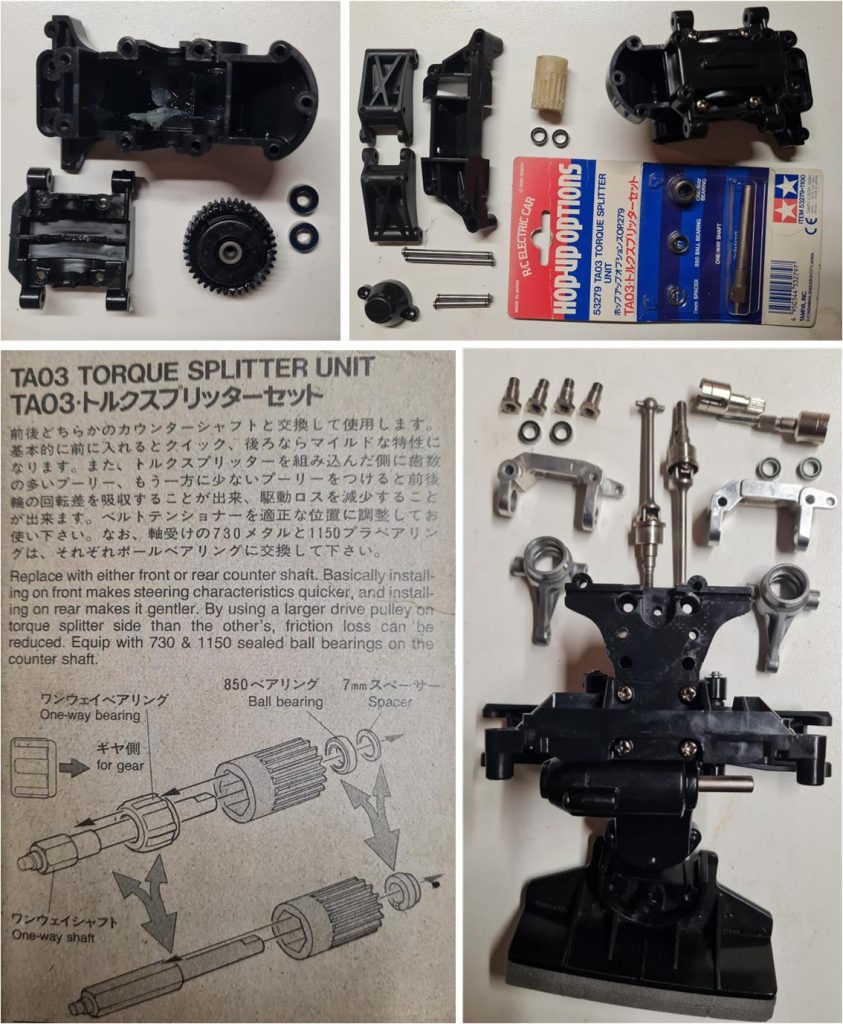
To improve handling, accessory number 53279 described as “TA03 Torque Splitter Unit” has been added, working in conjunction with the front one-way differential. This accessory can be installed in either the front or rear gearbox housing; its installation alters the model’s dynamic behavior:
– Installing accessory 53279 in the front gearbox increases steering responsiveness – Installing accessory 53279 in the rear gearbox makes steering behavior more intuitive and helps prevent understeer and oversteer
To complete the front gearbox assembly, it is sufficient to install the pulley. This subassembly is now ready to be mounted onto the chassis and is temporarily set aside while the remaining steps are completed.
The second subassembly to be prepared is the rear gearbox housing, which contains the ball differential. The drive shaft to the belt pulley is the original component included in the factory kit. As with the rest of the model, ball bearings are used throughout and the gears are made of white Teflon.
The rear gearbox housing accommodates the electric motor, which is therefore positioned in a mid-rear layout. This configuration improves weight distribution by concentrating mass near the center of gravity. The motor plate is purple anodized, in accordance with factory specifications. This second subassembly is now ready to be mounted onto the chassis and is temporarily set aside along with the front gearbox housing, pending completion of the central chassis structure composed of two carbon fiber plates.
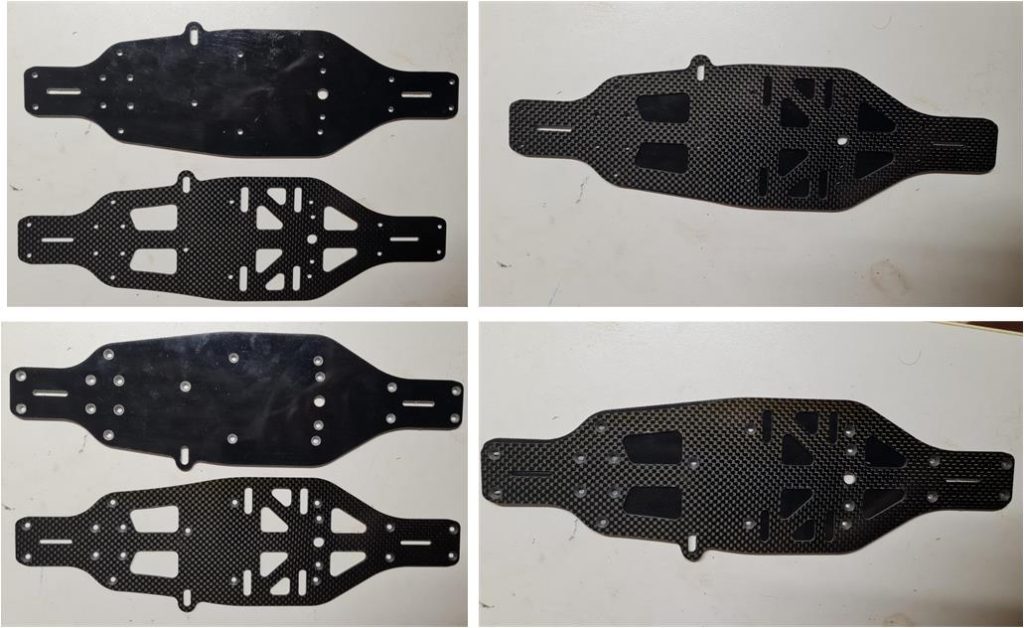
In the images below, the lower plate is compared between the FRP version and the carbon fiber version; the following observations can be made:
– The images in the left column show the two plates side by side; the first row is the top view and the second row is the bottom view. In both images, the FRP plate is positioned above the carbon fiber plate. The screw holes align between the two plates. The FRP plate is black, while the carbon fiber plate is dark grey and displays a visible fiber weave pattern (not present on the FRP plate). – The images in the right column show the two plates overlapped; the first row is the top view and the second row is the bottom view. The upper plate is the carbon fiber version. It is evident that the outer perimeter of both versions matches perfectly. The carbon fiber plate is shaped with cutouts to reduce weight, a geometric solution not applied to the FRP plate.
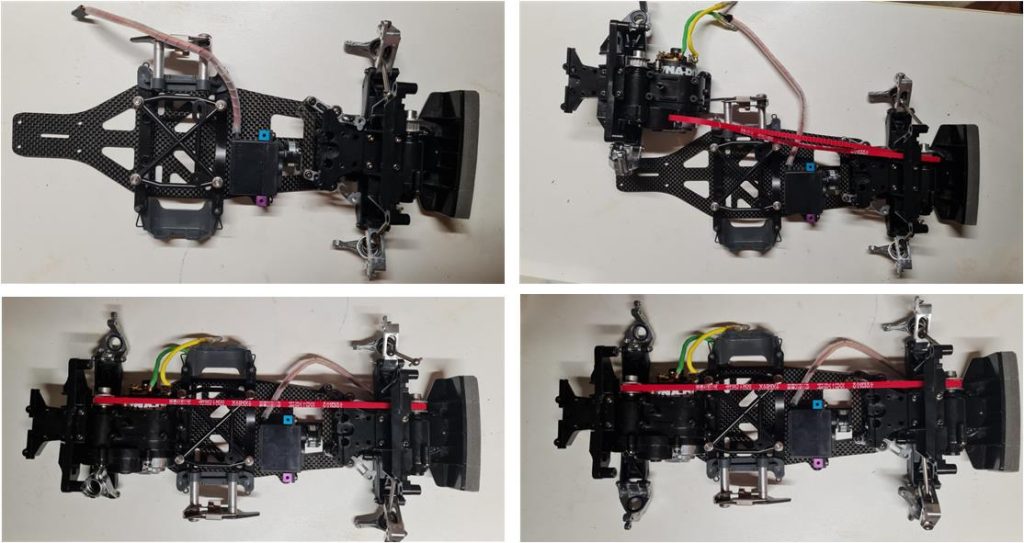
After preparing the two subassemblies (front and rear gearbox housings), assemble the central section composed of the lower carbon fiber plate. Prepare the plate by installing the battery holder frame, the X-shaped upper reinforcement frame, the steering servo and the dual bellcrank aluminum steering system.
The central plate is ready to be joined first with the front gearbox housing and then with the rear gearbox housing. During the installation of the rear gearbox, the drive belt is mounted in parallel; in this case, it is model 49103 described as “TA03FS & RS Reinforced Drive Belt (Red).”
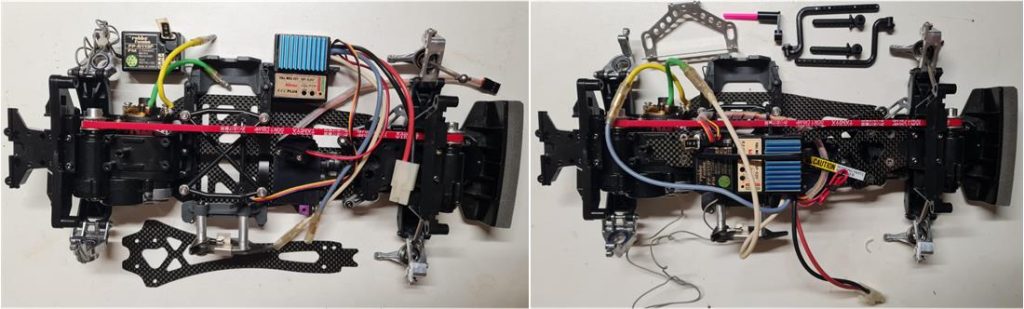
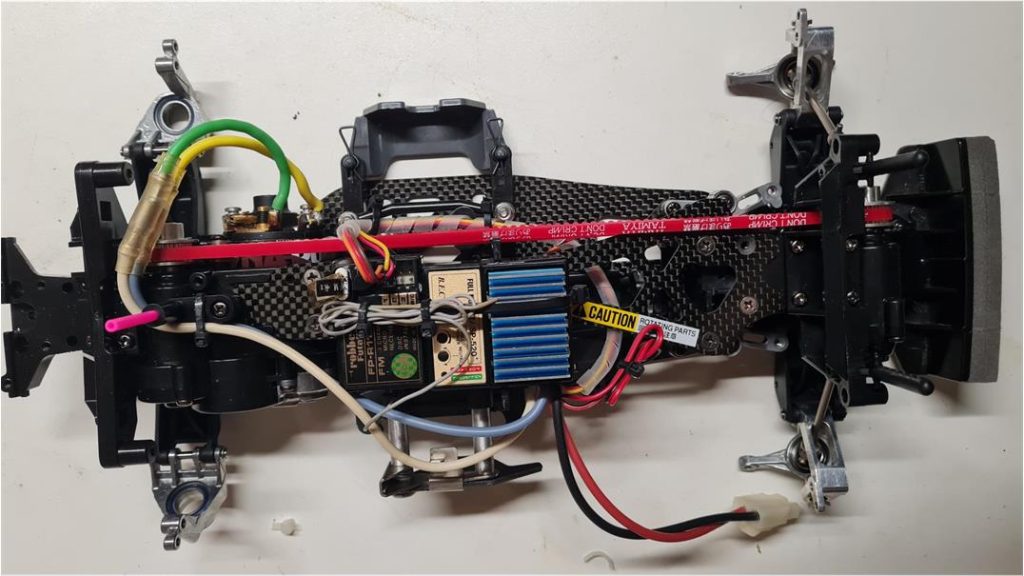
To complete the chassis, the upper plate and electronics must be installed. The ON-OFF switch, receiver and electronic speed controller are secured using double-sided adhesive tape; the switch is mounted to the steering servo, while the electronics are fixed to the carbon upper plate. To prevent the electronics from detaching after an impact or bump, a plastic zip tie is used to secure both components to the plate. The antenna mount is attached to the rear gearbox housing with a screw. While waiting to decide which body shell to mount on the chassis, it is unnecessary to install the rear towers and accessory number 53285 “Rear Mount Body Support Plate.”
The chassis is now nearly complete.
To replace the brass ball connectors, accessory number 300053642 described as “Ball Head Aluminum 5mm (Blue)” has been selected. Each package contains ten pieces. Assemble twenty 5 mm blue anodized aluminum ball connectors to be used as follows: eight for the four upper suspension arms, five for the dual bellcrank steering system, one for the steering servo and eight for the four dampers. Also install the two stabilizer bars, part number 53276 and the four wheel hex hubs, part number 53570.
The instruction sheet included in set 53276 refers to the plastic TA03 chassis and the chassis instructions can be used. Set 53276 is described as “Fluorescent Stabilizer Set TA03 OP-276.”
The instruction sheet included with set 53570 is also applicable to set 53569. The description of set 53570 is “Clamp Type Alu. Wheel Hub 4mm,” while the description of set 53569 is “Clamp Type Alu. Wheel Hub 6mm.” The wheel hex hubs are available in four versions:
– Set number 42352, width 3 millimeters, blue anodized aluminum – Set number 53570, width 4 millimeters, blue anodized aluminum – Set number 53823, width 5 millimeters, blue anodized aluminum – Set number 53569, width 6 millimeters, aluminum
Restored model
Images showing the completed model with the chassis returned to factory condition.
Body shell assembly
The standard kit does not include a body shell. As of 2025, four body shells are compatible with the short-wheelbase TA03 chassis:
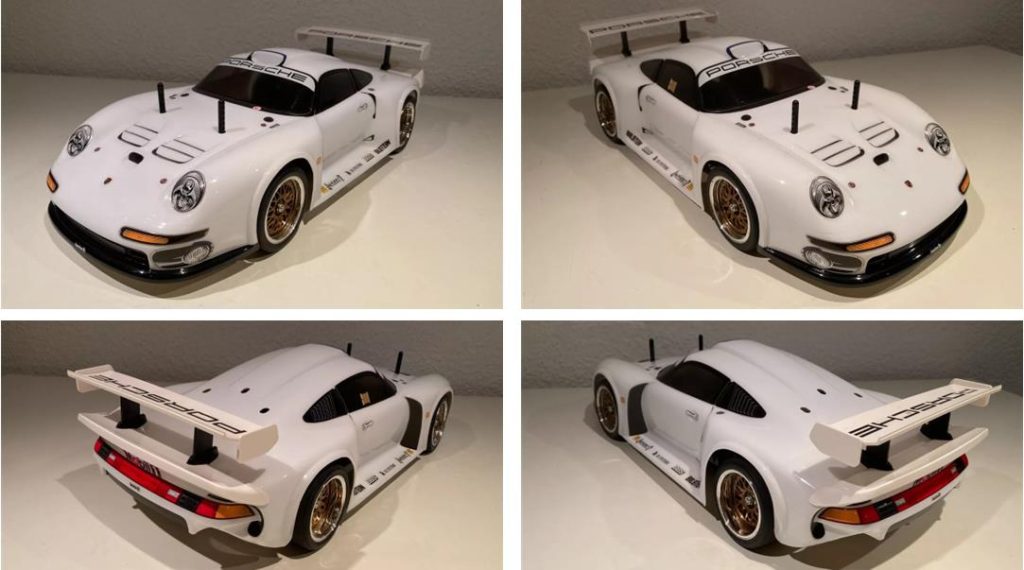
– Porsche 911 GT1, model number 58193; this model shares the same body as model 47443 but features a racing livery – PIAA Porsche 911, model number 58215 – Lancia 037 Rally, model number 58278, featuring a styrene body with numerous details – Porsche 911 GT1 Street, model number 47443; this model shares the same body as model 58193 but features a street livery without sponsor decals
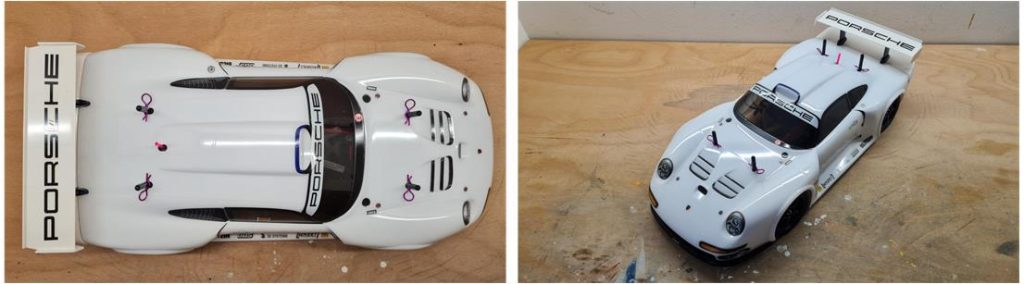
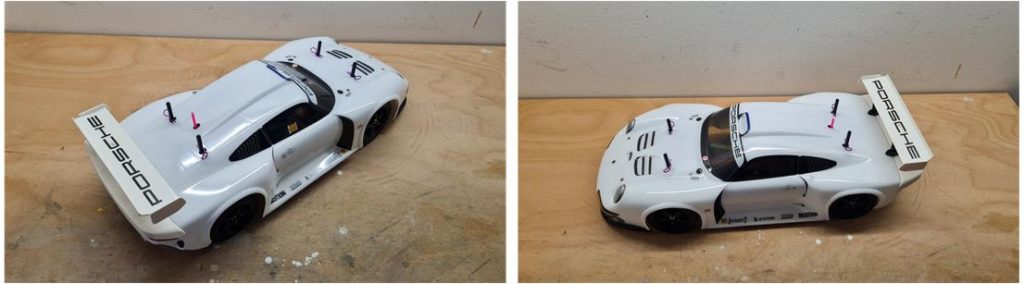
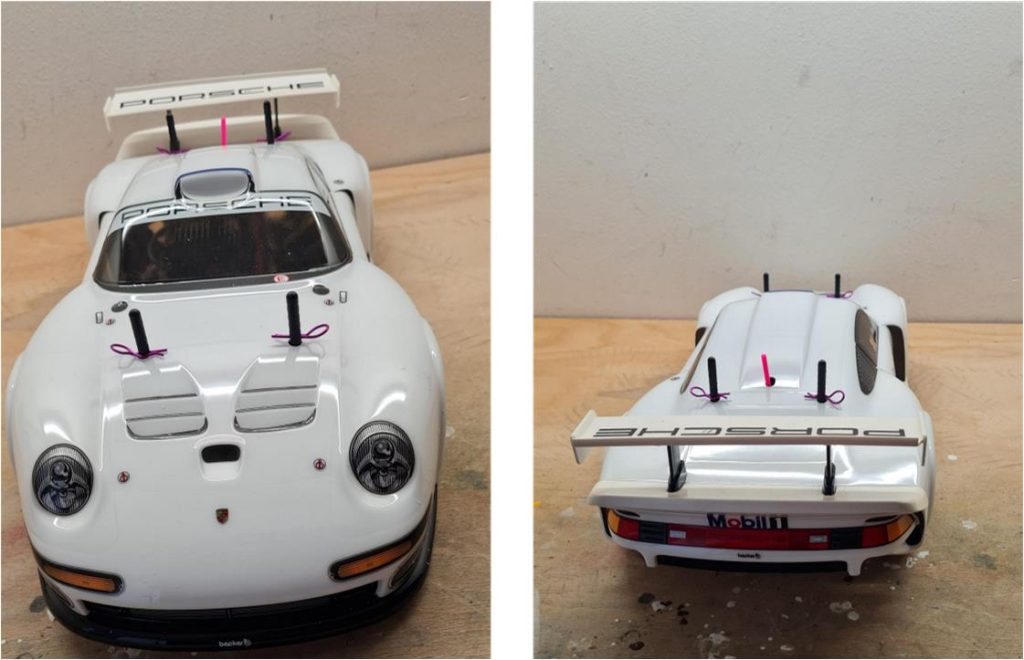
Among the options listed above, a body shell for model number 47443 was found for sale online and fits the TA03R-S TRF chassis perfectly. The body shell is supplied without the wheels shown in the reference images.
Restored model with body shell
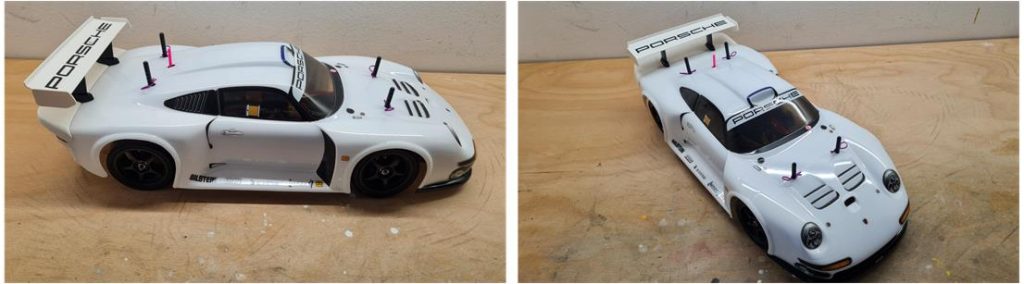
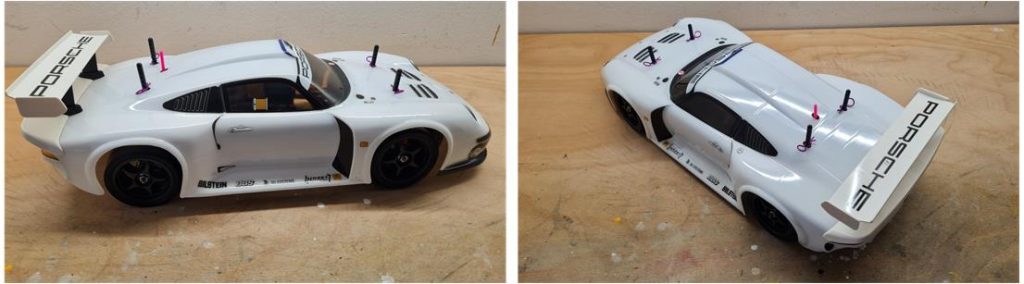
Images showing the completed model with body shell installed. The wheels are not stylistically suited to the Porsche GT1, but they are the ones specified for this chassis.
Tamiya, original figure, box art, guide book and catalogue are of TAMIYA INC, which does not endose or sponsor www.tamiyaclassic.com. Any brands, logos and trademarks represented on this website are the copyright of their respective owners.