The DT-01 chassis is an advanced evolution of the Grasshopper and Grasshopper II chassis. The designation DT-01 stands for “Dirt Two-Wheel Drive,” with “01” indicating that this is the first model in its family. The DT-01 chassis was first released in 1991 with a pre-assembled, ready-to-run model: the Rookie Rabbit, model number 57501. In 1996, the first kit-based model was introduced. The following models feature this chassis:
– Tamiya Fighter Buggy RX, model number 58184, released in 1996 and available on the market until 2003, featuring a rigid styrene body.
– Mad Bull, model number 58205, released in 1997 and available on the market until 2005, featuring a rigid styrene body.
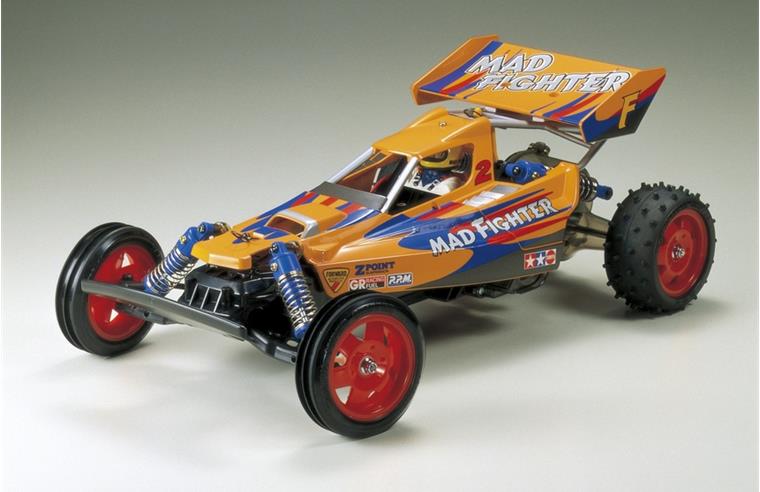
– Mad Fighter, model number 58275, released in 2001 and available on the market until 2008, featuring a rigid ABS body.
This advanced chassis represents Tamiya’s gateway for enthusiasts entering the world of radio-controlled cars. The DT-01 is more manageable to drive compared to its predecessors, the Grasshopper and Grasshopper II, as it offers greater stability and is less prone to flipping. In Germany, a championship is organized specifically for beginners and non-professional enthusiasts, where the DT-01 is the only authorized chassis. This championship, called Fighter Buggy, takes its name from the first kit-based model that introduced the DT-01 to the market.
The key features of this chassis are:
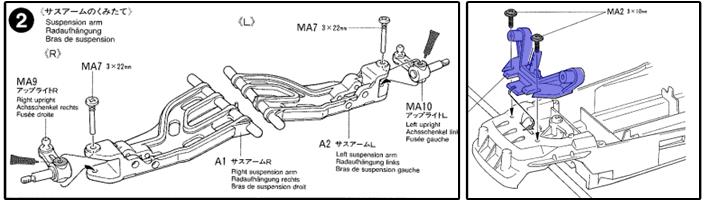
– Independent front suspension with a newly designed structure, differing from the previously used inverted A-type suspension. The shock absorbers remain spring-based and the front shock tower (highlighted in blue in the image) is separate from the chassis. This tower is a component prone to breakage due to the significant stress it endures.
– Reinforced central chassis shell with a new design. While the shell is entirely different from the Grasshopper chassis, it retains a resemblance to a grasshopper. This similarity comes from the two rear shock absorber towers, which evoke the insect’s hind legs and the rounded front end, reminiscent of its head.
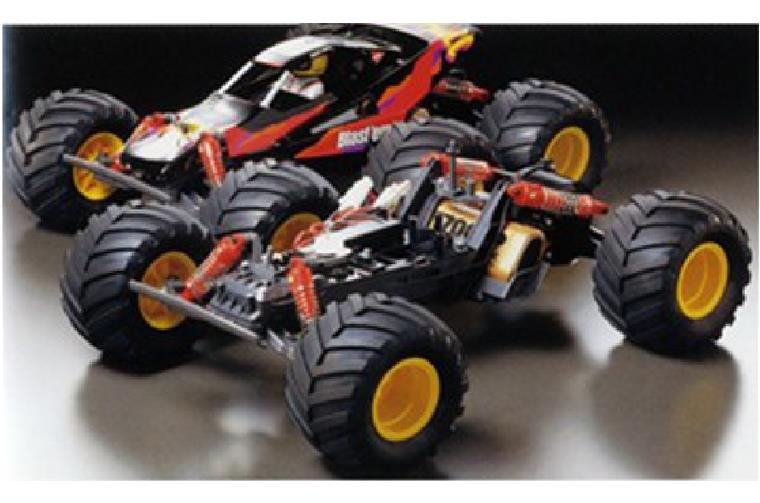
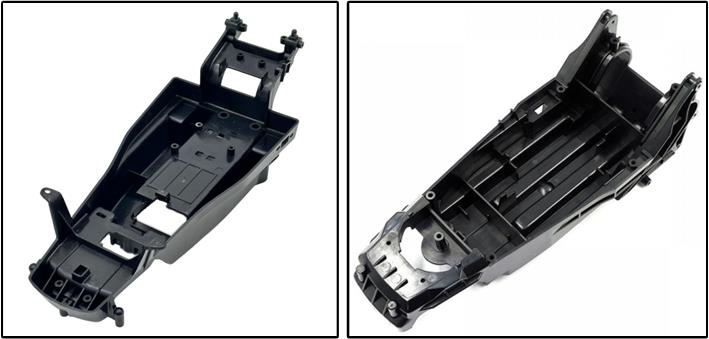
– Durability and structural integrity: The DT-01 chassis, made of ABS, withstands stress well even under rough handling. In the image below, a Grasshopper chassis (left) is compared with a DT-01 chassis (right). As seen in the images, the DT-01 chassis design is significantly more refined.
– Enhanced rigidity and protection: The ribbed structure increases chassis stiffness, while the lower shell is more enclosed, offering improved protection for electronics against dust and debris.
– Rear-wheel drive only, providing a classic two-wheel-drive configuration.
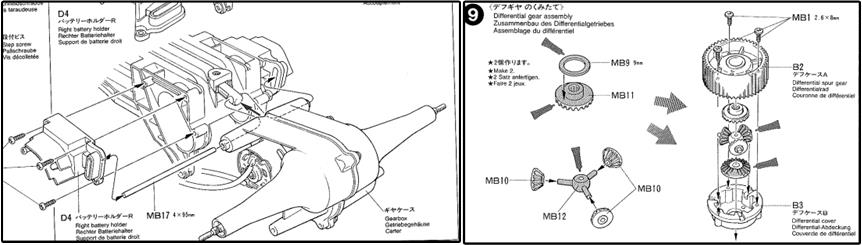
– Three-satellite differential, ensuring smooth power distribution and improved traction control.
– Rigid axle rear suspension, offering durability and a consistent driving experience.
Driving experience is influenced by the chassis design, where the assembly comprising the motor, gearbox and axle is not firmly secured to the frame—an issue Tamiya has carried over since the first Grasshopper series. When accelerating, the electric motor torque causes the axle to rotate in the opposite direction of the wheel rotation. The axle does not return to its original position until the electric motor is no longer under load. Two key design limitations hinder the resolution of this rotational effect:
– The chassis shell lacks sufficient weight to counteract this movement.
– The rear suspension geometry is too basic to effectively counterbalance this movement.
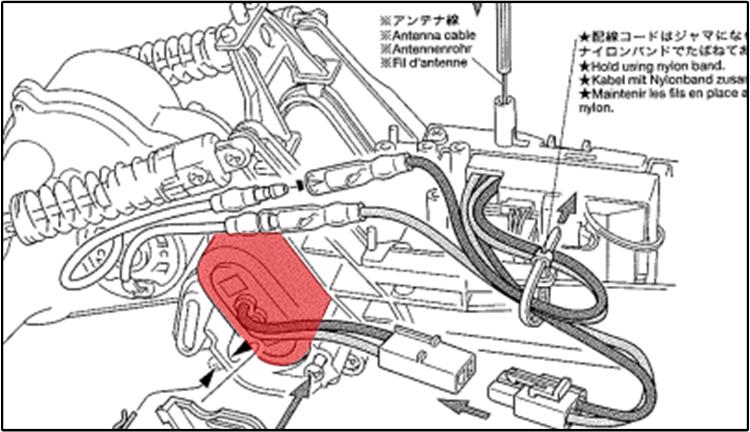
Due to these constraints, even installing oil dampers and replacing springs does not completely eliminate this phenomenon—it can only be minimized. While the issue lies in the chassis configuration, Tamiya has leveraged its experience with Grasshopper models in both configurations and invested resources into refining the central shell to enhance driving stability. The first adjustment involves repositioning the battery (highlighted in red in the image), which is now mounted transversely. In the Grasshopper chassis, the battery was installed longitudinally in the central section of the frame.
Shifting the center of gravity towards the rear significantly reduces bouncing on the rear axle but makes the front end lighter, causing it to hop over bumps and uneven terrain. The second modification involves widening the track width, which increases from 257 mm on the Grasshopper I to 253 mm on the Grasshopper II and expands further to 284 mm on the DT-01 chassis. The challenge in achieving balance primarily stems from the rigid rear axle design. In contrast, the Falcon chassis, a two-wheel-drive platform, offers advantages with its double-wishbone front suspension and independent rear suspension, which operate without being affected by acceleration. The Falcon’s complex suspension system delivers a better dynamic behavior compared to the DT-01, which retains a rigid rear axle. However, the DT-01 is intentionally designed for beginners, providing a stepping stone before progressing to more advanced two- or four-wheel-drive chassis.
Evolution
As of 2025, the DT-01 chassis continues to be used in various limited special editions and re-release:
– Mad Bull, model number 57006, fully equipped with electronics, released in 1997 and available until 1998.
– Mad Bull Special, model number 49174, released in 2000 and available until 2001.
– Mad Bull, model number 57709, fully equipped with electronics, released in 2001 and available until 2002.
– Mad Fighter, model number 57025, fully equipped with electronics, released in 2001 and available until 2002; later reintroduced as model number 57047 in 2004 and sold until 2005.
– Mad Bull 2011, model number 57813, fully equipped with factory-assembled electronics, released in 2011 and available until 2012.
– Fighter Buggy RX Memorial, model number 47460, fully equipped with electronics, released in 2021 and available until 2022.
The Fighter series has achieved considerable success, prompting Tamiya to introduce progressively more advanced chassis over time. The evolution follows this sequence:
– Fighter Buggy RX with the DT-01 chassis
– Super Fighter G with the DT-02 chassis
– Neo Fighter Buggy with the DT-03 chassis
– Fighter NXGEN with the DT-04 chassis