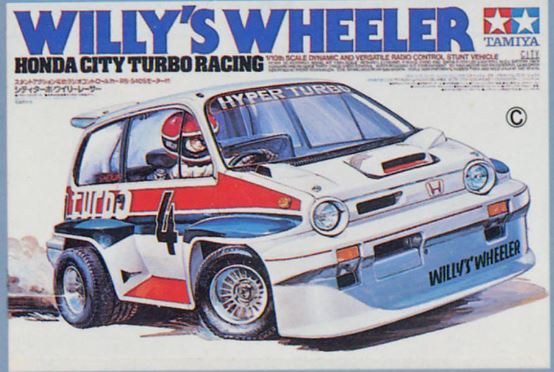
This family is named after the first model that was released for sale; there are two models with the WILD WILLY chassis:
– Wild Willy SWB, model number 58035, released to sale in 1982 and available on the market until 1985 – Wild Willy LWB, model number 58035, released to sale in 1985 and available on the market until 1987 – Willy’s Wheeler, model number 58038, released to sale in 1983 and available on the market until 1984
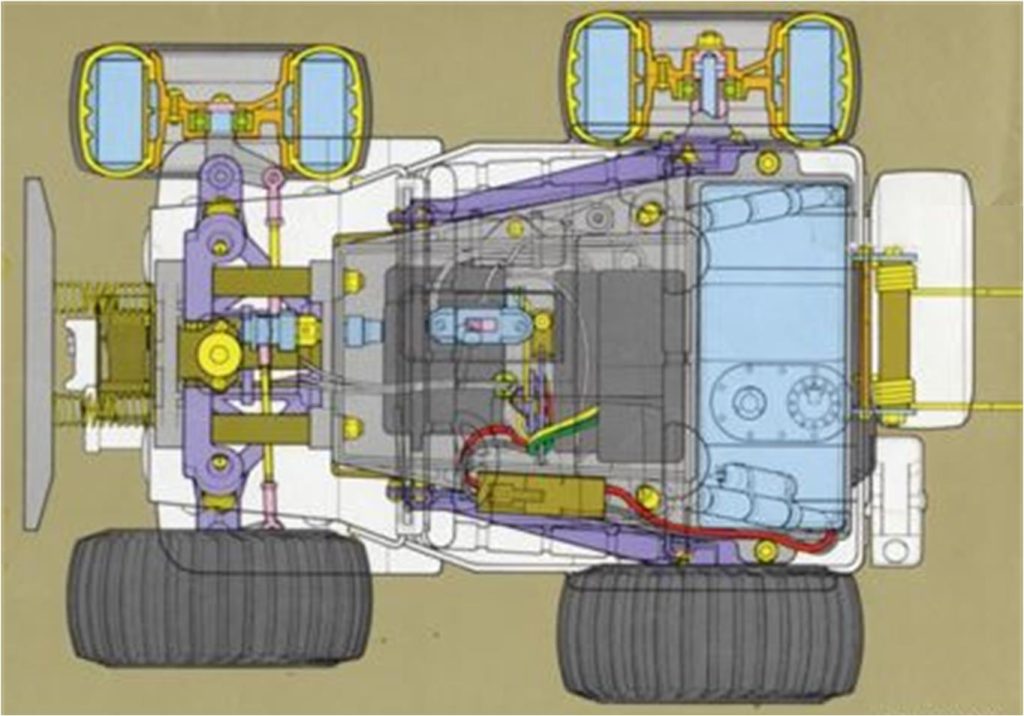
The original Wild Willy chassis was designed as a stunt model so the basic setup is a high centre of gravity shifted towards the rear. The battery is cantilevered behind the rear axle to facilitate wheelies, at the rear there is a double spring system that stabilises the model when travelling on two wheels.
Tamiya included an alternative body colour for the Wild Willy in the 1985 Guide Book.
These two models represent a very important innovation for Tamiya, there are several advertisements that Tamiya or the various importers around the world have published in trade magazines; in the image below is an example of an advertisement for both models.
The main features with which this chassis is advertised in trade magazines are:
– High-performance 540S motor, – Splash and mud-proof electronics box, – 3-speed mechanical control, – Tunable suspension, – Spring system to join chassis to body for Wild Willy and roll bar system for Willy’s Wheeler, – rear differential, – mechanical clutch so as not to stress the gears and – independent front suspension.
The main differences between the two models are purely cosmetic; starting from the rear moving towards the rear, the differences are:
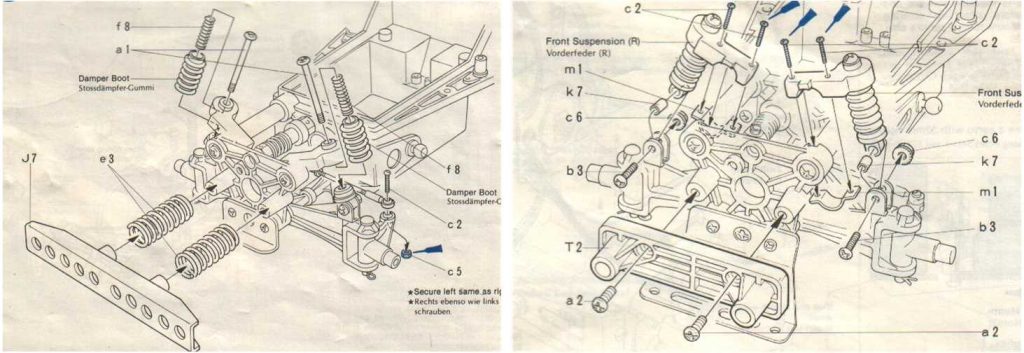
– front bumper. The Wild Willy model has an impact-absorbing front bumper in which two springs connect the bumper to the chassis. Willy’s bumper is that of the Lancia Rally which is famous for its delicacy, it breaks at the slightest impact.
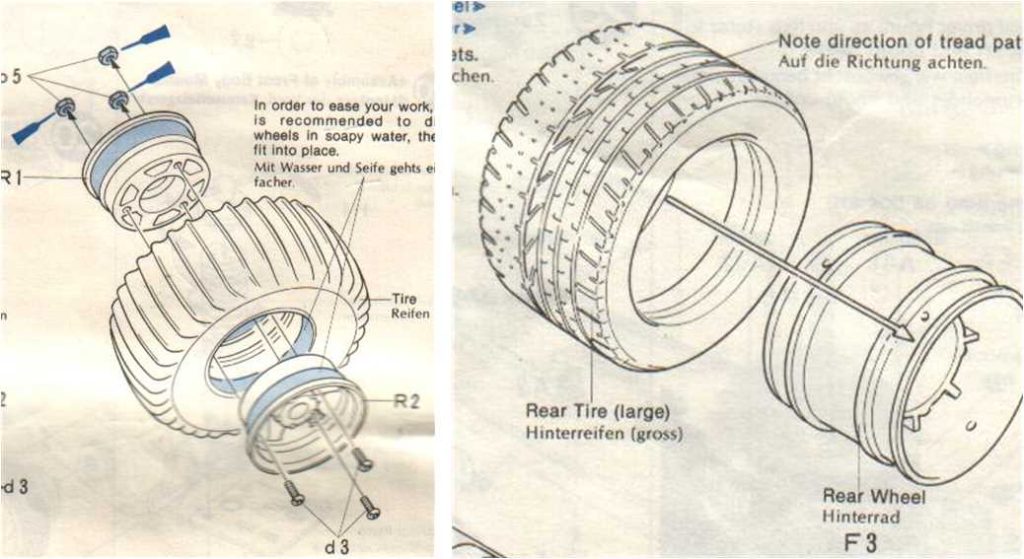
– models are isodiametric, the four wheels are identical in size and shape. They differ between the two models.
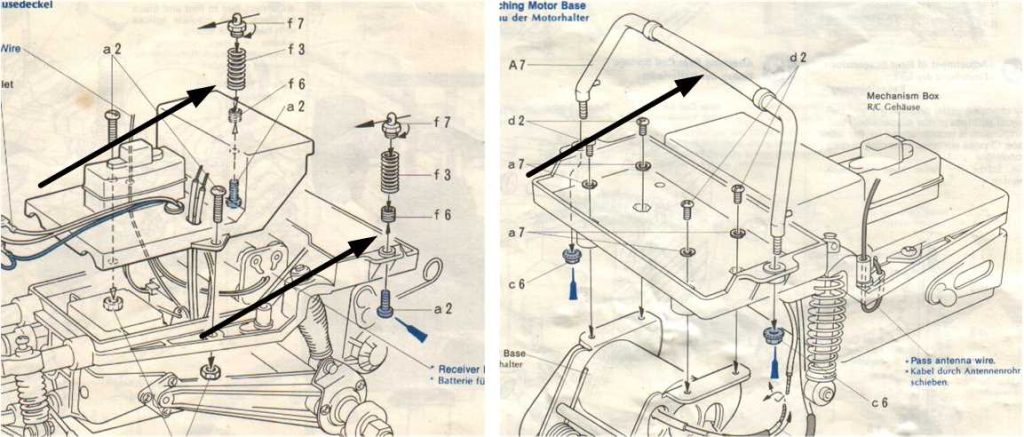
– The two models differ in their body, which is a reproduction of the famous World War II jeep for the Wild Willy model and a compact sports utility vehicle for the Will’s Wheeler model. This difference justifies a different way of attaching the body to the chassis at the rear. Wild Willy has two separate attachments with pins while Willy’s Wheeler is equipped with a roll bar.
The chassis has evolved to such an extent that we can speak of two completely different versions:
– SWB which stands for shot wheel base, so it is a version that has a shorter distance between the front and rear axles. This is the version first released for sale and can only be found on the first year of production model number 58035. – LWB stands for long wheel base, so it is a version that has a greater distance between the front and rear axles.
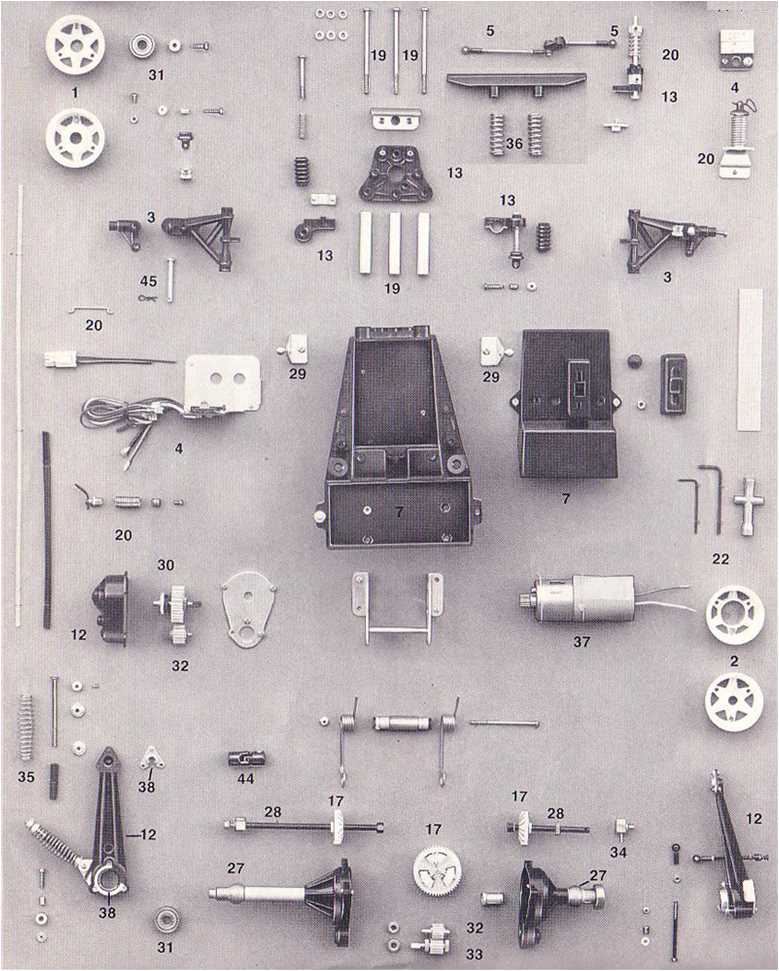
The difference in wheelbase is only about 10 mm and is achieved by changing some rear suspension details, it is easy to spot the differences by comparing the instructions of models built in different years. Actually, in the evolution of the chassis from SWB to LWB some parts of the lower and upper shell of the electronics box were also changed. Here is a picture of all the parts that make up this chassis in the SWB short wheelbase version.
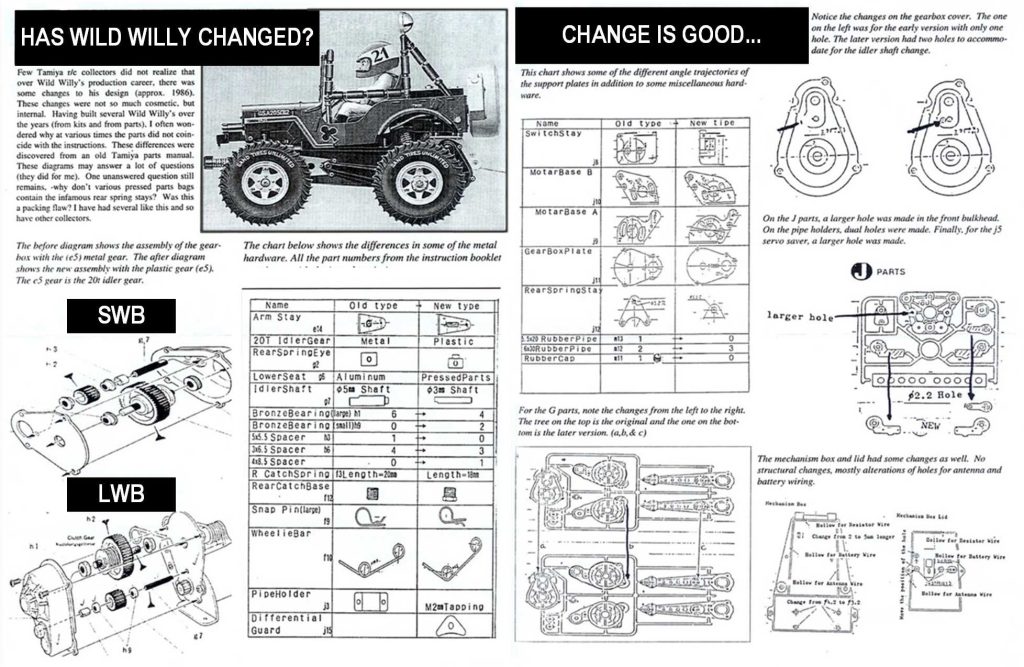
Tamiya itself has published a number of articles in trade journals informing how the model was updated. From the data observed on the disassembled and then reassembled models, the modifications seem to have been operational since 1985 or shortly before. In practice, the modifications have been operational since the Quattro chassis was released for sale; the article refers to 1986 as the date when the modifications were introduced. It is probable that in order to avoid disputes with customers Tamiya indicates the date when the modification is in operation on all packages leaving the factory. The document shows all the modifications introduced on this chassis.
Starting from the front and moving to the rear, the list of the main differences is as follows: The above is not exhaustive as Tamiya has over time incorporated and optimised production. The introduction of the Quattro chassis also made it possible to include changes in the common parts that were then transferred to the production of models equipped with the Wild Willy chassis. The Wild Willy and Quattro chassis share both the front steering and suspension system and the rear transmission and suspension system. Those listed are the modified parts that made it possible to lengthen the wheelbase by about 10 mm.
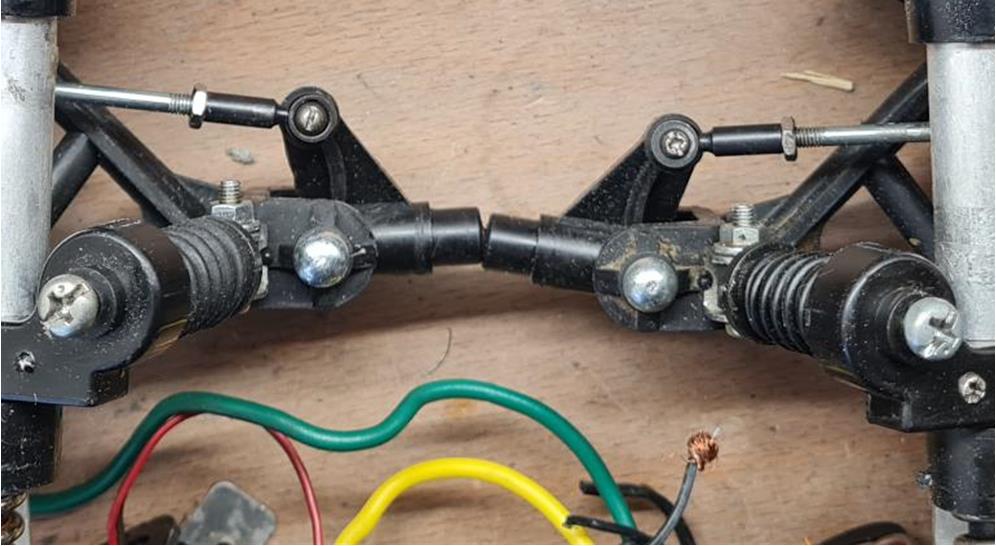
The first difference is in the hardware; in the SWB version, some screws have heads for the flathead screwdriver (picture below shows the steering tie rod screw on the left) in the LWB version, the screws all have heads for the flathead and Phillips screwdriver (picture below shows the steering tie rod screw on the right).
On the left the pictures refer to the SWB version and on the right the pictures refer to the LWB version.
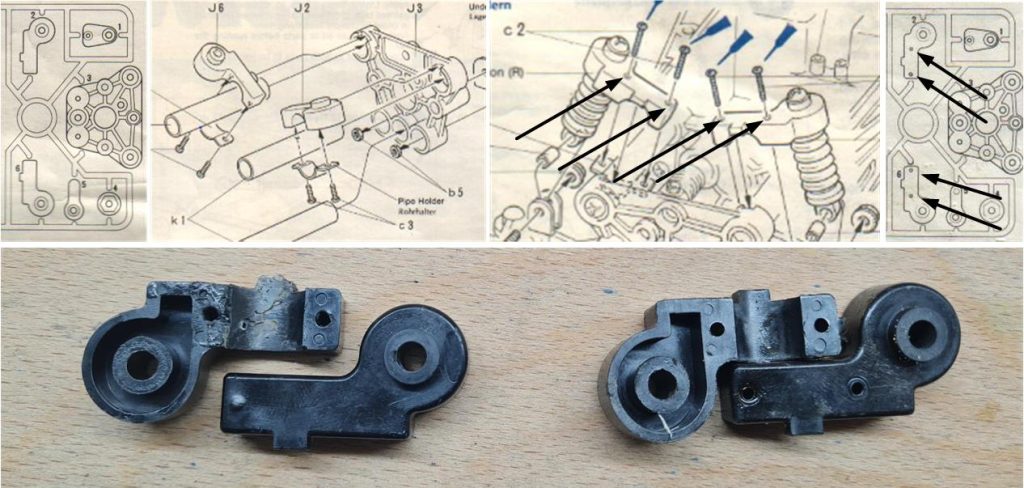
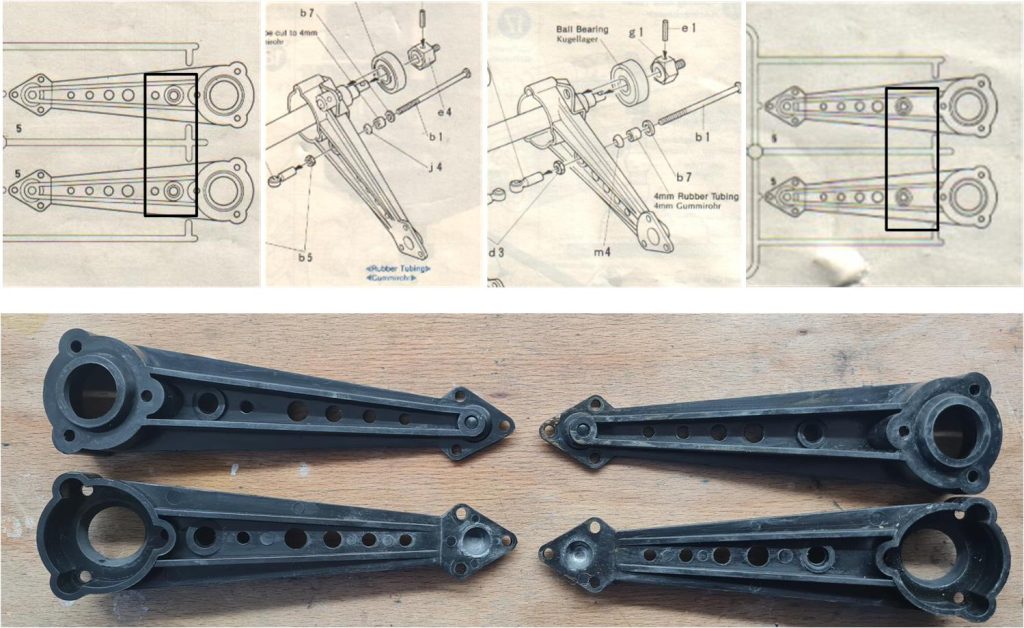
– front suspension system; the front shock absorbers are connected to the chassis via two plastic arms that attach to the front bumper-suspension system. The suspension of the first series has two different types of attachment of the front shock absorbers. The two left and right arms that act as supports for the shock absorbers are attached with two self-tapping screws in the SWB version and with two through-bolts that screw onto the metal plate in the LWB version. Thus the two plastic arms have no through holes in the SWB version and have through holes in the LWB version. In the photograph below, the short-wheelbase chassis solution is the two-piece solution on the left and the long-wheelbase chassis solution is the two-piece solution on the right.
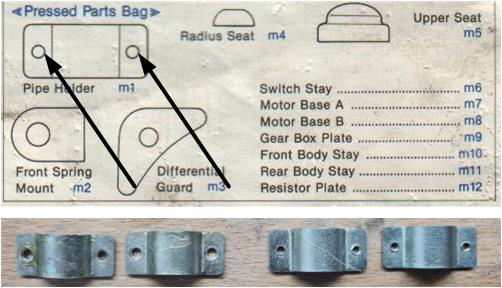
This also leads to a difference in the metal plate used to secure the plastic arms; the plate is located in the ‘Pressed Parts Bag’ and is referred to as ‘Pipe Holder’ code number M1. The hole is in both frames made for 2 mm diameter screws: in the SWB version it is not threaded and in the LWB version it is threaded. They are interchangeable between the two frames if you change the plastic part and the metal plate. In the photograph below, the short-wheelbase chassis solution is the two-piece solution on the left and the long-wheelbase chassis solution is the two-piece solution on the right.
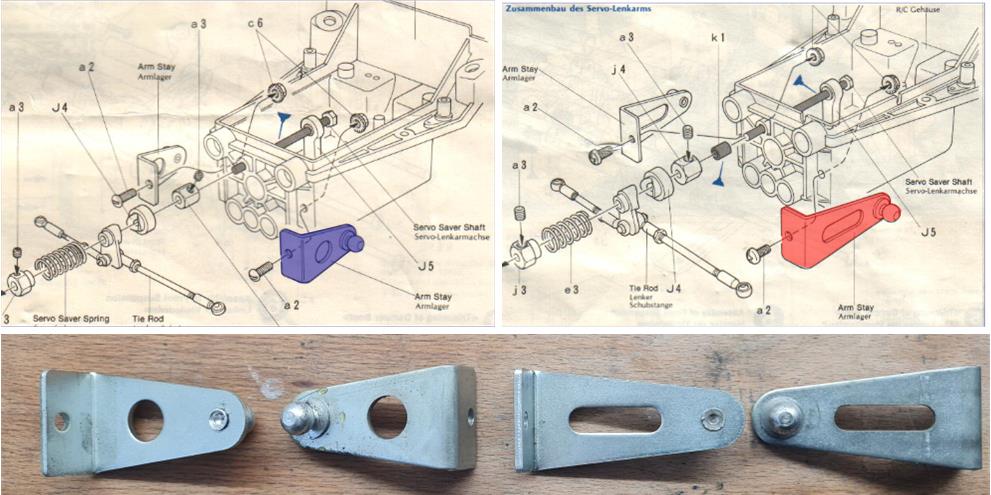
– The plate for the ball joint of the rear suspension swing arm has different dimensions between the short (highlight in blue) and long (highlight in red) wheelbase versions. It can be recognised by the hole, which is circular for SWB and oval for LWB. The two solutions are not interchangeable between the two chassis unless the suspension swing arms are also changed. In the photograph below, the short-wheelbase chassis solution is the two-piece solution on the left and the long-wheelbase chassis solution is the two-piece solution on the right.
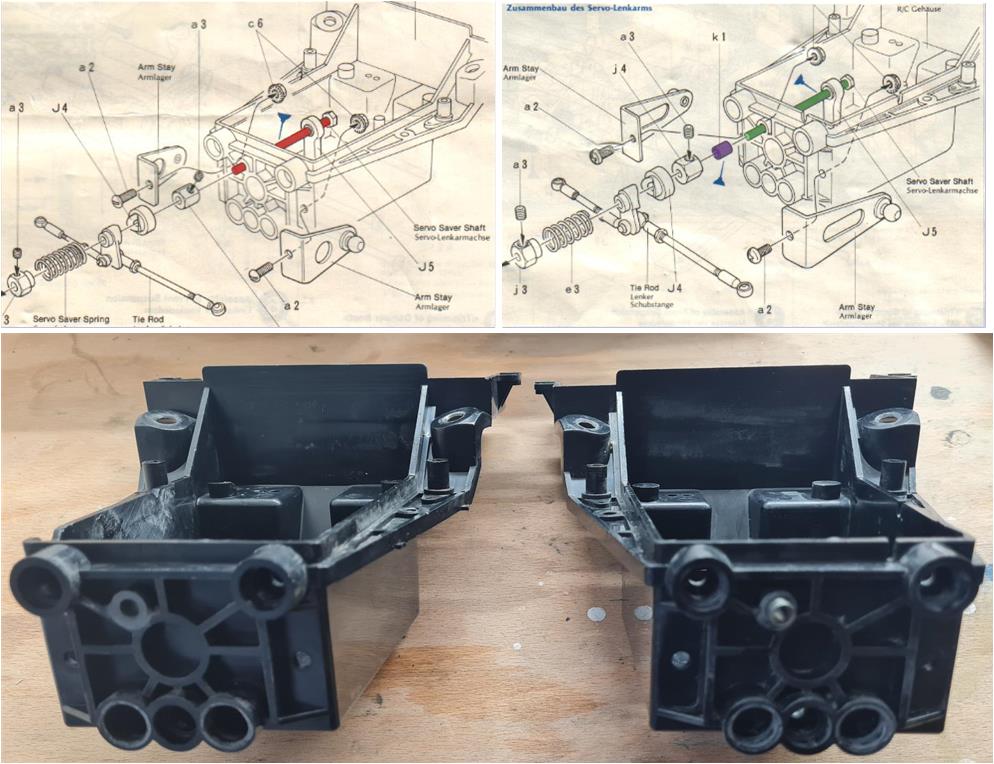
– There is also a subtle difference in the steering system and the hole in the lower frame shell. In the SWB version the hole in the frame for the steering column (highlighted in red in the photo below) is the right size and it is not necessary to install a bushing. In the LWB version the hole in the frame is slightly larger and it is possible to install a bushing in the shape of a small drilled cylinder (highlighted in purple in the picture below) which improves steering column rotation (highlighted in green). This modification is retained in the Quattro chassis. In the photograph below, the short-wheelbase chassis solution is on the left and the long-wheelbase chassis solution is on the right. In the lower right-hand shell you can see the metal tube slightly inserted into the frame. This tube serves to reduce the diameter of the bore and allows the use of the same steering column that is present in the short-wheelbase model. The movement of the steering in the long-wheelbase frame is therefore favoured by this metal friction of the column – metal of the tube, which must be oiled.
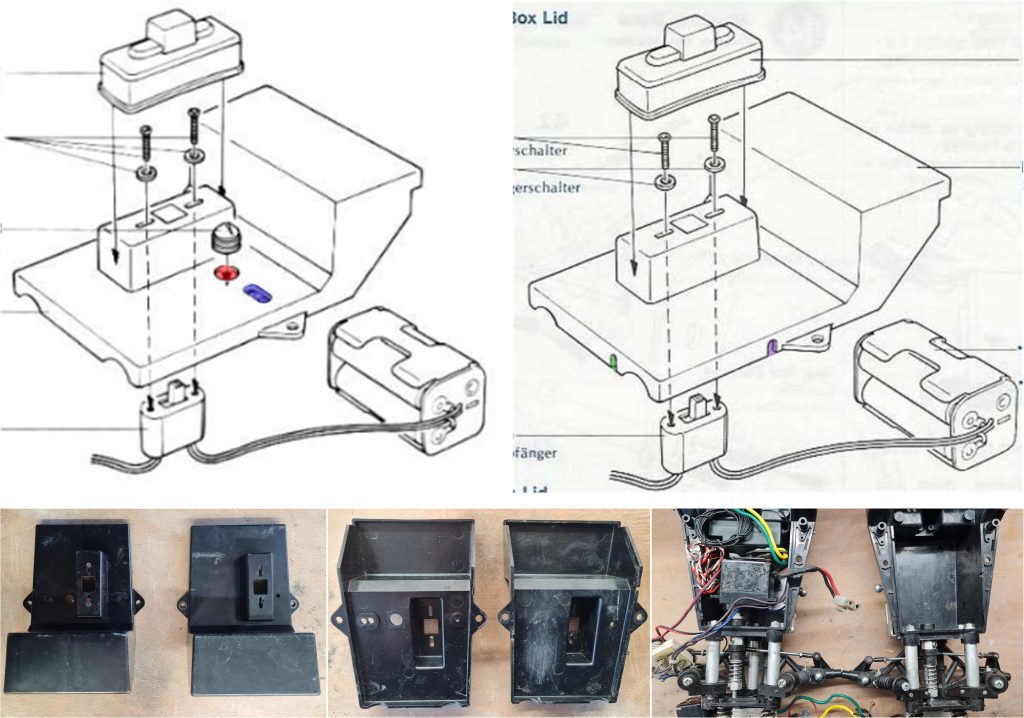
– The upper and lower shells of the two chassis differ in the type of electrical cable routing. In the SWB version the cables come out of the upper part of the upper shell (see picture below the part highlighted in red for the double electrical resistance cables and in red for the battery cables). In the LWB version, the cables exit through two slots, one at the front (highlighted in green in the picture below) for the electric resistor cables and one at the side (highlighted in purple in the picture below) for the battery cables. The slots are present on both the upper and lower shells.
– The swing arm of the two versions changes in shape, it is less complex for the LWB version. In addition, the SWB version has shorter arms than the LWB version. The arms and their attachments with ball joints are the main modification that leads to a change in the wheelbase between the front and rear axles. The two solutions are not interchangeable between the two chassis unless the ball joint plates to attach the two arms to the chassis are also changed. In the photograph below, the short-wheelbase chassis solution is the two-piece solution on the left and the long-wheelbase chassis solution is the two-piece solution on the right.
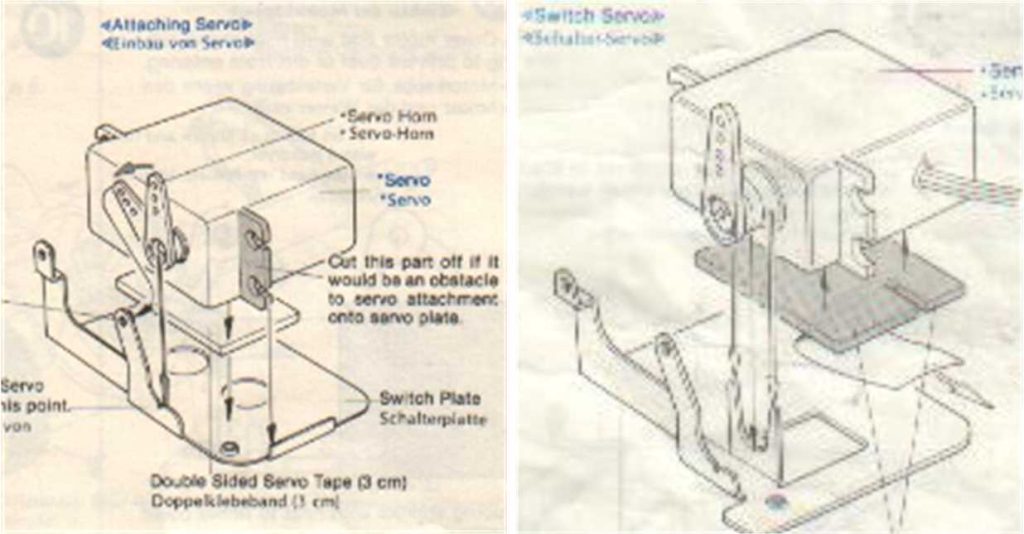
– The metal plate for the servo that controls the mechanical speed control system in the LWB is identical to that adopted later for the Quattro chassis. The base no longer has two circular holes, but a single rectangular photo. The two solutions are interchangeable between the two chassis.
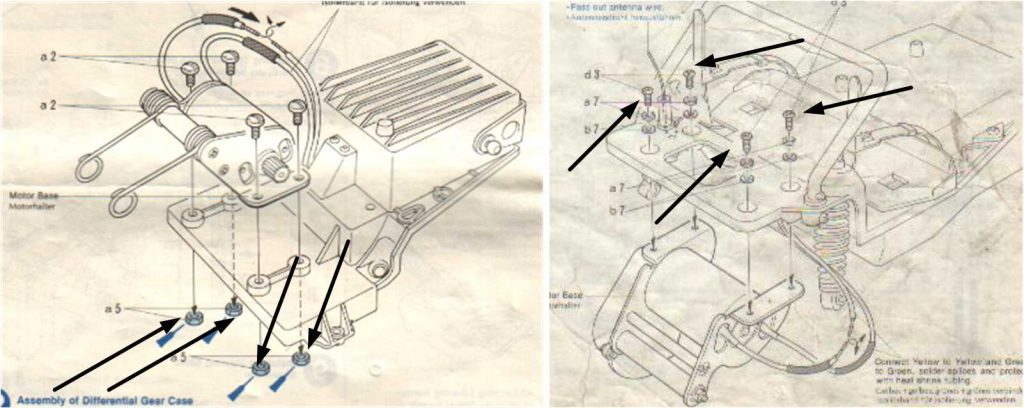
– The system for locking the drive unit to the chassis consists of 4 screws for both the SWB and LWB chassis. The SWB chassis is equipped with 4 nuts and bolts, while the LWB chassis is equipped with 4 screws that grip directly onto the metal plate that has been threaded, as in the Quattro chassis. The two chassis are interchangeable and the gear and motor assembly is completely different.
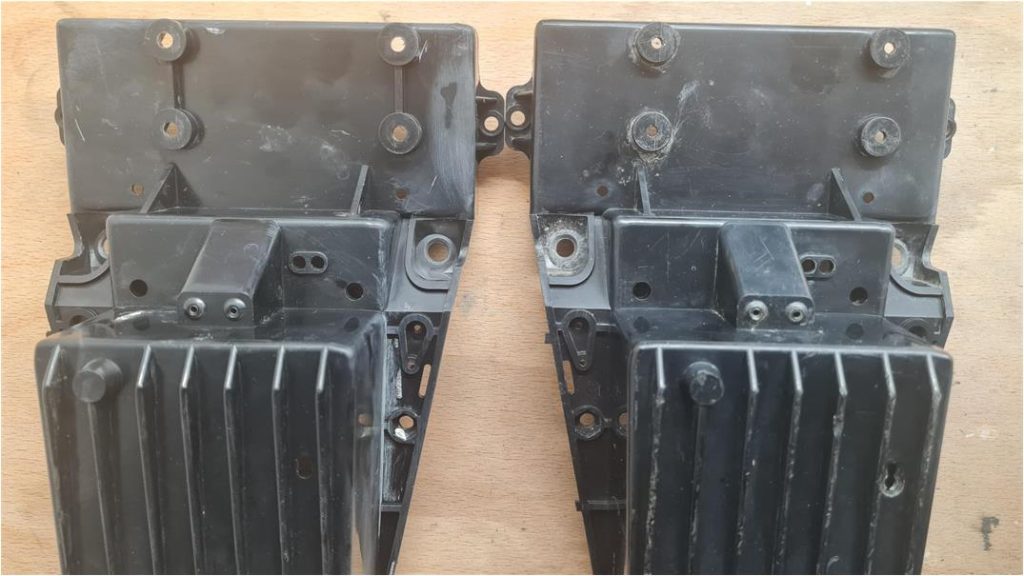
– the two chassis are slightly different in the structure that houses these four bolts. The inner shell of the short wheelbase model has two reinforcements which are two fins joining the towers that house the nuts and bolts. The first reinforcement joins the holes on the right side and the second reinforcement joins the holes on the left side. These lugs are absent in the long-pitch chassis. It almost looks as if the holes of the short-pitch chassis form a kind of 8. The short-wheelbase chassis is the one on the left and the long-wheelbase chassis is the one on the right in the picture below.
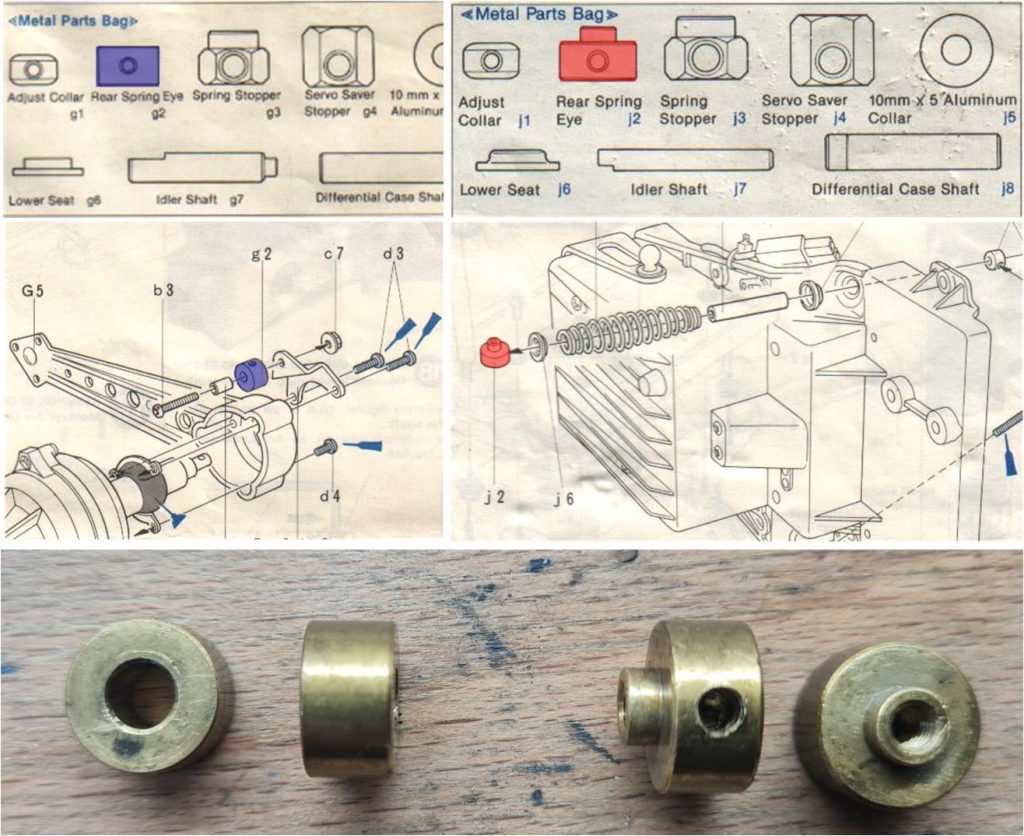
– The differences in the rear suspension are the most obvious, but they do not stop at the shape of the arms and their attachments. In the ‘Metal Parts Bag’ there are parts that have completely different initials and shapes between the two models. Included in the ‘Metal Parts Bag’ is the ‘Rear Spring Eye’ which is part G2 in the SWB (highlighterd in blue) and part J2 in the LWB (highlighted in red). They are evidently different because of a different construction of the joint that links the swing arm to the shock absorber. This difference means that the metal plate that connects the Rear Spring Eye to the axle is also of a different shape. It is possible to install an SWB motor unit on an LWB chassis and vice versa. In the photograph below, the short-wheelbase chassis solution is the two-piece solution on the left and the long-wheelbase chassis solution is the two-piece solution on the right.
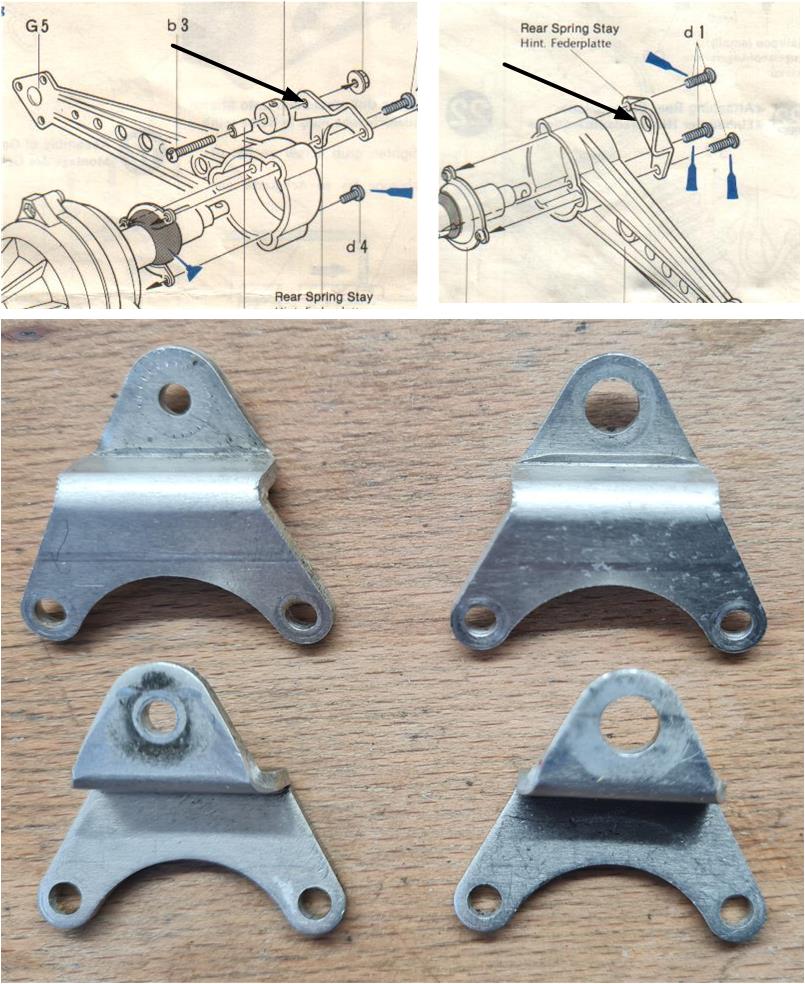
This difference means that the metal plate joining the Rear Spring Eye to the axle is also of a different shape. In the photograph below, the short-wheelbase chassis solution is the two-piece solution on the left and the long-wheelbase chassis solution is the two-piece solution on the right.
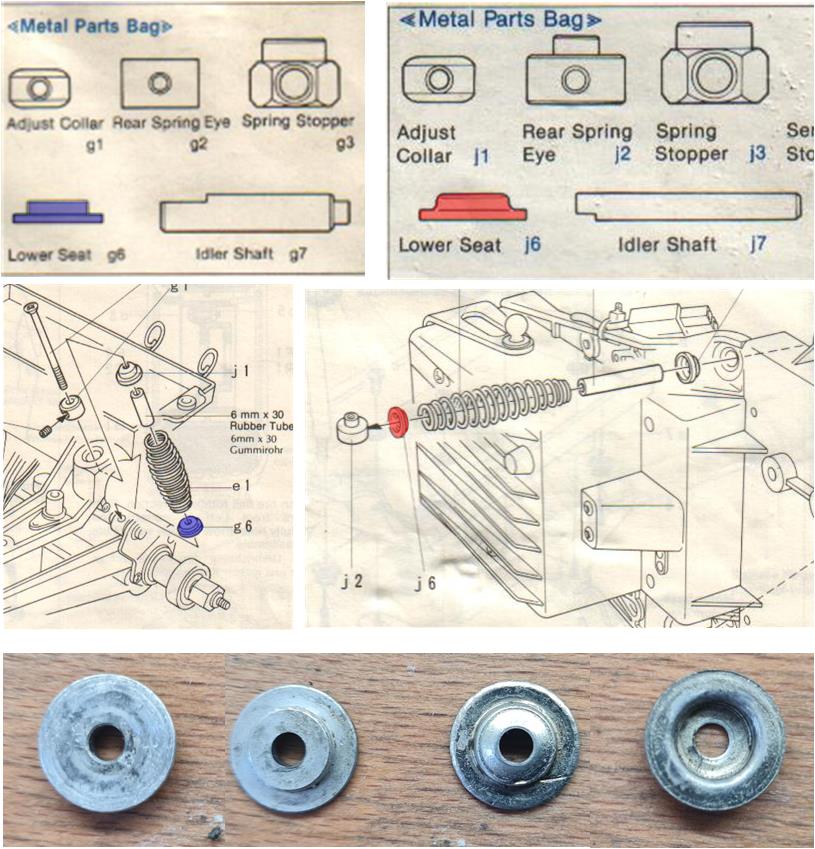
– Included in the ‘Metal Parts Bag’ is the ‘Lower Seat’ which is part G6 in the SWB and part J6 in the LWB. This part is always part of the rear suspension system. Although they are interchangeable, they are two completely different parts; in the SWB )highlighted in blue) it is CNC machined aluminium and in the LWB (highlighted in red) it is pressed steel. In the photograph below, the short-wheelbase chassis solution is the two-piece solution on the left and the long-wheelbase chassis solution is the two-piece solution on the right.
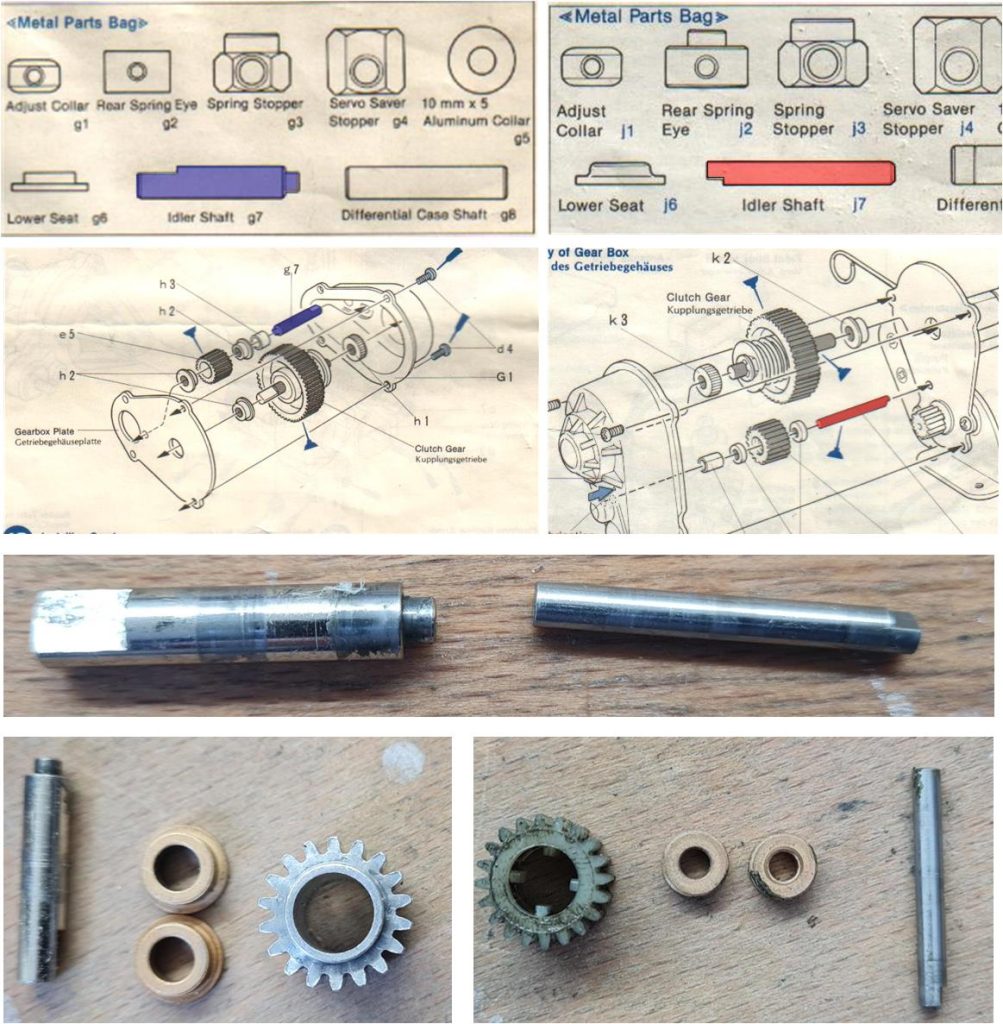
The LWB version adopted the Quattro chassis motor and transmission system, which is an evolved version of that found on the SWB. This variation caused several changes in the gearbox. – Included in the ‘Metal Parts Bag’ is the ‘Idler Shaft’, which is part G7 in the SWB (highlighted in blue) and part J7 in the LWB (highlighted in red). For the SWB chassis the ‘Idler Shaft’ is a 5 mm diameter aluminium axle, for the LWB chassis the ‘Idler Shaft’ is a 3 mm diameter aluminium axle that also changes in shape from the original version. The two differently sized axles justify the presence of two different types of gearing, which is metal for SWB and Teflon for LWB. The two solutions are not interchangeable between the two chassis. n the photograph below, the short wheelbase chassis solution is the one in the pictures on the left and the long wheelbase chassis solution is the one in the pictures on the right.
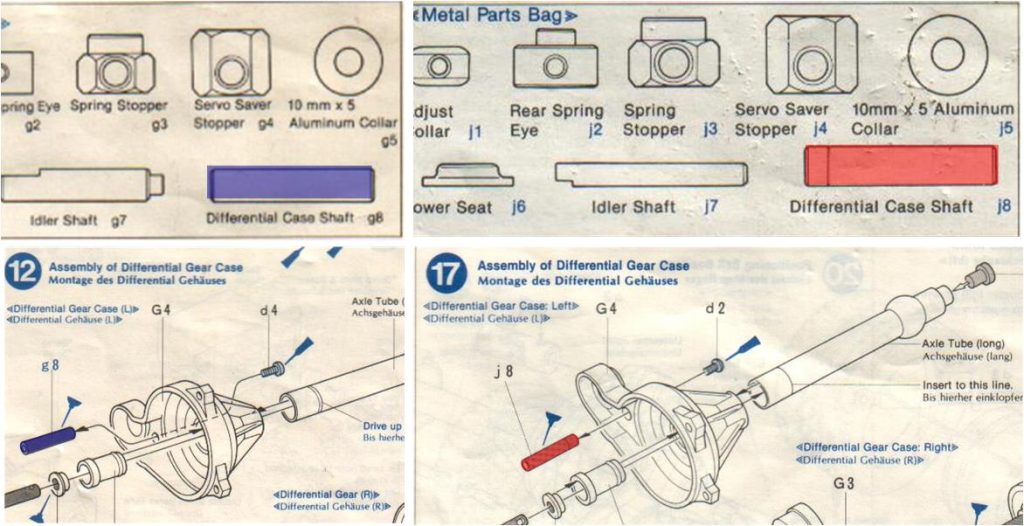
– Included in the ‘Metal Parts Bag’ is the ‘Differential Case Shaft’ which is part G8 in the SWB (highlighted in blue) and part J8 in the LWB (highlighted in red). The two solutions are not interchangeable between the two chassis.
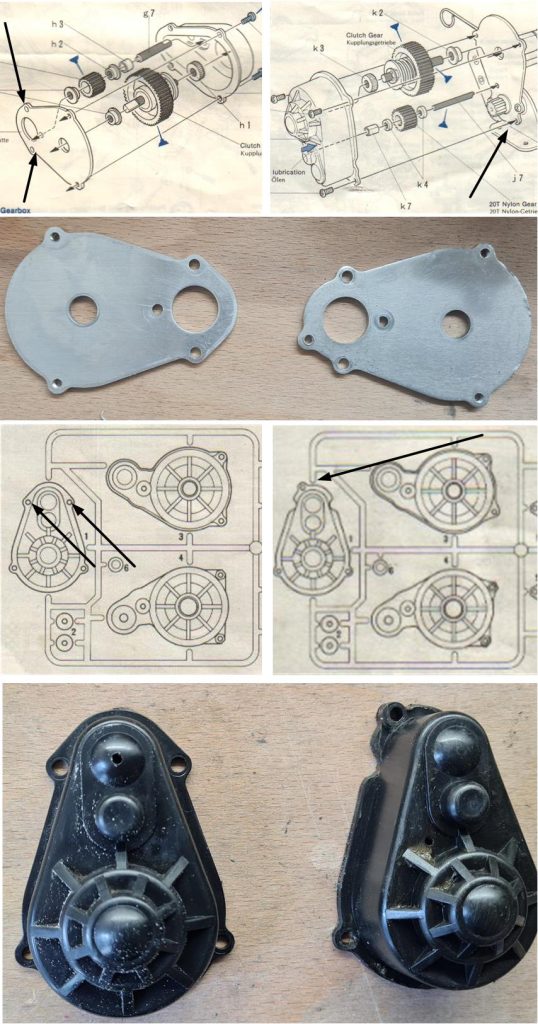
– The different shape of the gearbox results in a change to both the plastic outer case and the metal centre plate. In the photograph below, the short-wheelbase chassis solution is the piece on the left and the long-wheelbase chassis solution is the piece on the right. In the pictures the differences are highlighted; on the left the pictures that refer to the SWB version and on the right the pictures that refer to the LWB version. In the photograph below, the short-wheelbase chassis solution is the piece on the left and the long-wheelbase chassis solution is the piece on the right.
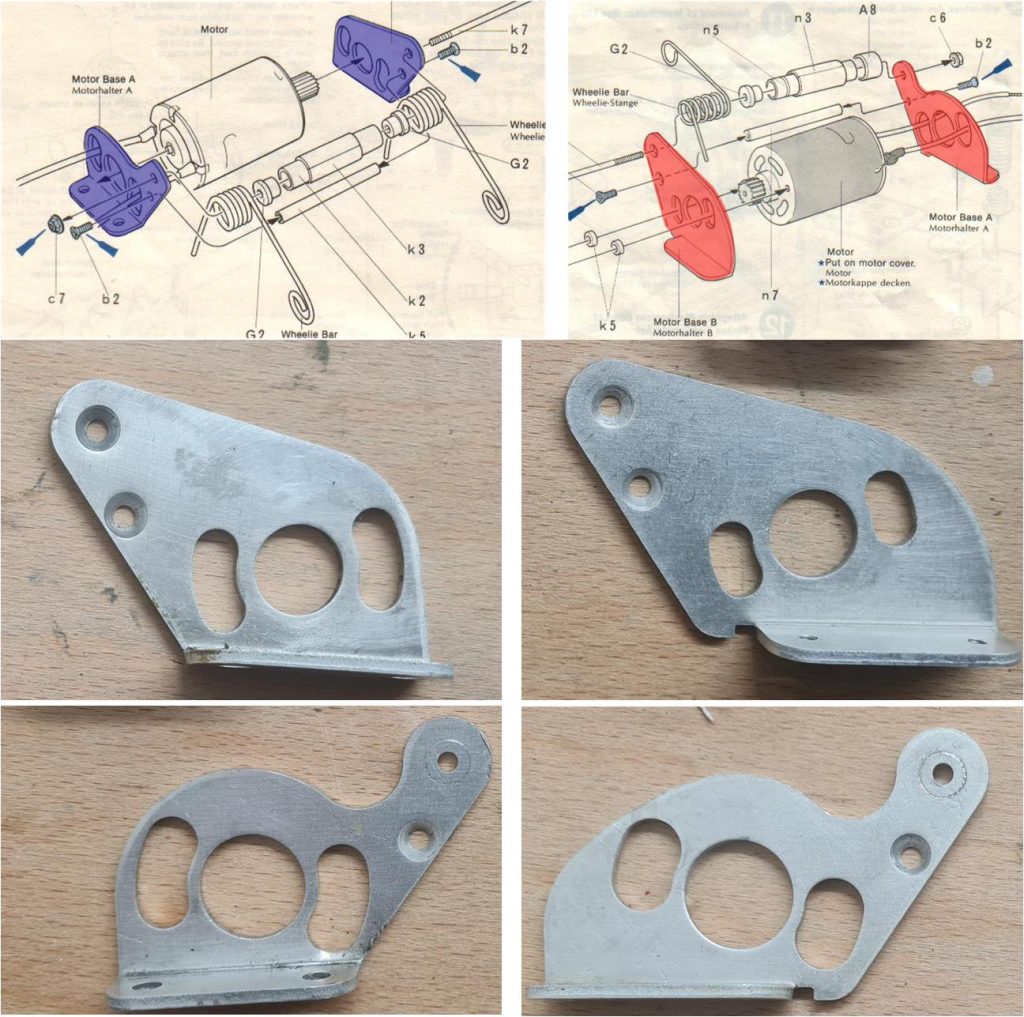
– The system for attaching the two rear springs and the motor changes between the SWB (highlighted in blue) and LWB (highlighted in red) versions. The two metal plates have similar shapes and different dimensions. The two springs are similar, but have a different shape. In the photograph below, the short-wheelbase chassis solution is the two-piece solution on the left and the long-wheelbase chassis solution is the two-piece solution on the right.
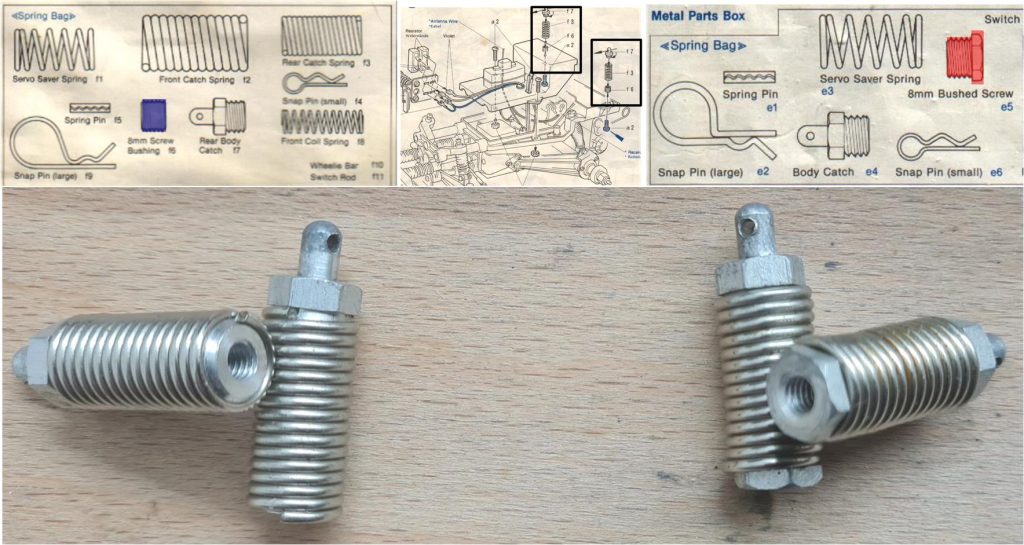
– Included in the ‘Spring Bag’ is the ‘8 mm Bushed Screw’ which is part F6 in the SWB (highlighted in blue) and part E5 in the LWB (highlighted in red). They form part of the system that is used to clamp the body to the chassis, have a different shape and are interchangeable between the two chassis. In the photograph below, the short-wheelbase chassis solution is the two-piece solution on the left and the long-wheelbase chassis solution is the two-piece solution on the right.
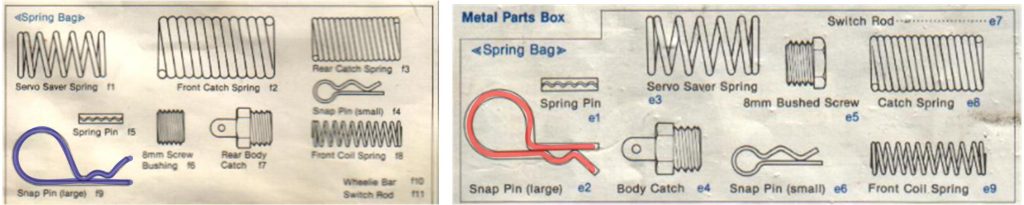
– Included in the ‘Spring Bag’ are the clips or ‘Snap Pin (Large)’ which are part F9 in SWB and part E2 in LWB. They are different in shape between the SWB (highlighted in blue) and LWB (highlighted in red) versions. In the pictures the differences are highlighted; on the left the pictures that refer to the SWB version and on the right the pictures that refer to the LWB version.
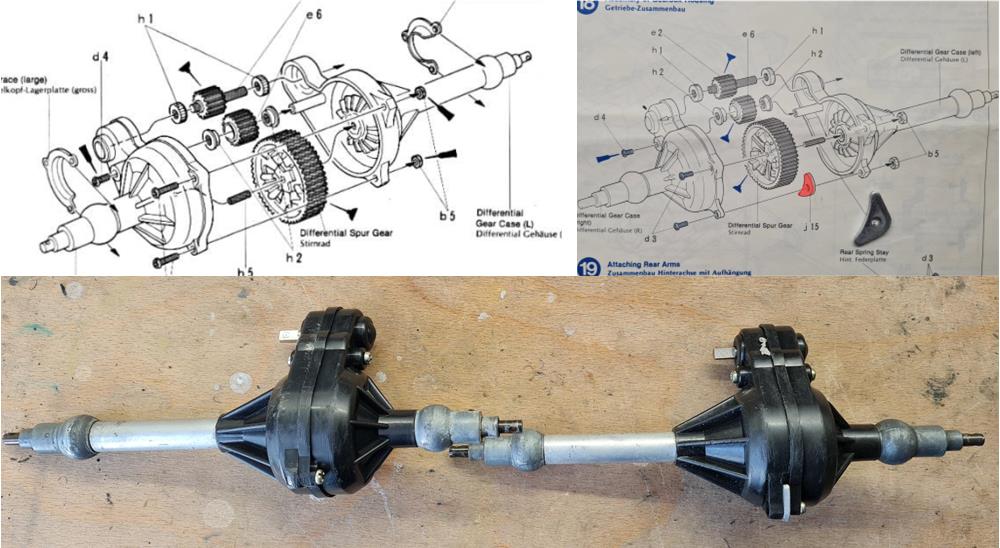
The rear differential housing is practically identical, but in the long wheelbase version a metal half-moon has been inserted, shown as part J15 highlighted in red in the picture on the right. The metal half-moon rests on the instructions on the right. This half-moon has the function of acting as a friction plate when the model is only resting on the rear wheels, protecting the differential housing which is made of plastic. The plastics of the shell with the short rear axle arm are therefore slightly different to accommodate this half-moon in the LWB version. This part is absent in the short wheelbase model (picture left).
The body has not evolved between the SWB and LWB versions, so aesthetically the only difference is in the Snap Pins.
Re-release:
To date (2023) there have been several releases of the two models:
– Wild Willy in 1999 and 2003 using a different chassis from the original; WR-02 – Whilly’s Wheeler in 2015 using a different chassis from the original; WR-02C
The photo shows the comparison of the Willy’s Wheeler model with the original chassis (left), which has no parts in common with that of the re-edition (right). In the case of the Wild Willy, the tyres also change in shape and size.
The differences for the Wild Willy model are also evident in the body:
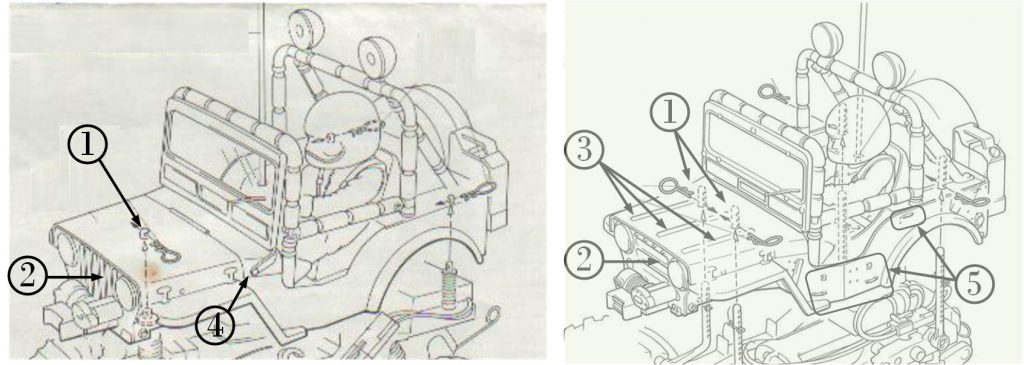
1 – the Clips – Snap Pin to lock the body are 3 in the original model and 4 in the modern version, because in the front from 1 in the central position become 2 positioned at the sides of the bonnet, 2 – the front radiator grille in the original model has 6 vertical louvers, which in the modern version becomes 3 horizontal louvers. The grille of the modern version has 4 rows of 4 bolts and the direction change lights change shape, 3 – the bonnet of the original version is smooth while the bonnet of the modern version has three longitudinal mouldings, 4 – in the original version there is a side hinge that serves in reality to lower the front window, the hinge is absent in the modern version. The upper part of the dashboard is fastened to the chassis with two screws. In the original version, this part features two lateral slots that allow the insertion of the right and left screws, which function as hinges for the windshield. Naturally, the two windshields differ: the original one has four holes for the two metal plates that serve as hinge arms, while the modern version has three holes for securing it to the roll bar. The roll bar differs as well, with the modern version having two lateral slots that enable the windshield to be locked in place. 5 – the side panel of the modern version has small handles and bolts at driver height which are completely missing in the original version.
Apart from these main differences, the same situation is found with various releases: the stickers are different.
The differences for the Willy’s Wheeler model are also present in a minor form in the body:
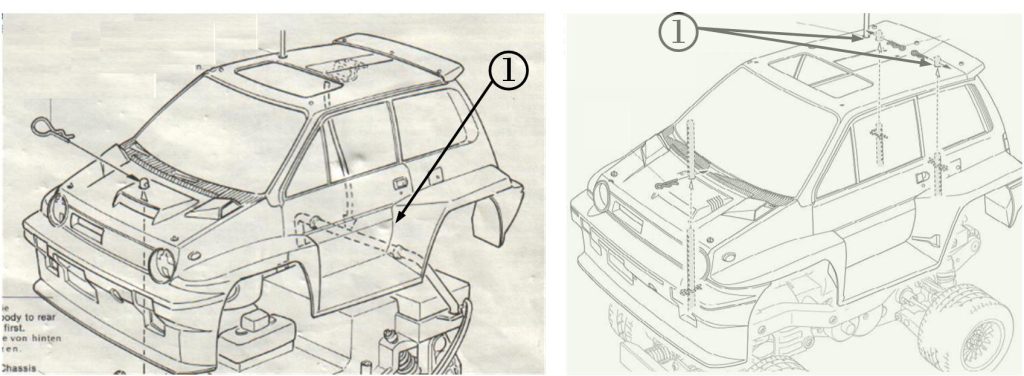
1 – system for locking the body to the chassis; in the original model it consists of a single Clip – Snap Pin with a rear hook on the roll bar, which becomes in the modern version 3 Clip – Snap Pin because in the rear the hook on the roll bar is replaced by 2 Clip – Snap Pin – the additional front bumper is missing in the modern version.
Tamiya, original figure, box art, guide book and catalogue are of TAMIYA INC, which does not endose or sponsor www.tamiyaclassic.com. Any brands, logos and trademarks represented on this website are the copyright of their respective owners.