Model
Tamiya Ferrari F40, model number 58098, released in 1991 and available on the market until 1995
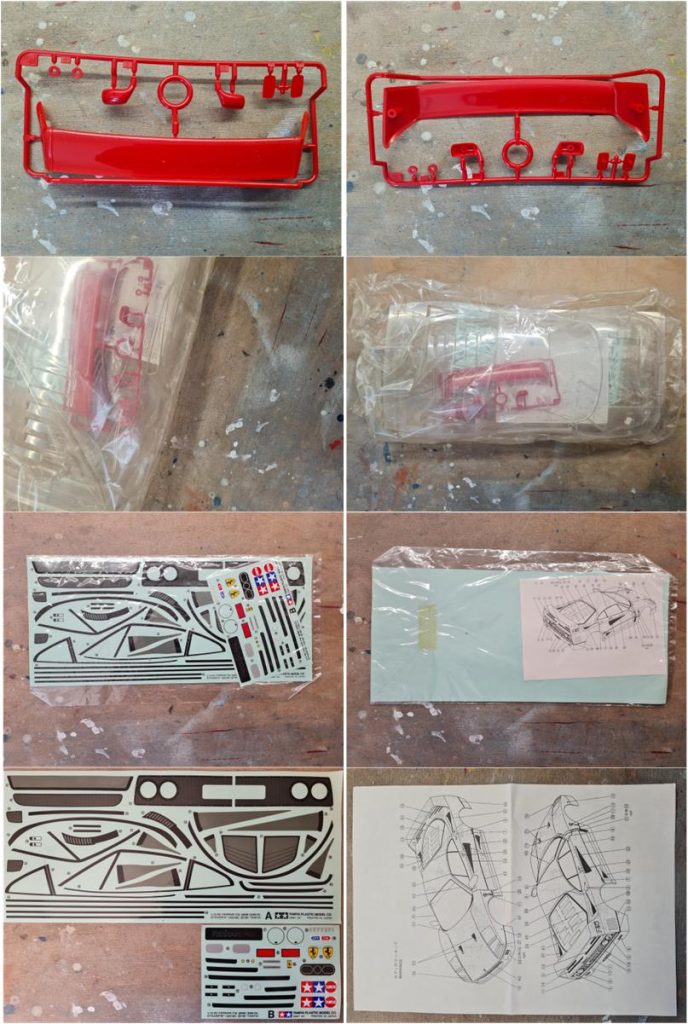
Lexan body shell enriched with some red‑styrene details: driver’s side mirror, passenger’s side mirror and rear spoiler
Group C chassis, short‑wheelbase version
Tamiya takes inspiration from the Ferrari F40 developed to celebrate the first forty years of racing activity of the Modena manufacturer; the real car was produced between 1987 and 1993 to replace the Ferrari 288 GTO Evoluzione, with production limited to 1,311 units instead of the 400 initially planned. The F40 retains the passenger cell of the 288 GTO Evoluzione, which itself had been developed starting from the 288 GTO. Given the excellent performance of the 288 GTO, improving the performance of its successor required drawing heavily from Formula 1 racing technology and adapting it for road use. The F40 is the first Ferrari road car to rely on composite materials to reduce overall weight: kevlar for the chassis, aeronautical resins for the fuel tank, fiberglass for some body parts and plexiglass for the driver–passenger windows and engine cover. The engine cover (mounted centrally) opens clamshell‑style like sports prototypes; for the first time, it features a large transparent plexiglass surface to showcase the engine.
The bodywork is designed by Pininfarina, while the mechanical project is developed under the close supervision of Nicola Materazzi, who builds from scratch a new gearbox and engine achieving a weight‑to‑power ratio of 2.58 kg/HP with a specific output of 163 HP/liter. Materazzi is the father of the 288 GTO Evoluzione design, which inspired the F40; therefore, in developing this model he brought all the experience gained with the 288 GTO. The engine is a 90‑degree V8 with two turbochargers generating a compression ratio of 7.7:1 for 478 HP (352 kW) at 7000 rpm, maximum torque 577 Nm at 4000 rpm, displacement 2936.25 cm³, bore 82.0 mm, stroke 69.5 mm, DOHC per bank, four valves per cylinder with two injectors per cylinder. The new longitudinally mounted gearbox is, of course, a 5‑speed manual with reverse gear and a dry twin‑plate clutch. Among its various records, this car was the first road‑legal vehicle to exceed 320 km/h top speed.
Project
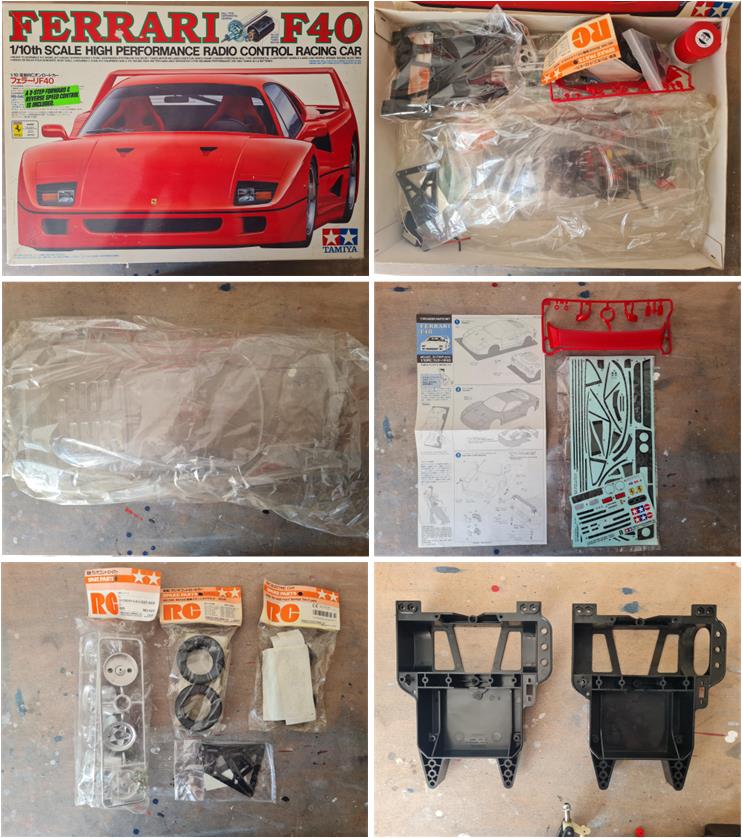
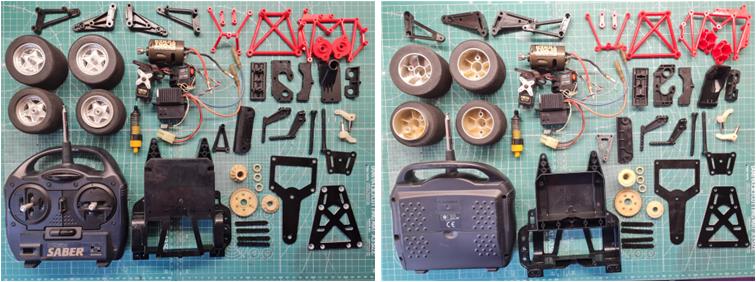
The purchased lot includes the box (left image in the first row), which is in good condition, but the inner parts boxes and blister are missing; together with the box there are the model manual and two body‑shell manuals. The lot contains several new and used parts (right image in the first row), among the new ones a body shell still to be painted (left image in the second row). The previous owner indicated that the original body shell included in the kit was destroyed during use. This explains why there are two body‑shell manuals: one for the destroyed shell and one for the new one. The F40 was reissued by Tamiya in 2005 as model 58356; it is not possible to determine whether the body shell in the lot is an original 1990s spare part or a spare from the 2000s reissue. The bag containing the body shell is yellowed with age, the two body‑shell manuals in the lot both show the 1990s code 50425 and the decals are those of model 58098 (right image in the second row); however, this does not allow determining with certainty when the body shell was produced.
The only difference between the original model 58098 and the reissue 58356 is the color of the plastic A‑parts of the shock‑tower frame, which changed from red to black.
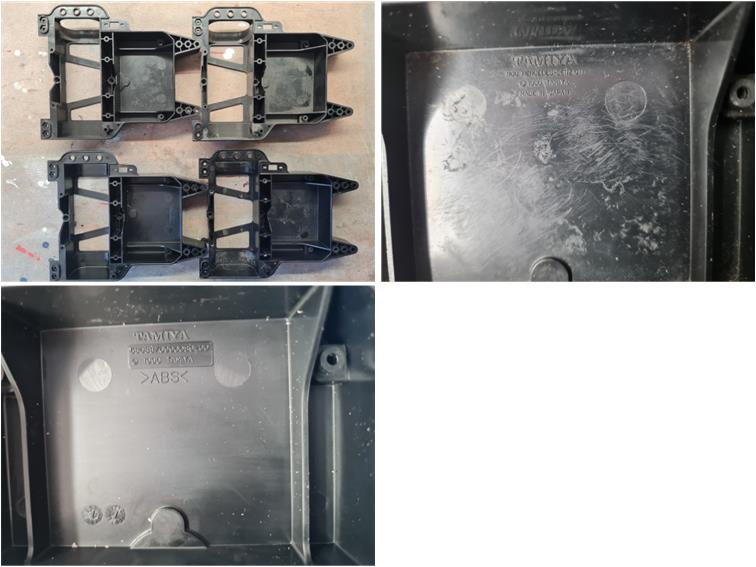
The lot includes the rims code 50426, the front foam tires code 50397 and the rear foam tires code 50398. The front foam tires recommended in the manual are code 50387, which differ from the available 50397 because they are 2 mm wider. These three sets are clearly from the 1990s, as the label color typical of that period is recognizable (left image in the third row). The lot also includes two additional bathtub‑type plastic chassis, one of which is new (placed on the left in the right image of the third row) and the carbon‑fiber parts (bottom‑right corner in the left image of the third row). It is necessary to analyze the new plastic tub to determine whether it is a 1990s chassis or the spare part still produced today (2026) for the Group C family: code 10335109 described as “Chassis for 58088”. The original 1990s central plastic tub has the following marking stamped inside the front section: “Tamiya RCC Mercedes Benz C11 @1990 Tamiya MADE IN JAPAN”. The central plastic tub produced today (2026) shows in the same position the marking “Tamiya 58088099059‑00 @1990 Tamiya >ABS<”. The new central plastic tub is a 2026 spare part and the used central plastic tub is an original 1990s spare. The same analysis must be performed for the carbon‑fiber parts, but it is not possible to determine whether they are original 1990s spares or parts sourced today (2026) on the market; there is no difference between the two: code 19805375 described as “F&L Plate Bag for 58088”.
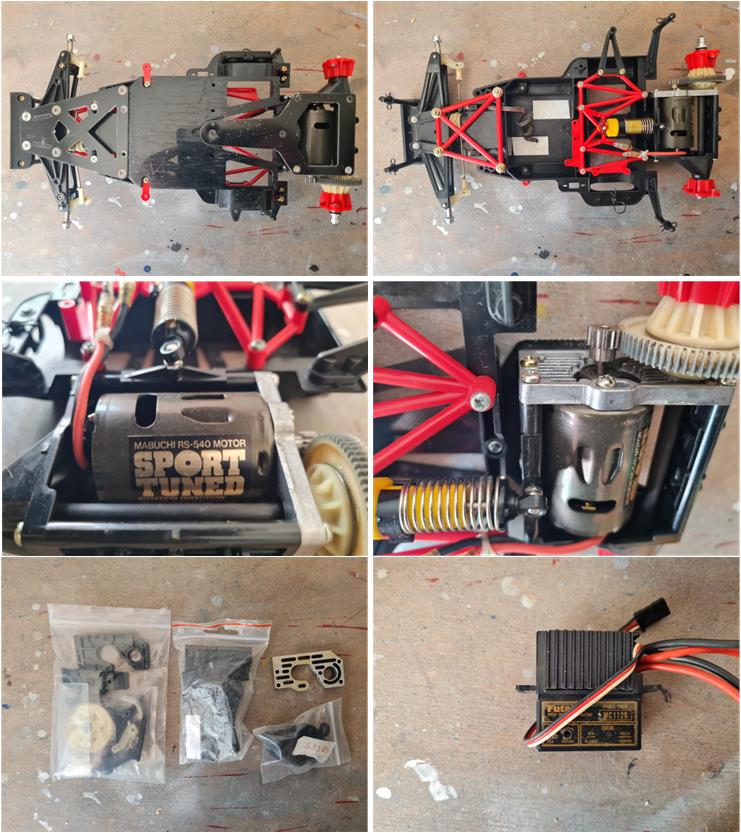
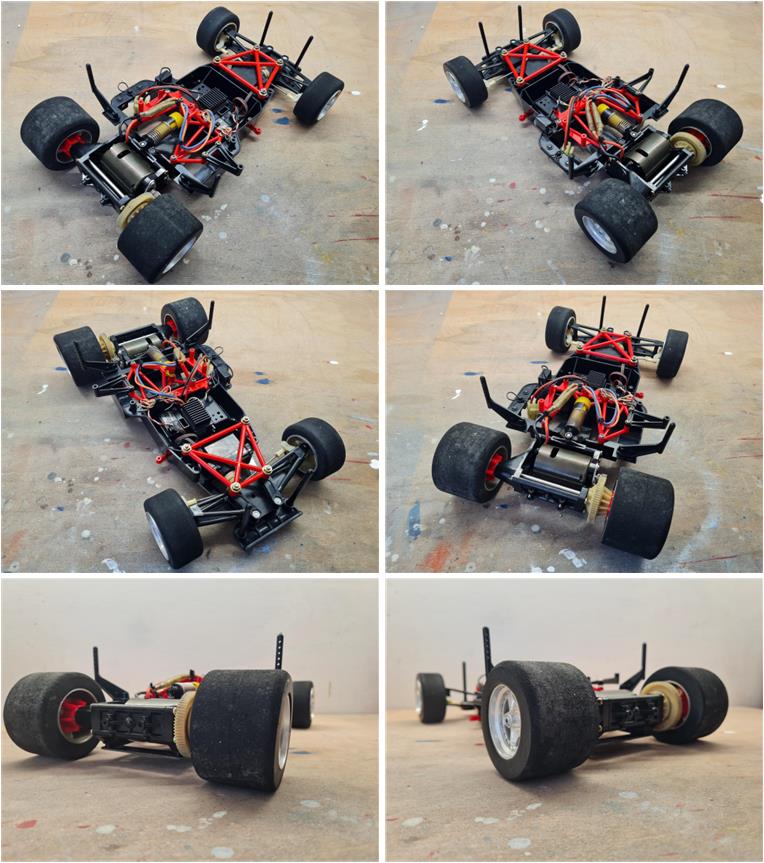
The chassis is complete in every part and there are no broken components; the red plastic parts and the body‑mount towers are present (right image in the first row). The underside of the chassis shows extensive track use with minimal ground clearance (left image in the first row). As specified in the bill of materials, an RS‑540 Sport Tuned electric motor is installed (left image in the second row), part number 53068, with the black can typical of the 1990s; the metal plate used to secure the motor is also installed (right image in the second row), an optional performance‑enhancing accessory, part number 53106, described as “Racing Developed Aluminium motor mount”. This was one of the few accessories recommended in the manual. Various spare parts are included (left image in the third row), including a C‑shaped metal plate and a Futaba electronic speed controller, model MC112B (right image in the third row).
Over the years, many spare parts, complete chassis and body shells for the Ferrari F40 have been collected; this latest lot adds to what had already been accumulated. The goal of the project is to restore this model to like‑new condition, installing only the parts listed in the factory bill of materials.
Chassis restoration
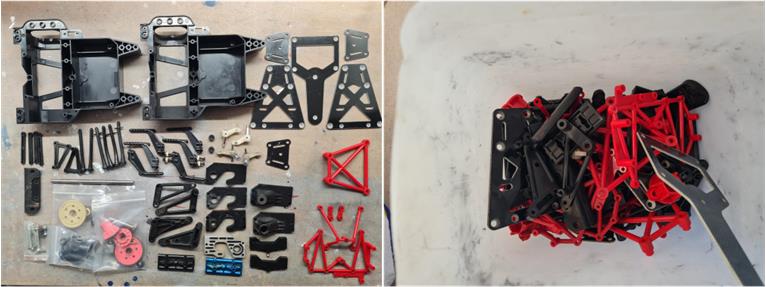
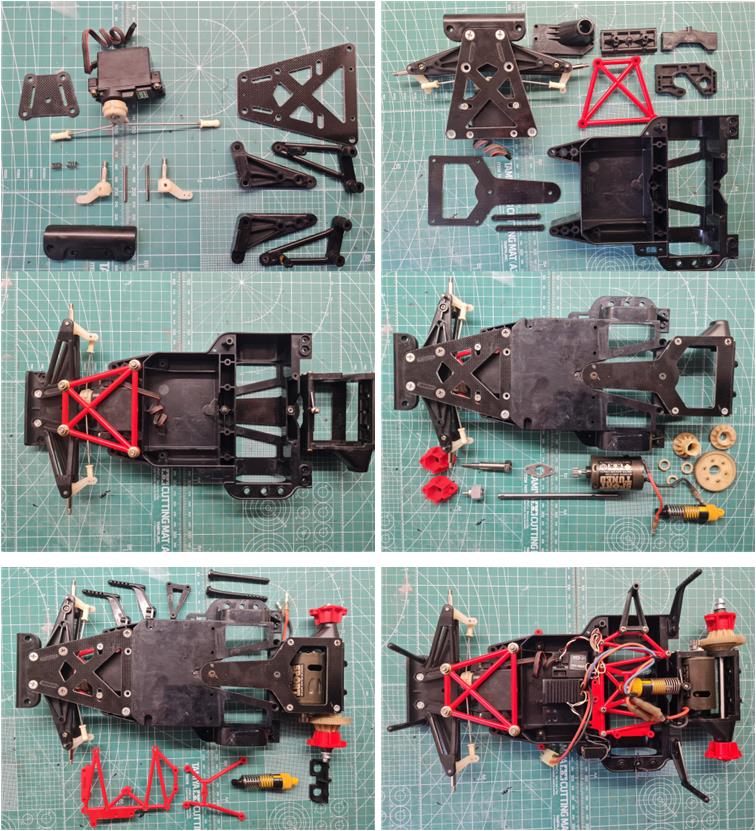
Disassemble the chassis completely and separate the various parts according to their material: gears, plastic, fiber and metals. To complete this project, all parts available on the shelves for the Group C chassis were gathered (left images). The goal is to select the best ones and use them for the restoration. Before selecting them, each part must be cleaned.
Leave the metal parts immersed for one week in a container filled with diesel fuel. Diesel chemically attacks oxidation and rust, dissolves grease and dirt. Once this phase is complete, leave the parts in the sun for one day. At the end of the treatment, the parts are clean and covered with a thin oil film that protects the metal from oxygen, preventing new oxidation.
Leave the plastic and fiber parts (right image) immersed for two days in a container with water and a good amount of dish soap. The surfactants in the soap attack the dirt, which dissolves or softens. Once this phase is complete, mechanically remove the most stubborn dirt using an old toothbrush. Rinse the parts thoroughly with warm water and then leave them in the sun for a few hours to dry.
Treat the gears with a kitchen paper towel to mechanically remove the dirt and grease that have accumulated over time.
Once the regeneration process is complete, it is possible to select the best individual parts. The largest component of this chassis is the central plastic tub. Four tubs are available (left image in the first row). Of these four tubs, one is the version sold by Tamiya with the re‑releases (left image in the second row) and the other three are originals from the 1990s (right image in the first row).
Inventory of the parts confirms that it is possible to assemble three complete chassis with body shell:
– Ferrari F40 with box and instructions (this project)
– Ferrari F40 with performance‑enhancing accessories
– Ferrari F40 complete, but with parts that show signs of track use
For this project, the best‑preserved parts have been selected.
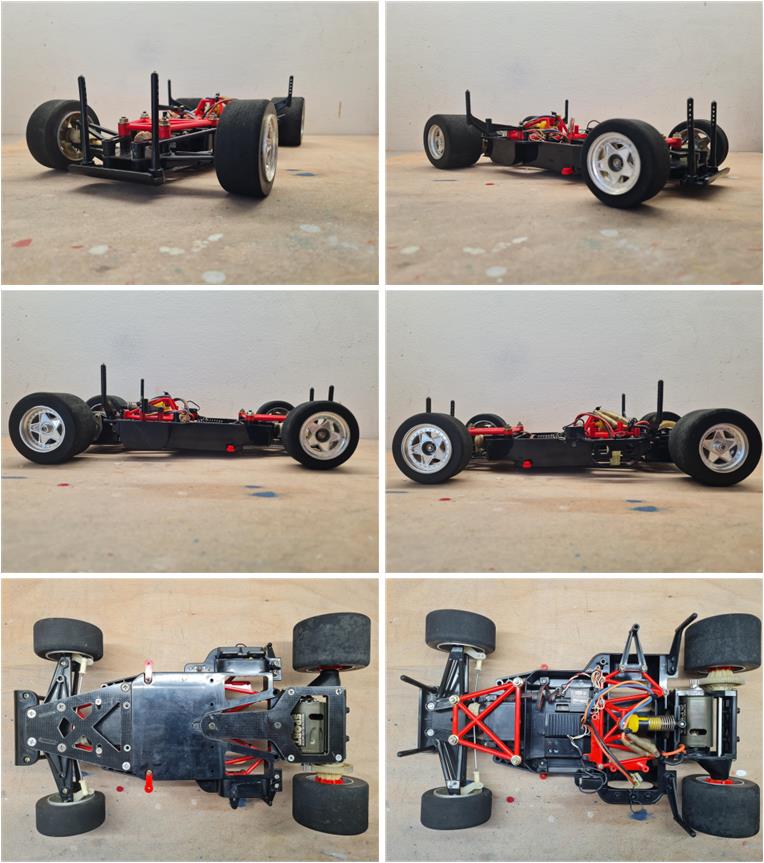
Images of the assembled chassis.
Body shell
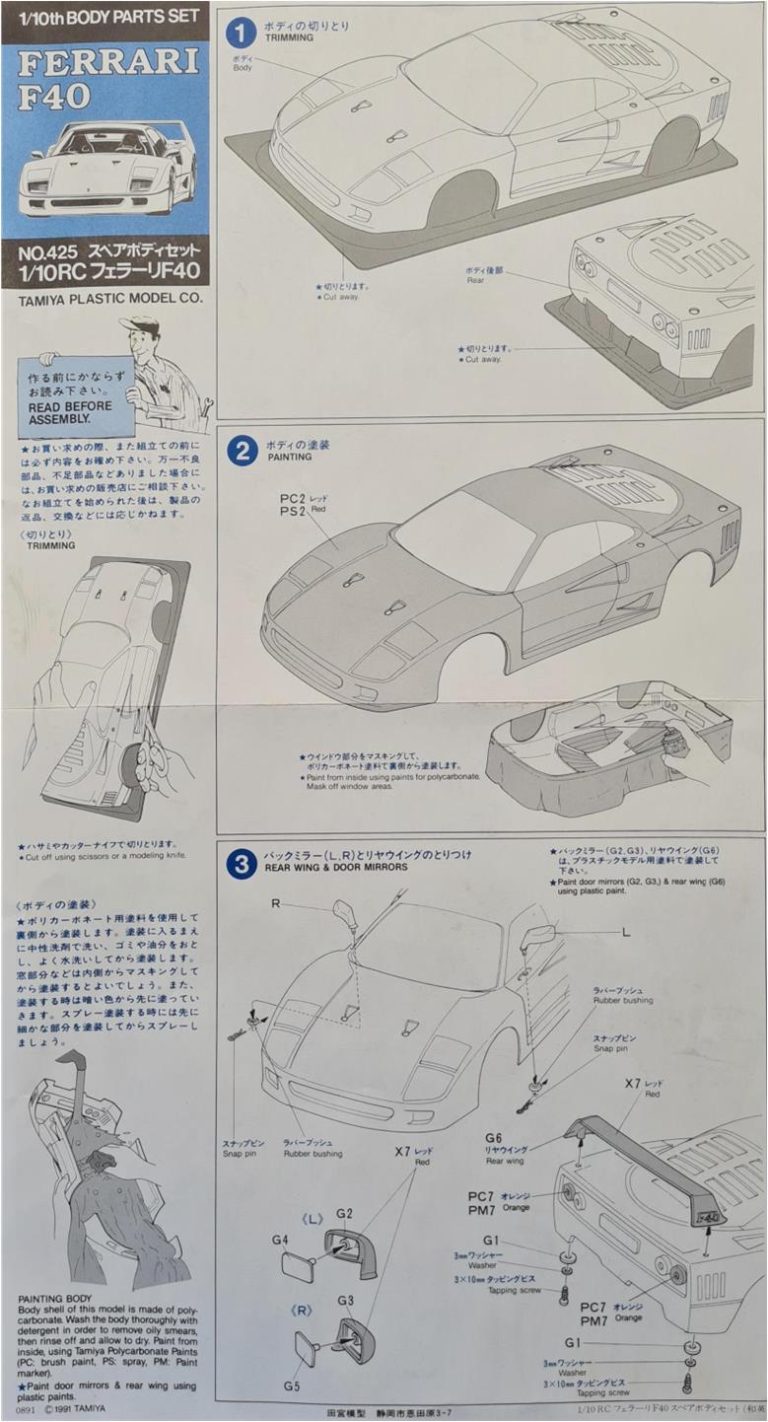
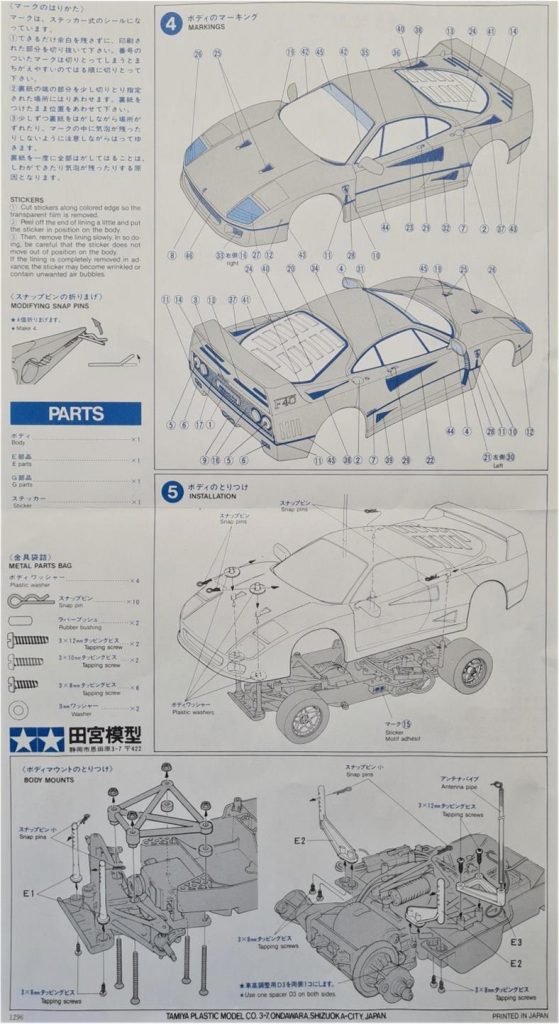
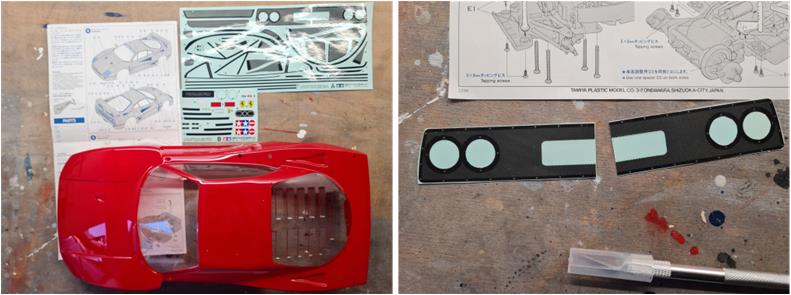
A new body shell is available, complete with decals. The body shell comes with an assembly manual and a decal‑installation manual. The parts are made of red styrene, so applying paint is not necessary. The decal manual included with the decals confirms that this is an original 1990s lot (right image in the last row).
The body‑shell manual is included.
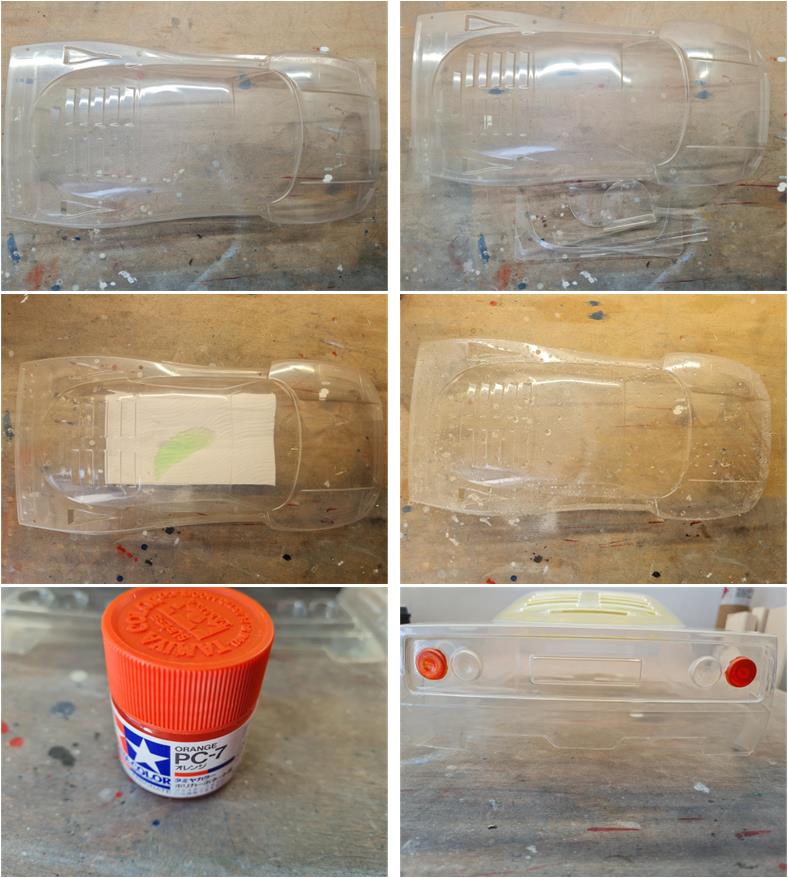
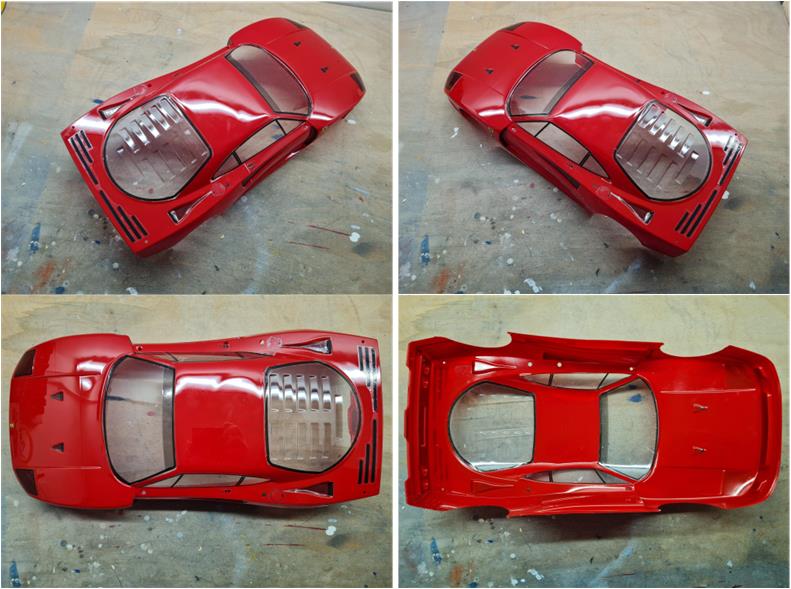
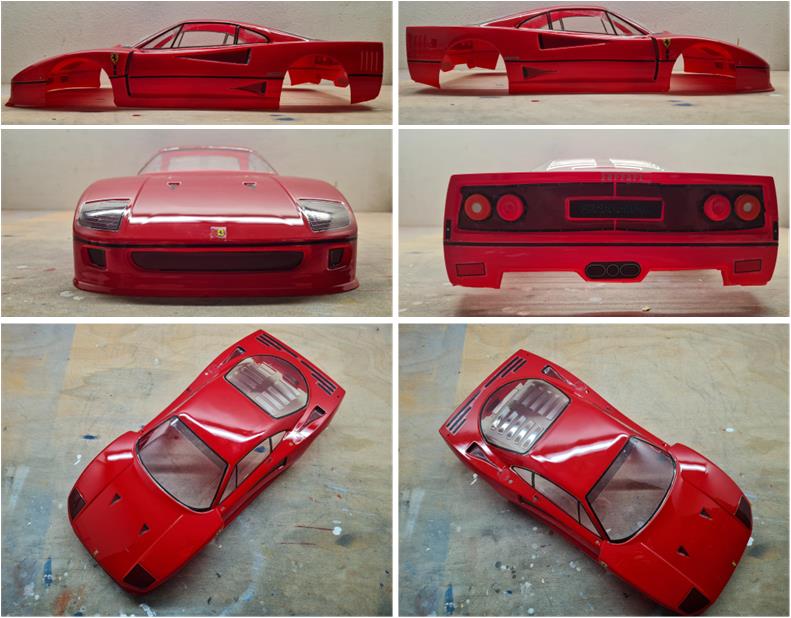
Cut away the excess parts of the body shell (images in the first row); the wheel‑arch openings are already pre‑cut, which greatly speeds up the body‑shell preparation work. The body shell is still impregnated with the oils used during its thermoforming process; wash the inside of the shell with warm water and degreasing dish soap (left image in the second row). Dry the inside with a kitchen paper towel to remove droplets that, if left to evaporate, would leave unsightly marks (right image in the second row). Apply at least two coats of PC7 orange paint to the circular rear turn signals (images in the third row).
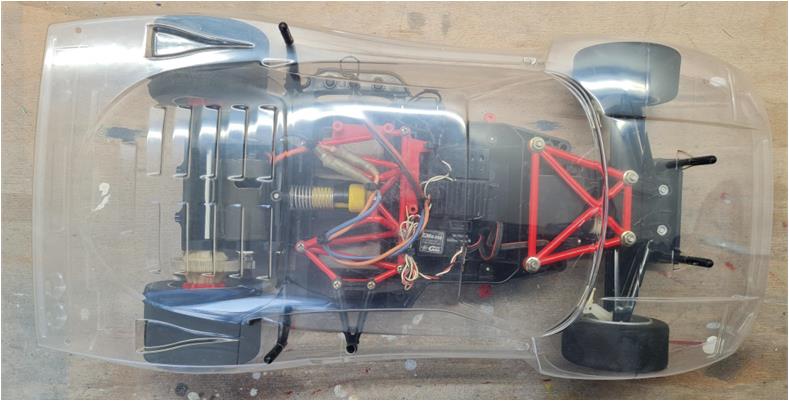
Test‑fit the body shell on the chassis.
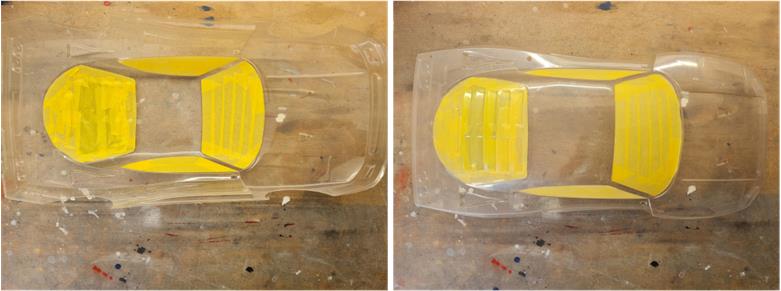
Apply the masking to the cockpit windows; the masking must be applied from the inside of the body shell. On the outside, apply pieces of painter’s tape over the holes for the four body‑mount posts, the antenna, the rear‑view mirrors and the rear spoiler.
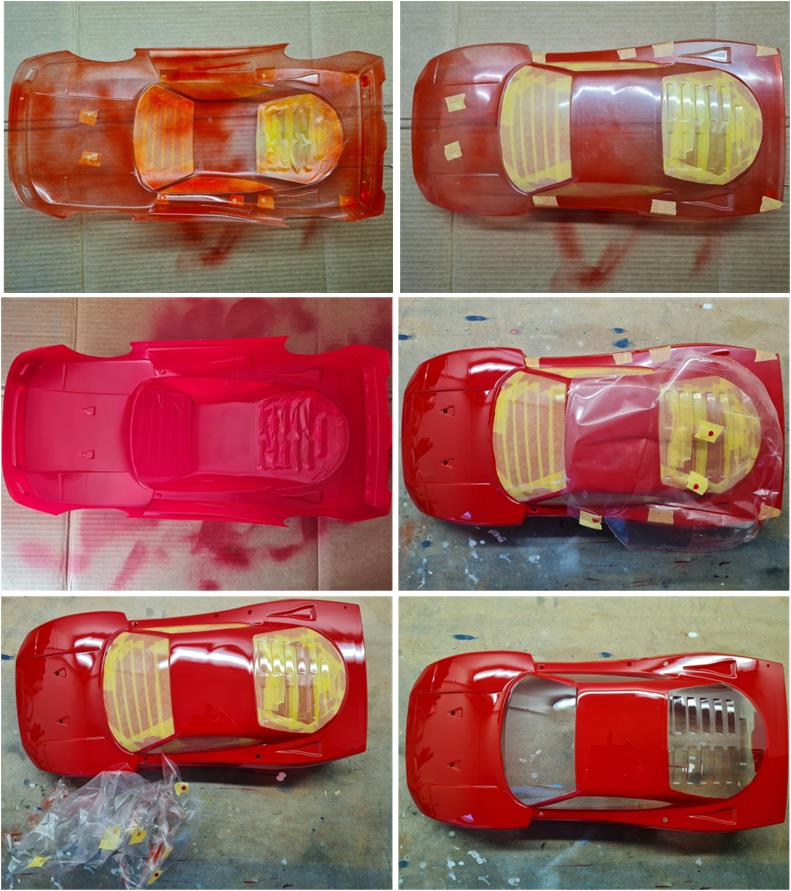
Apply the PS2 red paint from the inside, applying several light coats rather than fewer heavy ones. After applying multiple coats, you can remove the outer film and the interior‑applied window masking.
Now you can apply the decals; the most problematic one is the rear grille, where there are two circular tail lights on each side. The holes for these lights must be made with a scalpel; after doing this, it became clear that making the holes with a larger diameter would have been better.
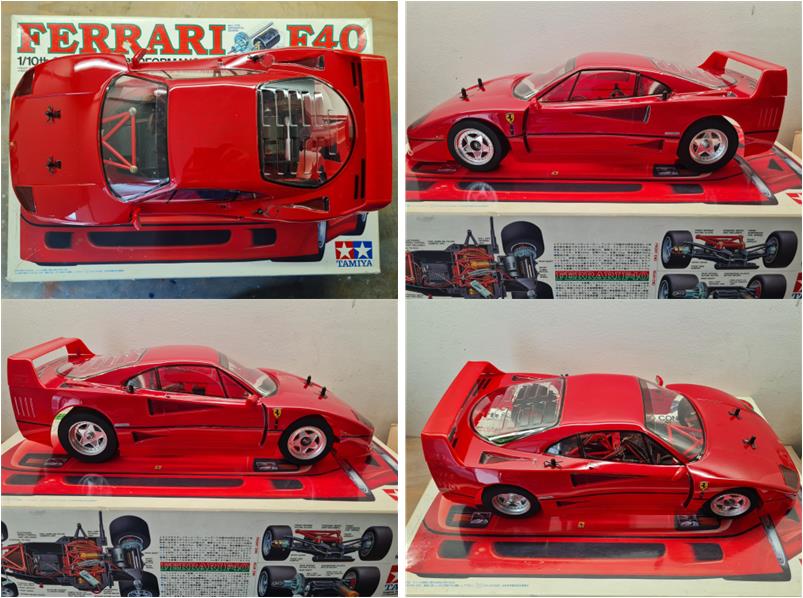
Images of the restored body shell complete with decals and accessories.
Restored model
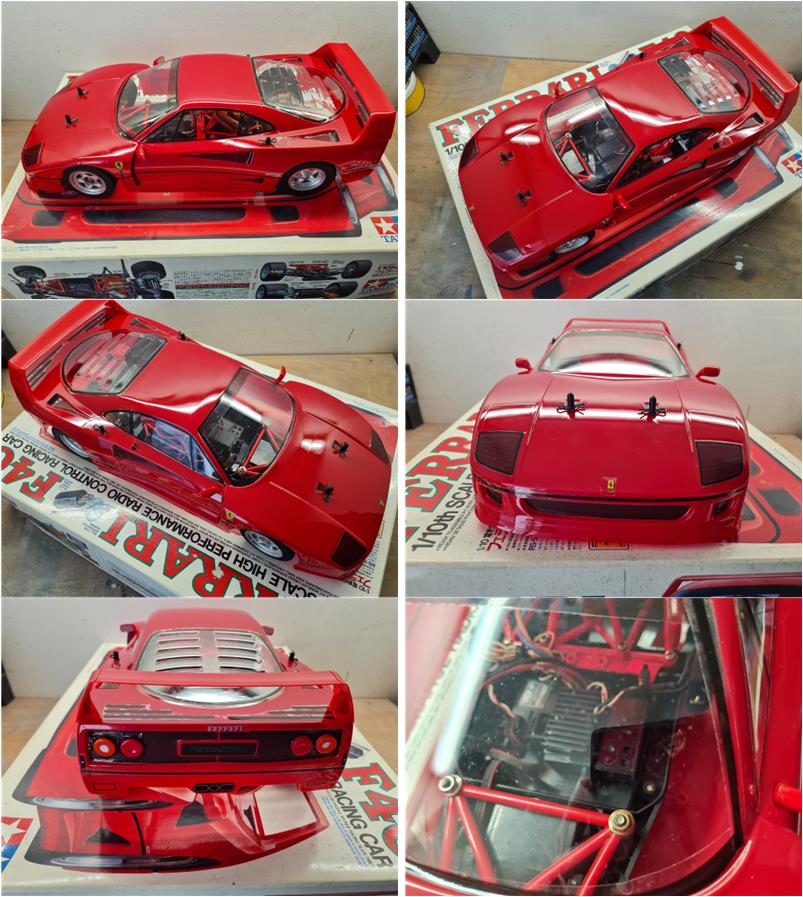
Images of the restored model.