The GB-01 chassis marks Tamiya’s return to the 1/16 scale radio-controlled buggy category. Tamiya designed and developed an entirely new chassis concept, distinct from its prior production line. Part of the GB-01 TamTech-Gear series by Tamiya, the following model is included as an assembly kit:
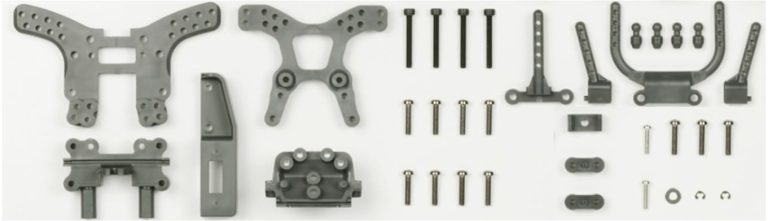
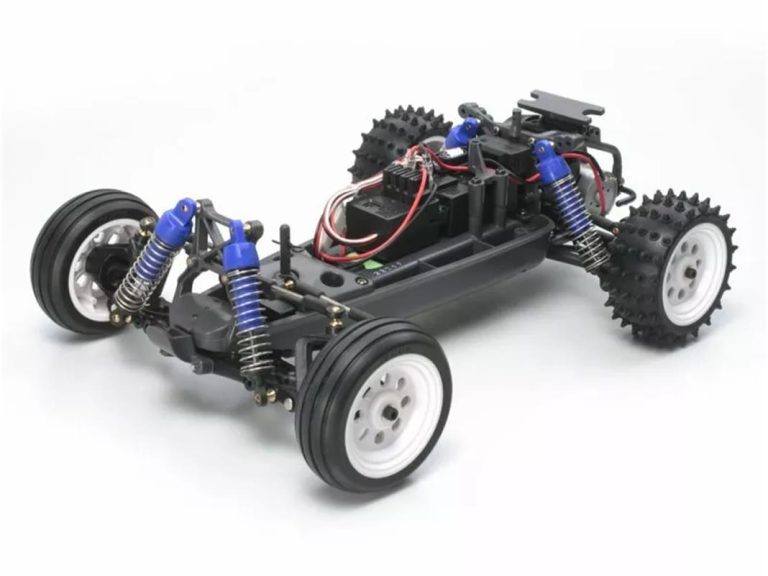
– GB-01 chassis-only version, model number 57102, released in 2007 and available on the market until 2008. Any TamTech-Gear buggy body compatible with the GB-01 chassis can be mounted on this frame. By purchasing set 40527 (referred to as “GB-01 Racing Damper Stay”; see reference images below), it is also possible to fit the GB-01 chassis with the body of the Wild Boar model, which originally comes with the GB-01T chassis. There is no equivalent set that allows installation of the Suzuki Jimny SJ30 body—originally mounted on the GB-01T chassis—onto the GB-01.
Model 57102 is the only chassis-only release within the entire TamTech-Gear product line.
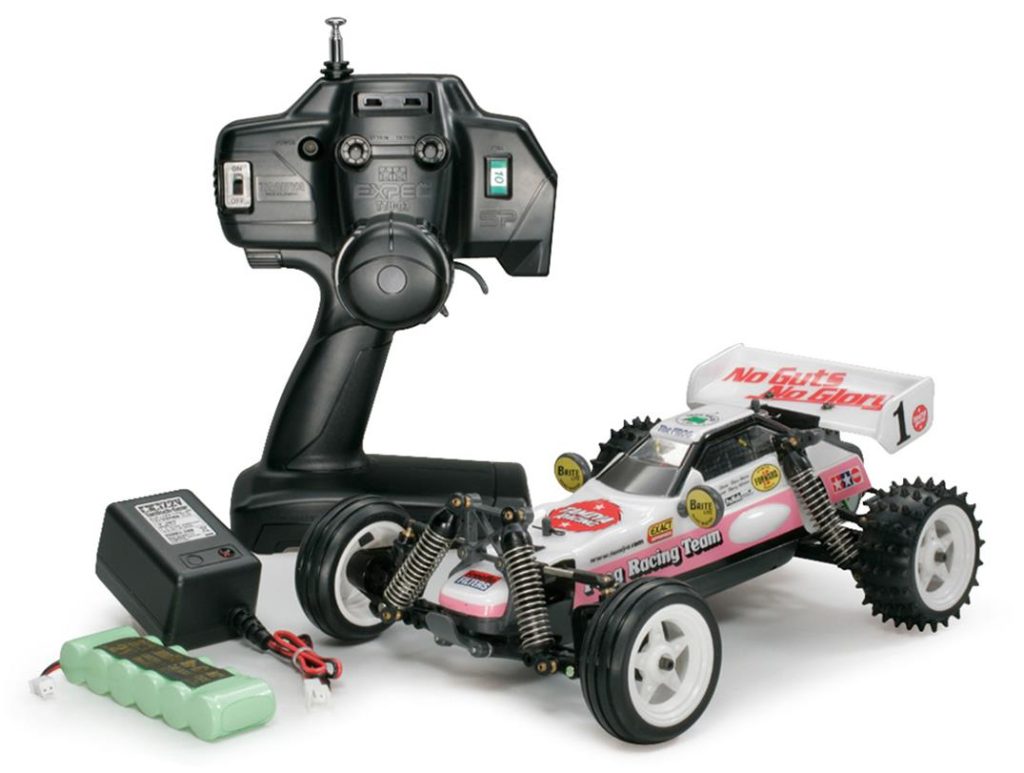
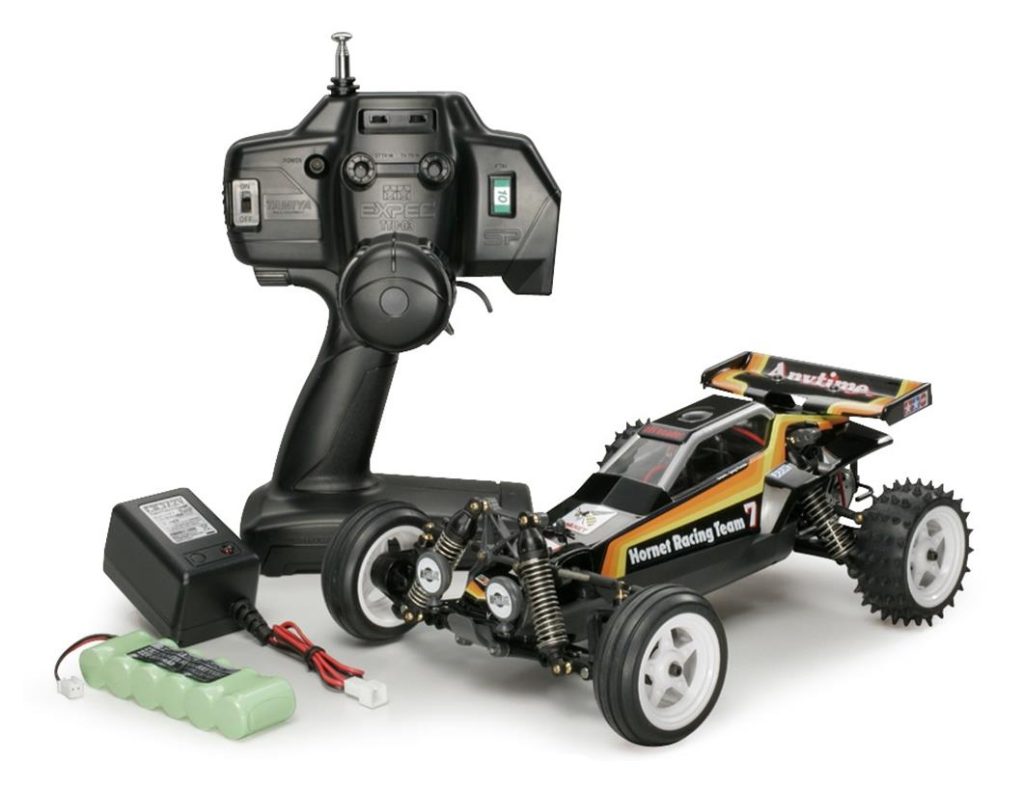
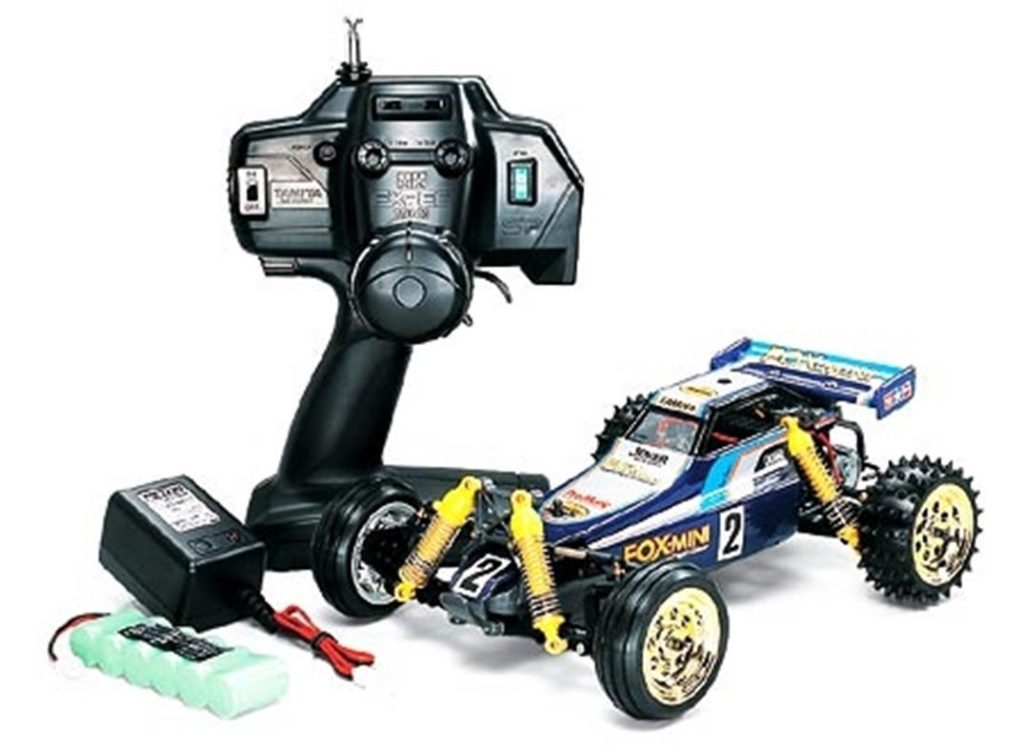
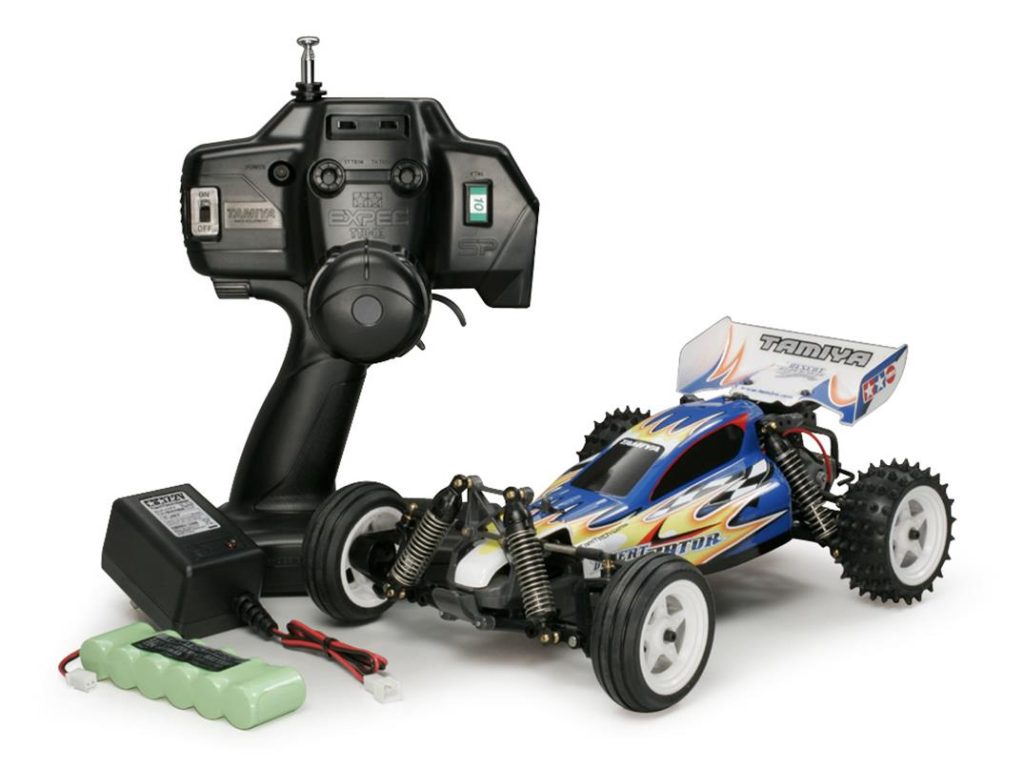
The following preassembled models are part of the GB-01 TamTech-Gear by Tamiya series. Each unit comes factory-assembled with electronics, battery and charger (the charger is mainly included for the US market and select other regions):
– The Frog Mini, model number 56701, released in 2006 and available on the market until 2007. 1/16 scale reproduction of model 58041 – The Frog – The Hornet Mini, model number 56702, released in 2006 and available on the market until 2007. 1/16 scale reproduction of model 58045 – The Hornet – Fox Mini, model number 56703, released in 2006 and available on the market until 2007. 1/16 scale reproduction of model 58051 – The Fox – Desert Gator, model number 56705, released in 2006 and available on the market until 2007. 1/16 scale reproduction of model 58344 – Desert Gator
The chassis in question is an entirely new design, with all components miniaturized for compatibility with the reduced scale, which results in longer maintenance procedures. Adequate time must be allocated to complete any operation. The chassis is composed of numerous parts, including many components not utilized in the model assembly. This suggests Tamiya planned potential future developments sharing moldings with these initial GB-01-based models. As of 2025, several variants based on the GB-01 chassis have been introduced: GB-01S, GB-01T and GB-02. The GB-03 model differs significantly from the others due to its four-wheel drive configuration.
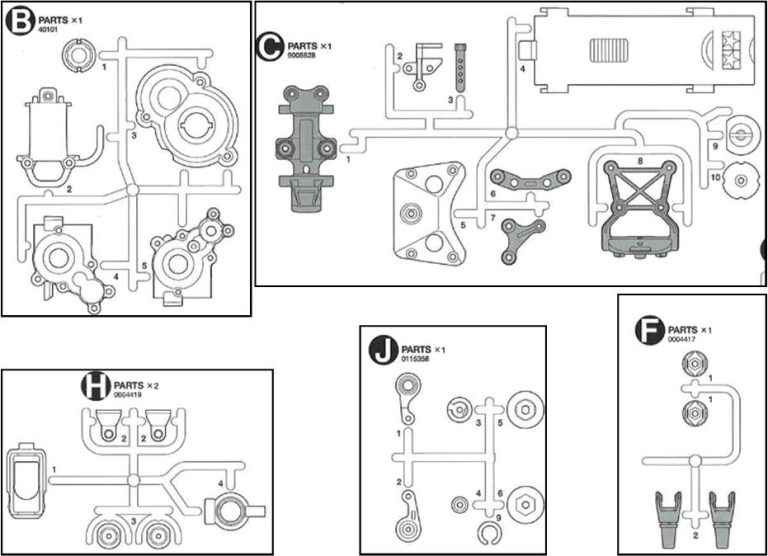
Although the GT-01project is distinct from the GB-01, it shares many components with the GT-01 chassis, which represents the on-road variant of the TamTech-Gear series. Excluding hardware and fasteners, the following parts are shared:
– Part B, code 40101 – Part C, code 0004415 (GB series), closely resembles 9005828 (GT-01 series) – Part F, code 004417 – Part H, code 004419 (two units per package) – Part J, code 0115358
Technically, the chassis includes the following features, described from rear to front:
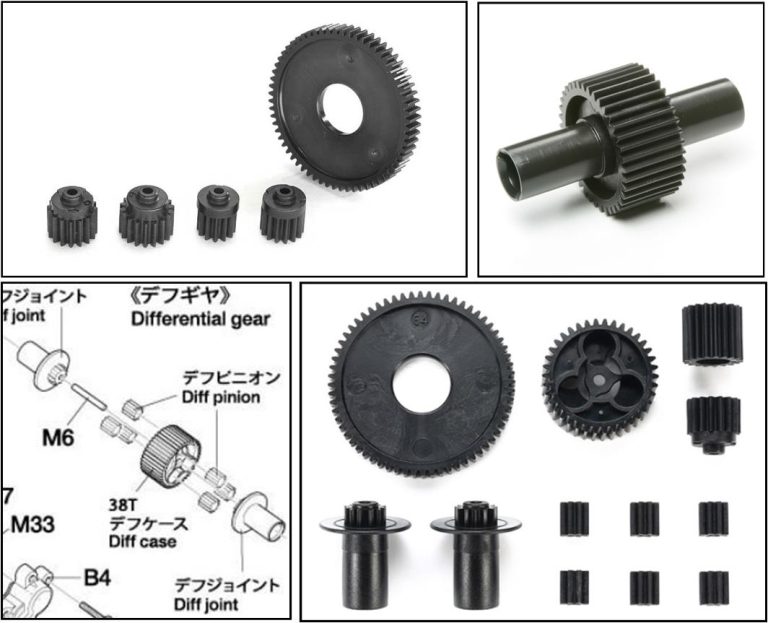
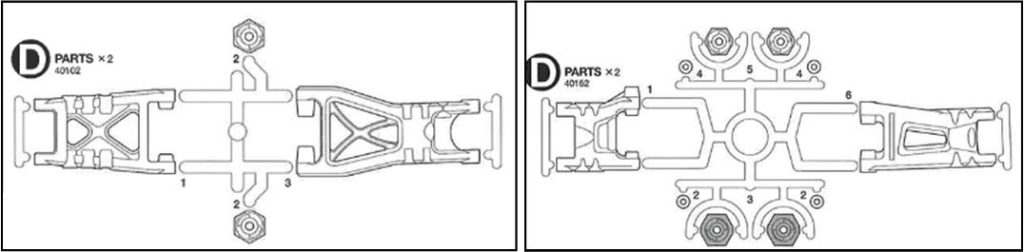
– Rear-wheel drive powered by a Type 370 motor with a Teflon pinion (refer to the factory-supplied 12, 14, 16 and 18-tooth pinions shown in the lower-left image, first row). RK370 motor specifications at peak efficiency: 10,600 RPM, torque 5.4 N·m, current draw 1.8 A. For performance enhancement, install optional part number 40537 labeled “Tamtech-Gear Sports Tuned Motor SPT” – Factory-preassembled ball differential (part number 40106; shown in the lower-right image, first row). Tamiya opted for preassembly due to the component’s small size. With the release of the GB-01S chassis, Tamiya introduced a more durable planetary gear differential, compatible with the GT-01 chassis. This updated differential is listed under part number SP-1685 or 51695 and labeled “Tamtech Gear GB-01S Spare Gear” (highlighted in the lower image, second row)
– Drivetrain equipped with an anti-hop slipper clutch. The slipper clutch consists primarily of two disks kept in contact by a spring preloaded with a bolt. The slipper clutch serves two functions to compensate for the lack of traction between surface and wheels. The first function is to protect the drivetrain during jumps. While airborne, the model’s drive wheels spin freely without ground resistance and tend to increase rotational speed. During long jumps, the motor’s RPM is modulated by the operator to control flight attitude and landing angle. In both scenarios, upon touchdown, the wheel speed must suddenly match the model’s actual ground speed, causing a rapid shift in RPM. This exerts significant stress on the drivetrain gears.
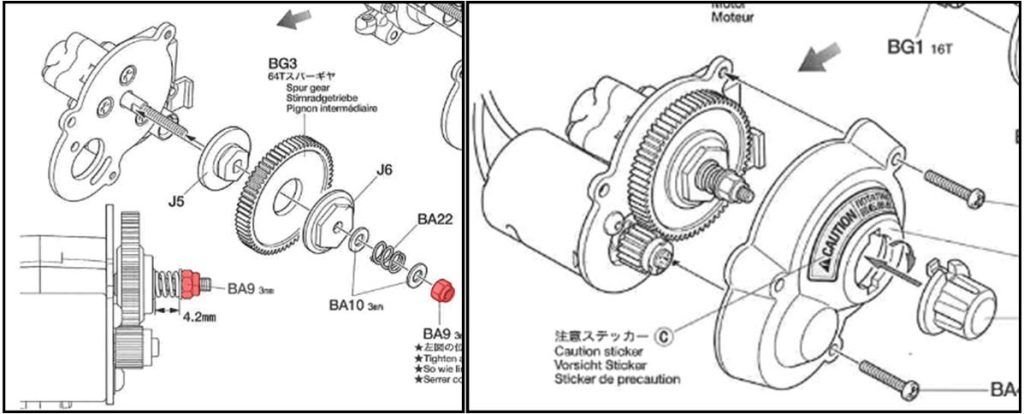
The second function of the slipper clutch is to prevent premature gear wear when the motor, during sudden acceleration, increases its rotational speed faster than the wheels can respond. The same occurs during abrupt deceleration. The clutch maintains traction and prevents unnecessary stress on the drivetrain components. This dual role protects the transmission assembly, where the motor pinion is subjected to the highest mechanical load. To achieve optimal performance, clutch slip must be adjusted via the tuning nut (labeled “BA9” and highlighted in red in the upper-left image). Follow the instructions by compressing the spring to a total length of 4.2 mm, establishing an initial clutch engagement setting. Place the model on a flat surface, power on the electronics, lock the rear wheels by hand and briefly engage the throttle. There are two outcomes:
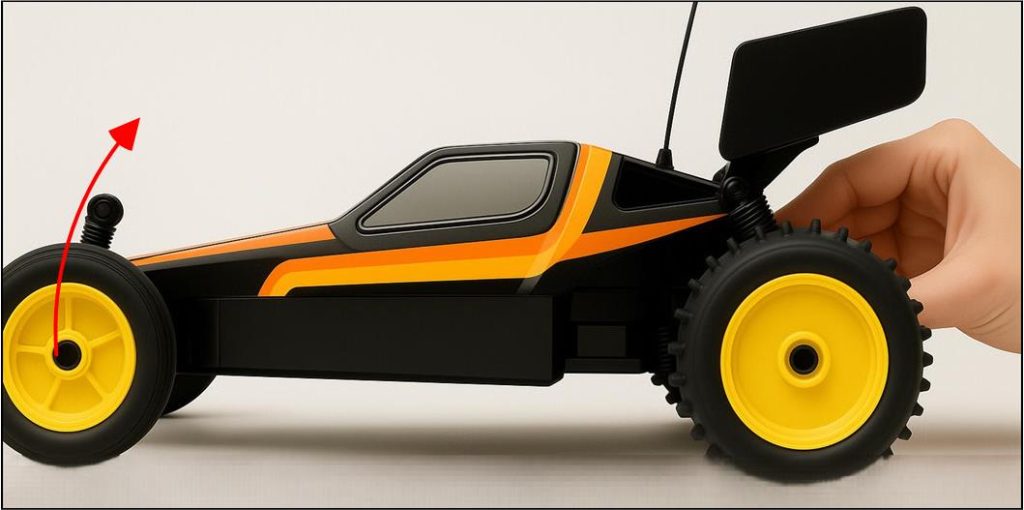
– The model attempts to move and the front end lifts off the surface (following the red line in the image below) – A sound is heard from the gearbox, indicating clutch engagement and the front end remains in contact with the surface
The image illustrates a hand holding the rear wheels stationary and the expected front axle movement upon throttle input (highlighted by the red arrow).
The optimal slipper clutch setting is achieved when the nose and front wheels slightly lift off the surface; this serves only as a baseline. The ideal adjustment depends on track surface conditions and traction levels, requiring tuning accordingly. The two worst configurations represent adjustment extremes: an over-compressed spring or an overly loose one. In the first case, the gears are rigidly coupled to the drive axle, rendering the clutch ineffective. In the second, the spring is too loose to transmit any motion to the wheels, preventing the model from moving. Tamiya’s first slipper clutch, designated TTC (Tamiya Torque Control), was engineered for the Super Astute, introduced in 1991.
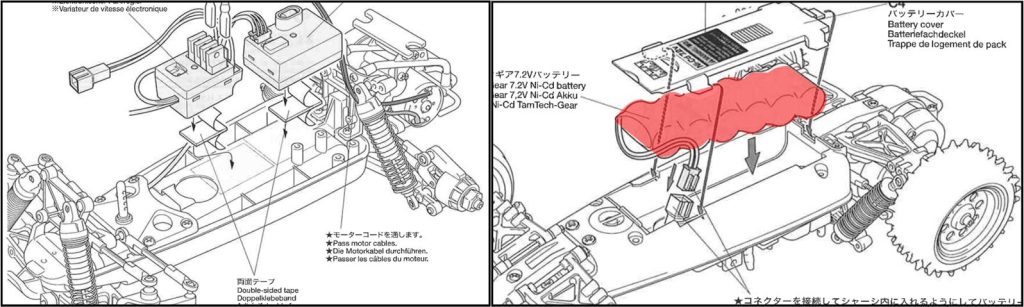
– Driveshaft with full ball bearings to reduce friction, thereby increasing system efficiency and extending run times – Central bathtub-type chassis providing low overall weight and reduced center of gravity. The chassis includes a battery compartment accessible from the underside (see image below with batteries highlighted in red). The GB-01 series bathtub chassis differs from that of the GT-01.
– Four-wheel independent suspension system with four shock absorbers, either CVA oil-filled or spring-type depending on the specific model. The suspension arms are significantly longer than those on the GT-01 chassis, accounting for the width difference between the two platforms: 168 mm for the GT-01 chassis (shown on the right in the image below) and 181 mm for the GB-01 chassis (shown on the left in the image below).
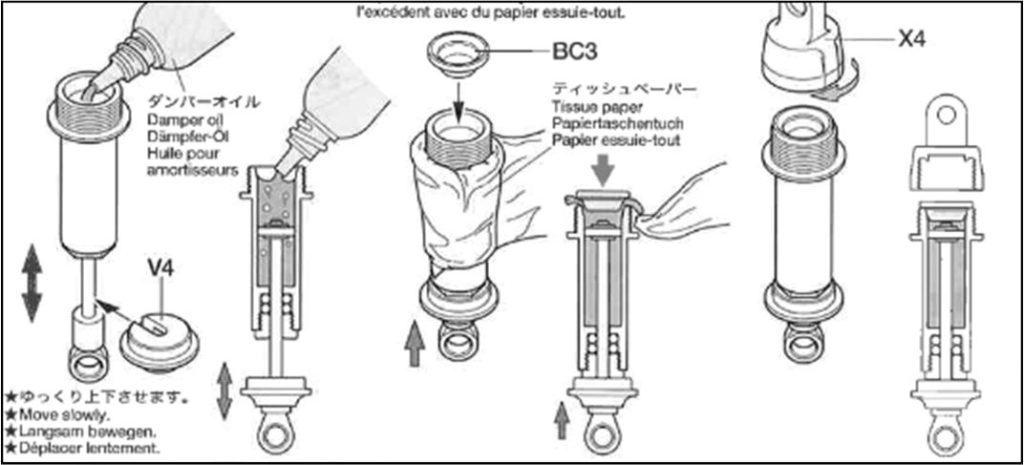
The shock absorbers are a downsized pair of those used in 1/10 scale models. The Fox Mini is equipped with yellow spring-type dampers; the Hornet Mini, Frog Mini and Desert Gator come with black spring-type dampers. The GB-01 chassis-only kit, model number 57102, is supplied with blue CVA dampers (see image below, accessory code 40529); however, in some promotional magazine photos and on the product box image, it is shown with black CVA dampers. Two performance upgrade options are available for replacing the factory-installed spring dampers:
– Set number 40529, labeled “TamTech-Gear CVA Damper Set (4 Pcs.)” – Set number 40513, labeled “GB-01 Aeration Oil Filled Damper (4 Pcs.),” offering the highest performance level.
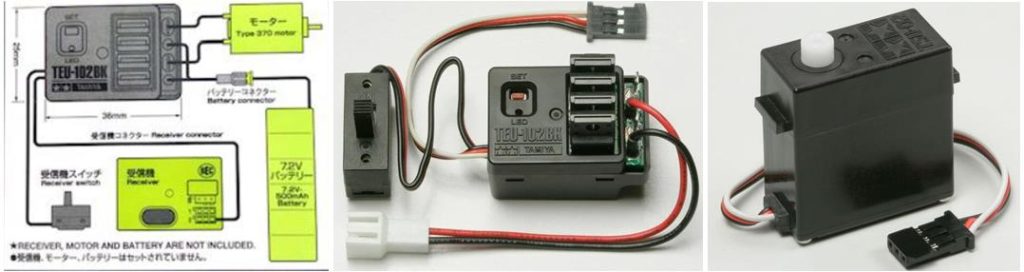
– Various clear Lexan bodies are available, all precisely molded to replicate models from the 58xxx series. – Most screws used in models with the TamTech-Gear GB-01 chassis feature M2.6 threading. – Tamiya recommends installing the same electronics in kit-assembled models as those included in factory-ready models. The radio system operates on AM 27MHz technology and includes the Expec SP TTU-03 transmitter (part number 17254324 or 7254324) and the TRU-02 receiver (part number 45036). The onboard electronics consist of the TSU-02 servo and the TEU-102 BK ESC (reference image sourced from box packaging). As of 2025, these components are no longer available on the market. Note: The TEU-102 BK lacks a “cut-off” function and is therefore unsuitable for LiPo battery usage. Since LiPo batteries must not be fully discharged, it is advisable to replace the electronic speed controller if using modern battery technology.
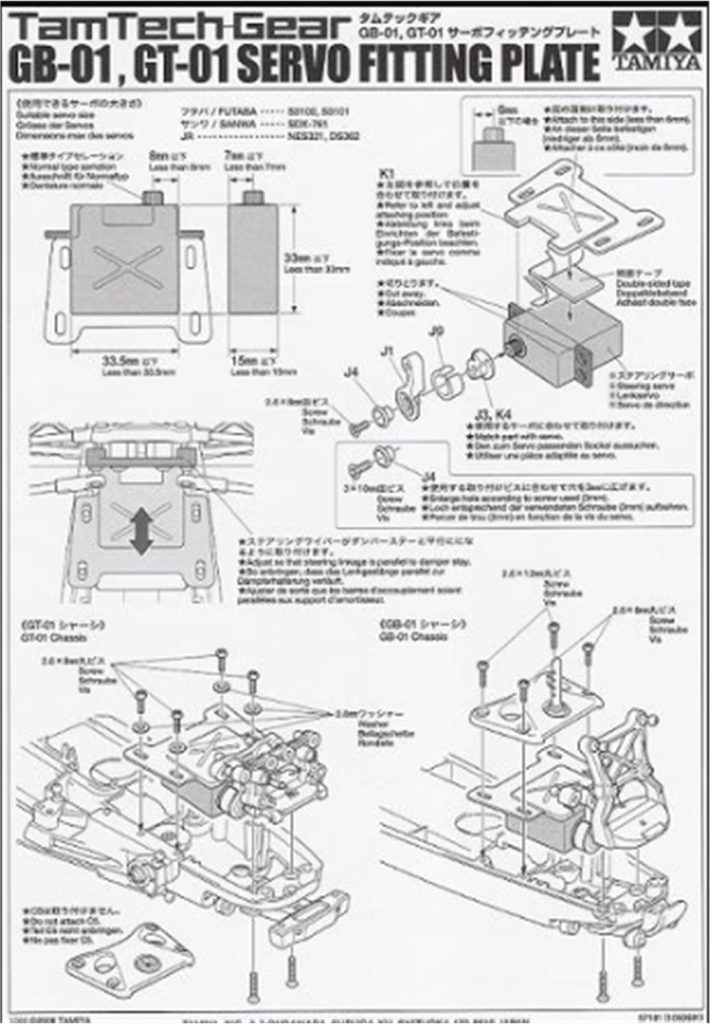
The manual includes a dedicated section illustrating how to install an alternative steering servo (refer to image below). This installation sheet is not always provided with factory-assembled models but is consistently included in assembly kits. Tamiya specifies that the servo must be of mini size, with a head measuring less than 8 mm from the short side and less than 7 mm from the long side. An approved list of compatible alternative servos includes: Sanwa SDX-761; Futaba S3102 and S3101; and JR NES321 and DS362. The image below shows the supplementary instruction sheet titled “Servo fitting plate” for GT-01 and GB-01 chassis. This plate is not included in factory-assembled models.
List of optional parts designed to enhance performance or components not included in the factory GB-01 kit; some accessories are shared with the GT-01 platform and other GB-01xx series:
– 40513: GB-01 Aeration Oil Filled Damper (4 pcs) – 40514: GB-01 Sport Tuned Motor (equivalent to RK-370-SD-3265); technical specs at maximum efficiency: 15,000 RPM, 6.8 N·m torque, 2.1 A current draw. Identified by black rear housing. Also available as 54919 “Torque Tuned Motor” – 40515: GB-01 Bumper Set – 40516: GB-01 Aeration Oil Damper Maintenance Kit
– 40517: GB-01 Carbon Damper Stay (Front) – 40518: GB-01 Carbon Damper Stay (Rear) – 40519: TamTech-Gear Setting Spring Set (Short) – 40520: GB-01 Aluminum King Pins (pink color)
– 40522: GB-01 Aluminum King Pins (blue color) – 40523: GB Wheel Bolt/Collar Set (blue color) – 40524: 2.6 x 29 mm Aluminum Turnbuckle Shaft (6 pcs, blue color) – 40525: GB-01 Aluminum 4 mm Ball Connectors (blue color)
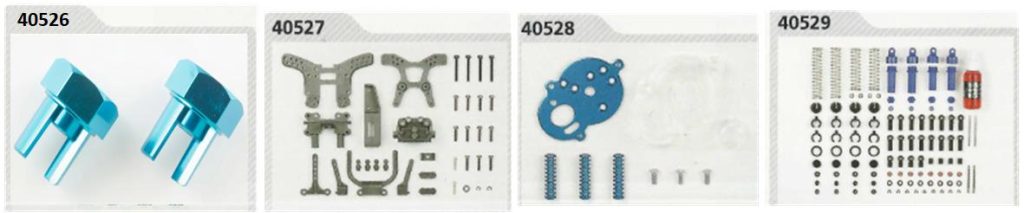
– 40526: GB-01 Aluminum Wheel Hub (blue color) – 40527: GB-01 Racing Damper Stay (converts a GB-01 chassis into a GB-01T chassis) – 40528: GB-01 Aluminum Motor Plate (blue color) – 40529: TamTech-Gear CVA Damper Set (4 pcs.)
– 40530: TamTech-Gear Low Friction O-Ring Set for Oil-Filled Dampers – 40537: TamTech-Gear Sports Tuned Motor SPT (equivalent to RK-370-SD-4045); technical specs at maximum efficiency: 21,000 RPM, 7.7 N·m torque, 3.3 A current draw. Identified by red rear housing. Also available as 54860 “Sport Tuned Motor”; highest performance among catalog options – 40538: Aeration Damper Attachment Bolt (4 pcs) – 40539: Aeration Oil-Filled Damper Short Case (2 pcs)
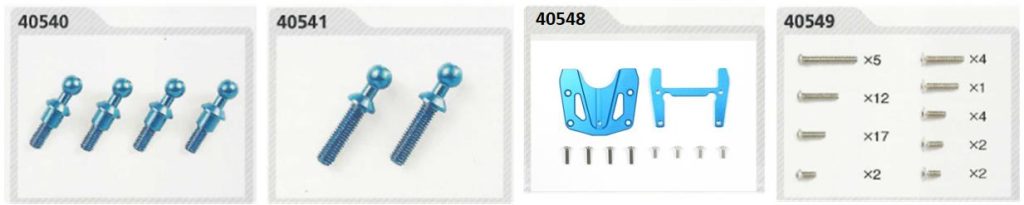
– 40540: 4 x 3 mm Aluminum Step Ball Connector (4 pcs, blue color) – 40541: 4 x 10 mm Aluminum Ball Connector (2 pcs, blue color) – 50548: Aluminum Front Upper Plate for GB-01, GB-01T, GB-02, GT-01 (blue color) – 40549: GB-01 Titanium Screw Set
These reduced-scale models are ideal for indoor use; however, the stock rear knobby tires and front sand tires do not provide optimal grip on smooth surfaces. Several alternative tire options offer improved traction on such surfaces. The first option is to use tires from the GB-02 TamTech Buggy Champ chassis, which are compatible with GB-01 wheels:
– Set number 40155: GB-02 Front Tires (factory-installed on the GB-02 chassis) – Set number 40156: GB-02 Rear Tires (factory-installed on the GB-02 chassis)
Alternatively, the same tires are available with foam inserts to stiffen the sidewalls:
– Set number 40542: GB-02 Front Tires (with foam inserts) – Set number 40543: GB-02 Rear Tires (with foam inserts)
These tires are compatible with the following rims:
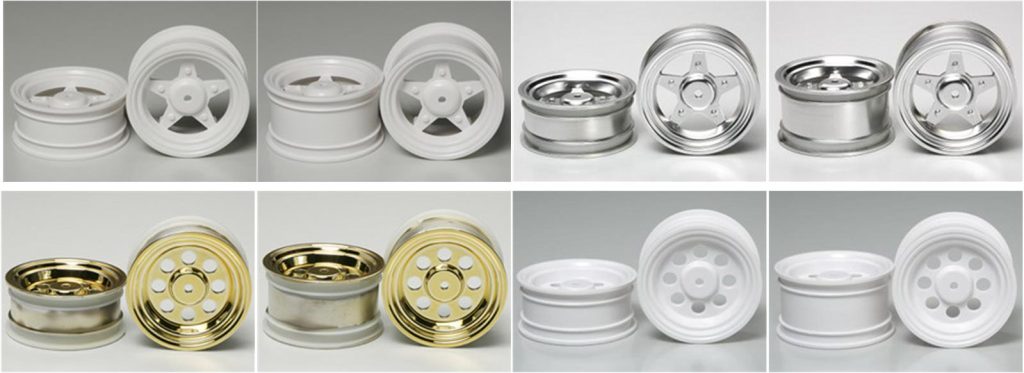
– Set number 40109: White front wheels factory-installed on The Frog Mini, The Hornet Mini and Desert Gator – Set number 40110: White rear wheels factory-installed on The Frog Mini, The Hornet Mini and Desert Gator – Set number 40552: Chrome-plated front wheels, equivalent to 40109 in chrome finish; accessory item not factory-installed on any model – Set number 40553: Chrome-plated rear wheels, equivalent to 40110 in chrome finish; accessory item not factory-installed on any model – Set number 40133: Gold-plated front wheels factory-installed on The Fox Mini – Set number 40134: Gold-plated rear wheels factory-installed on The Fox Mini – Set number 40160: White front wheels available in GB-01 chassis-only kit, item number 57102 – Set number 40161: White rear wheels available in GB-01 chassis-only kit, item number 57102
The second solution is to purchase one of the tire and wheel sets that Tamiya has released to complete the Buggy line based on the GB-01T chassis used by the Wild Boar and Suzuki Jimny SJ30:
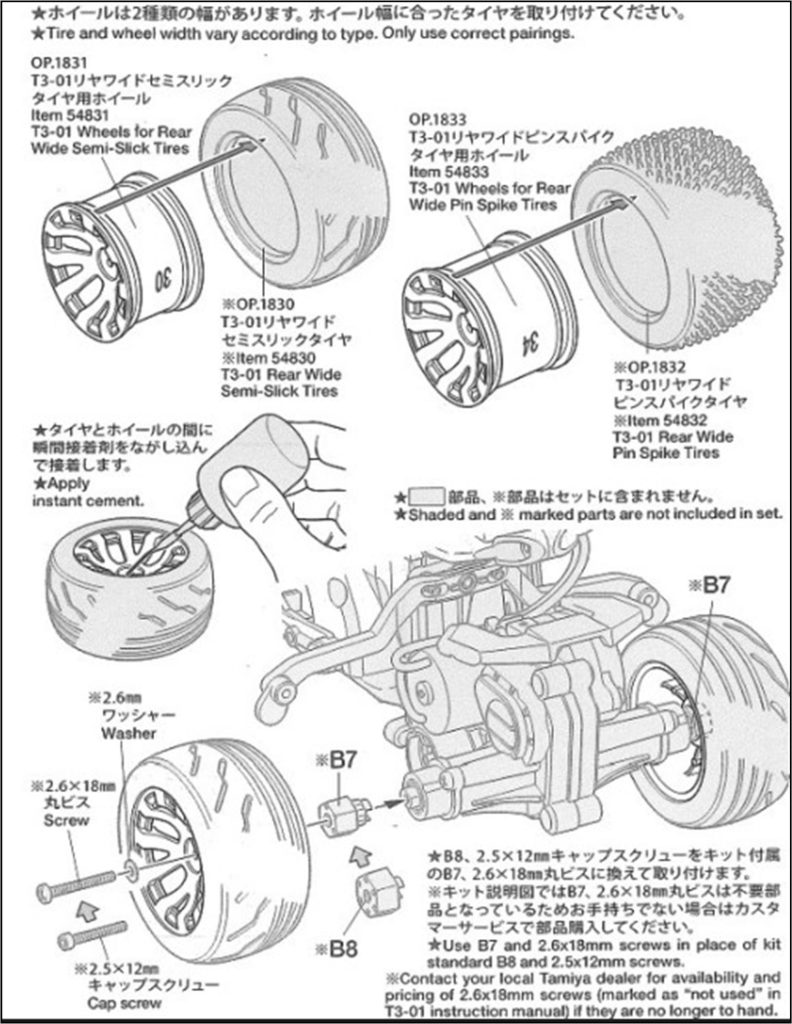
– Set number 40137: GB-01T Wild Boar front wheels (also available as set number 54831), to be paired with – Set number 40139: GB-01T Wild Boar front tires (also available as set number 54830) – Set number 40138: GB-01T Wild Boar rear wheels (also available as set number 54833), to be paired with – Set number 40140: GB-01T rear tires (also available as set number 54832)
GB-01T wheels significantly improve grip on smooth surfaces thanks to their greater width and diameter compared to the standard GB-01 wheels. Note: these tires are specifically designed to fit GB-01T rims and are not compatible with the stock GB-01 wheels.
The third solution is to use wheels from 1/10 scale models. The package includes 12 mm hex hubs that allow the installation of rims from larger models. There is a substantial difference: the axle hole of 1/10 scale rims measures 4 mm, whereas the axle hole of 1/16 scale model rims measures 2.6 mm. Installing 1/10 scale wheels and rims on TamTech-Gear models is mechanically feasible, but it is important to select wheels and rims that are not excessively large and stay close to the original dimensions: front wheels 21 mm wide and 61 mm in diameter, rear wheels 26 mm wide and 64 mm in diameter. Oversized wheels and rims are heavier and strain the suspension, gears and motor, making the model harder to control and reducing maneuverability. This solution will inevitably shorten the life of various components due to increased wear on the small-scale model. The fourth solution would be to install rims and tires from the GT-01 chassis, but these are smaller than the stock wheels. As a result, the model becomes slower and less agile.
Tamiya, original figure, box art, guide book and catalogue are of TAMIYA INC, which does not endose or sponsor www.tamiyaclassic.com. Any brands, logos and trademarks represented on this website are the copyright of their respective owners.