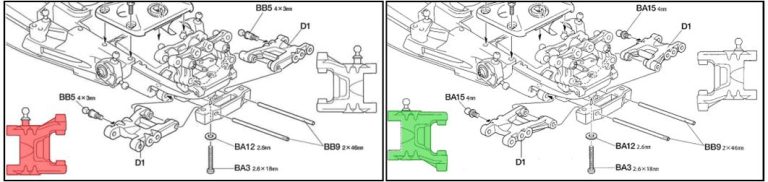
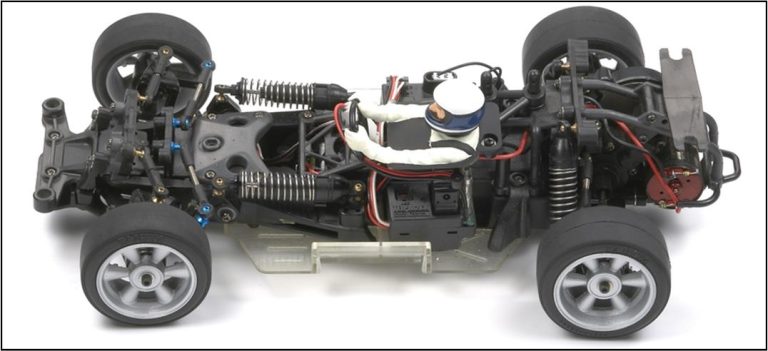
The GT-01 chassis marks Tamiya’s return to the world of 1/12 scale on-road radio-controlled cars. Tamiya has designed and developed an entirely new chassis that represents a clean break from all previously developed production. This chassis is engineered in two versions that differ only in wheelbase, which can be changed simply by reversing the installation orientation of the front suspension arms. The long-wheelbase installation is highlighted in red on the left in the image below, while the short-wheelbase installation is highlighted in green on the right in the image below.
The following assembly models are part of the GT-01 Tamteck Gear By Tamiya family:
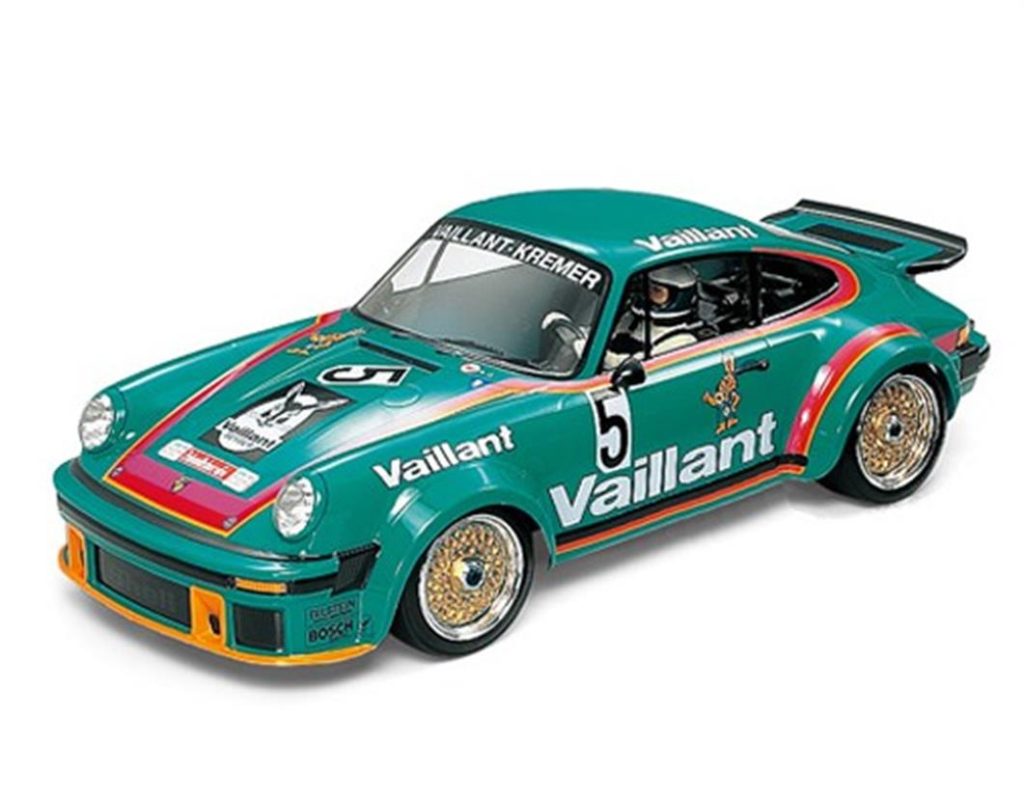
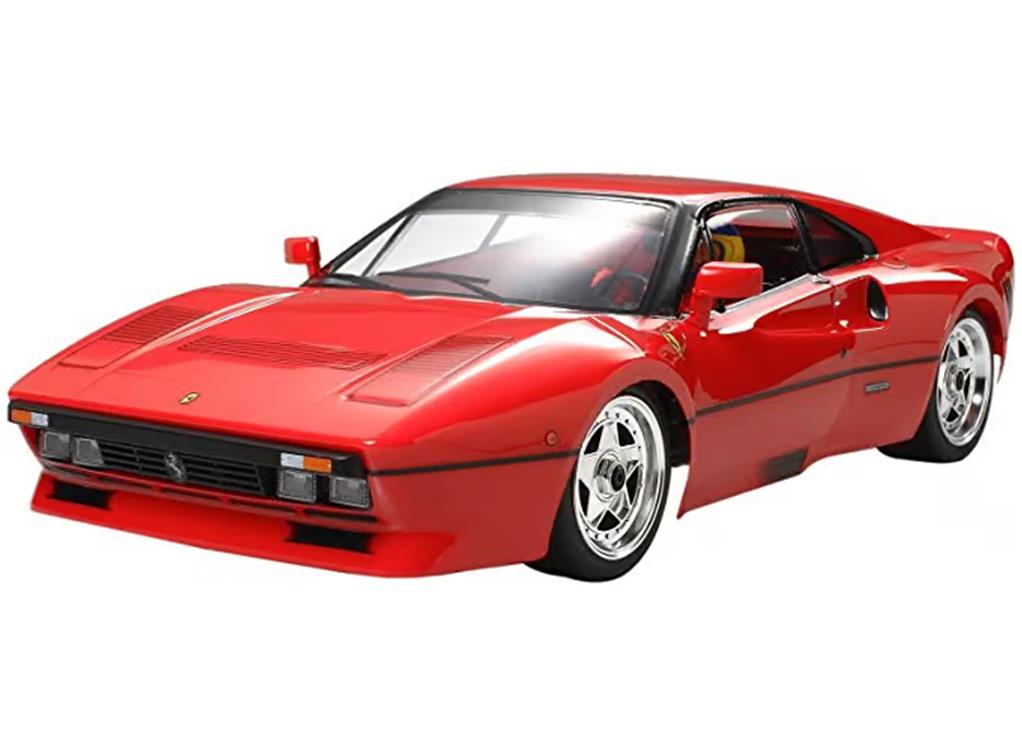
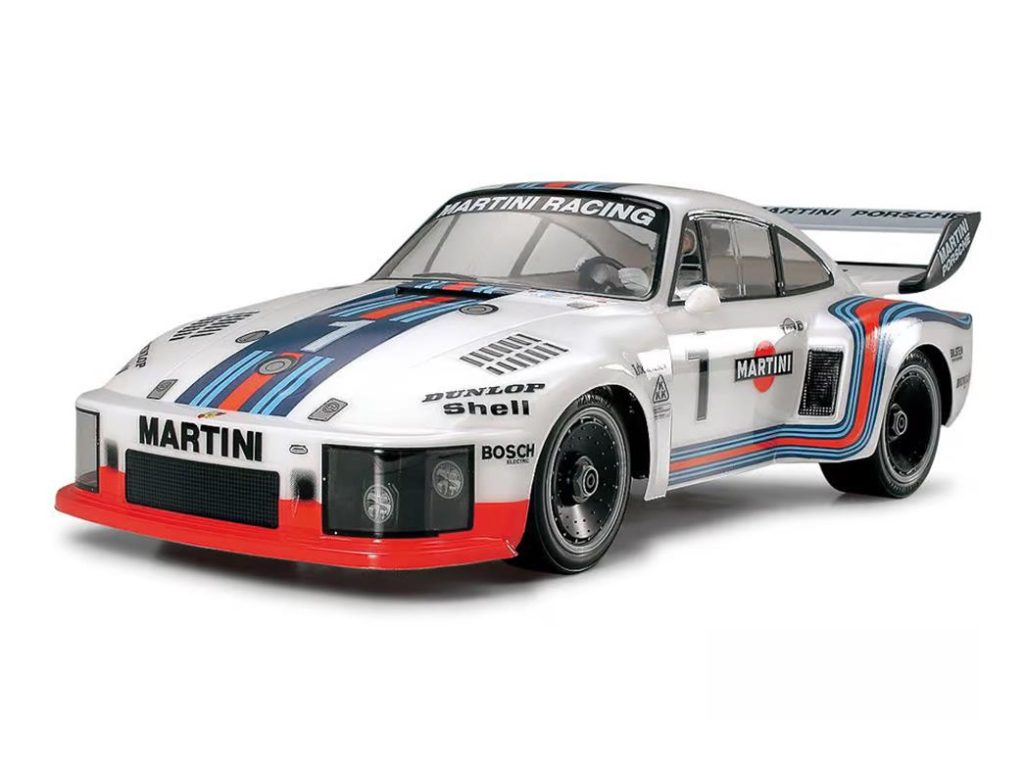
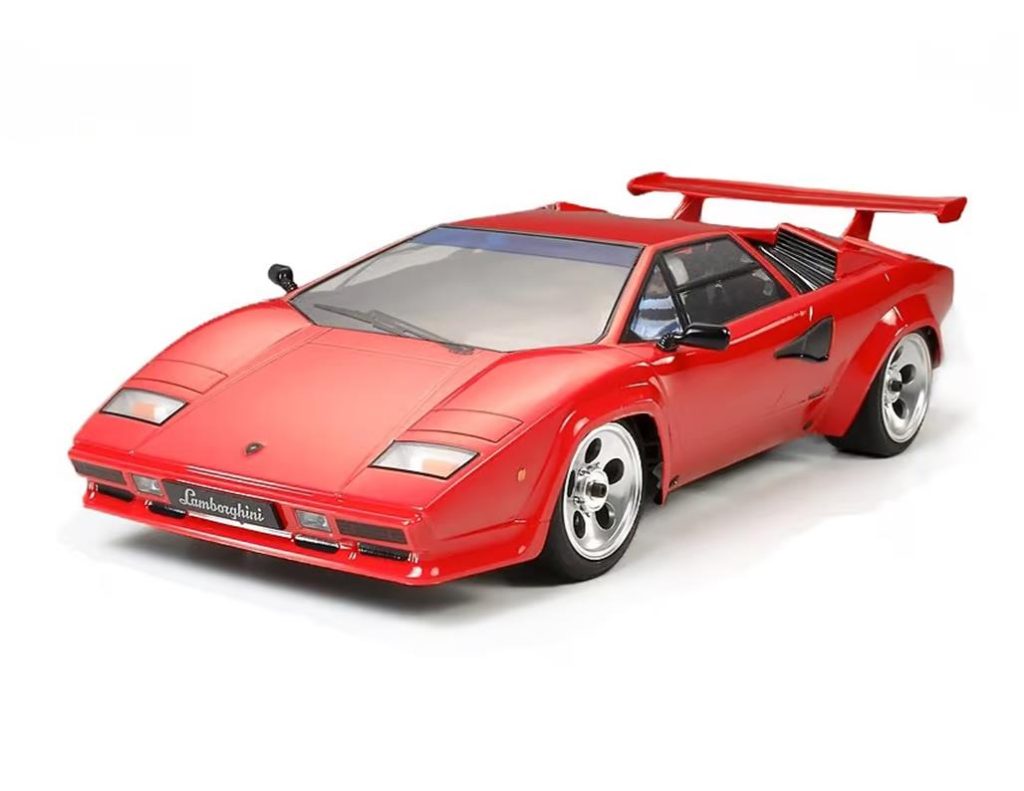
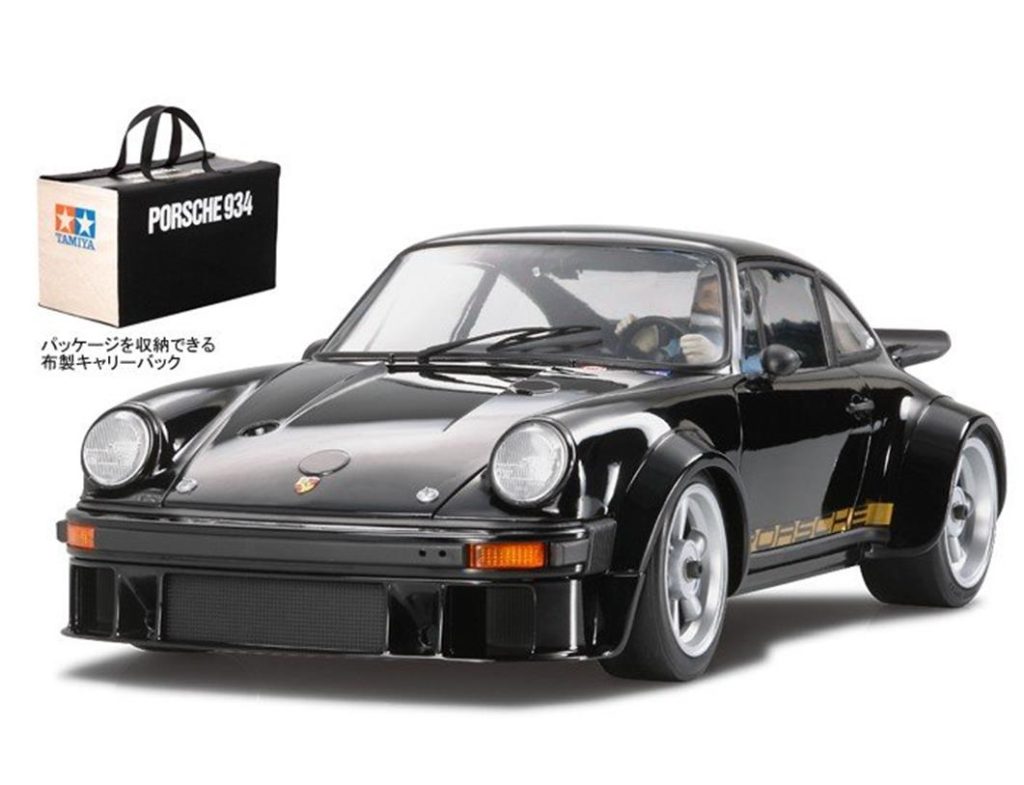
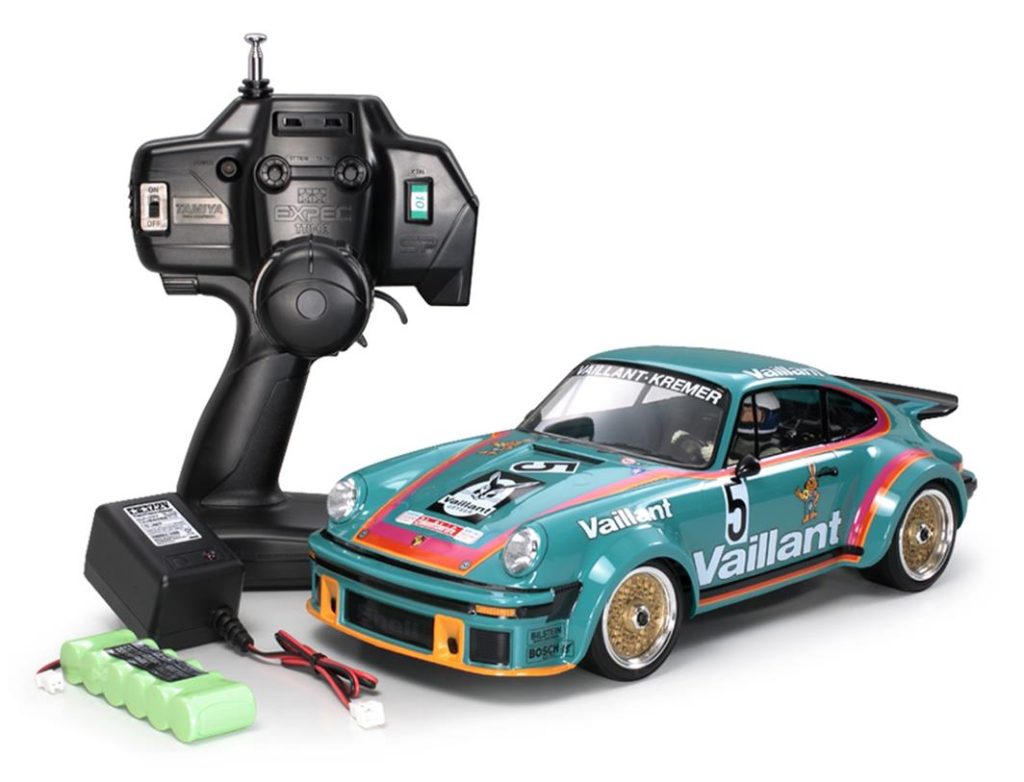
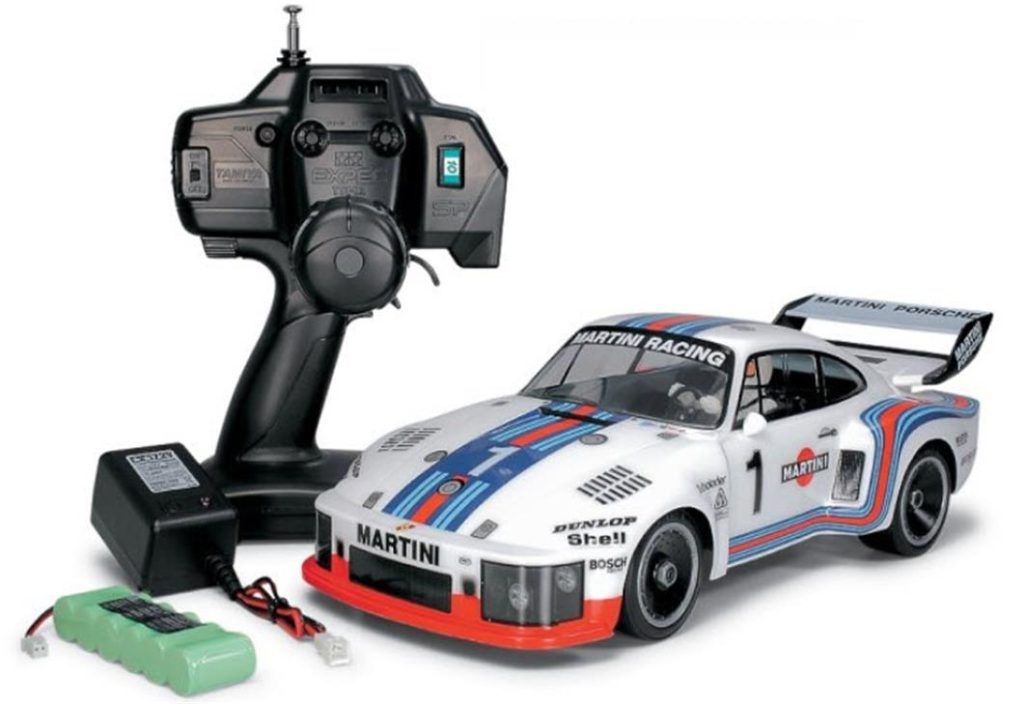
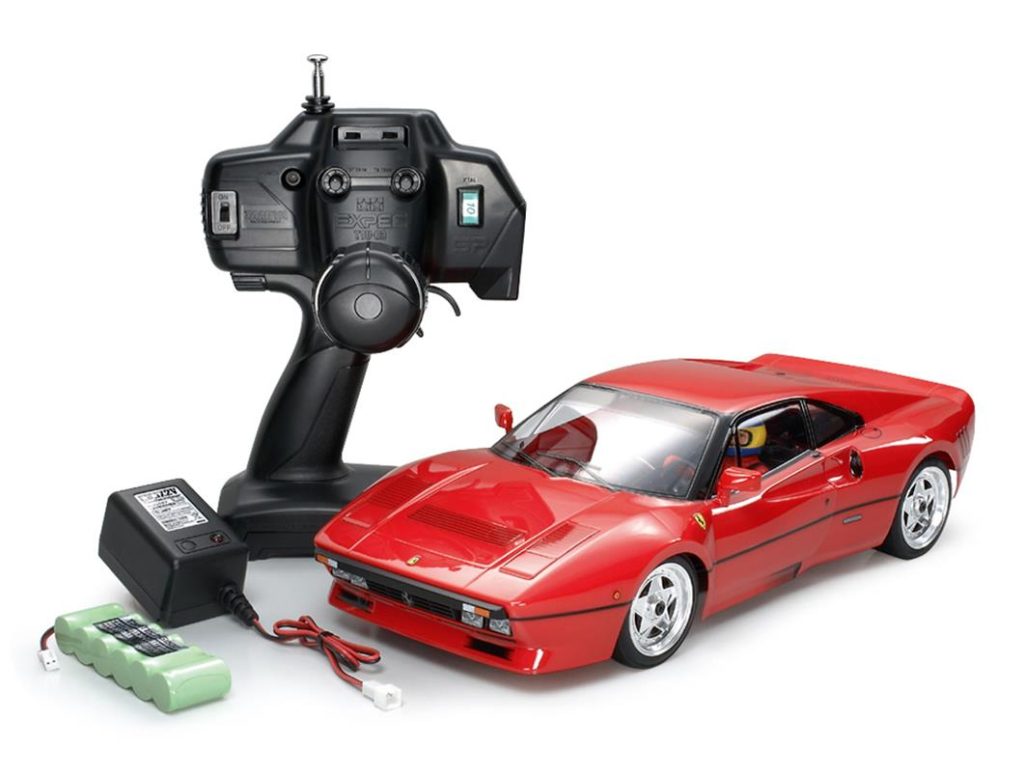
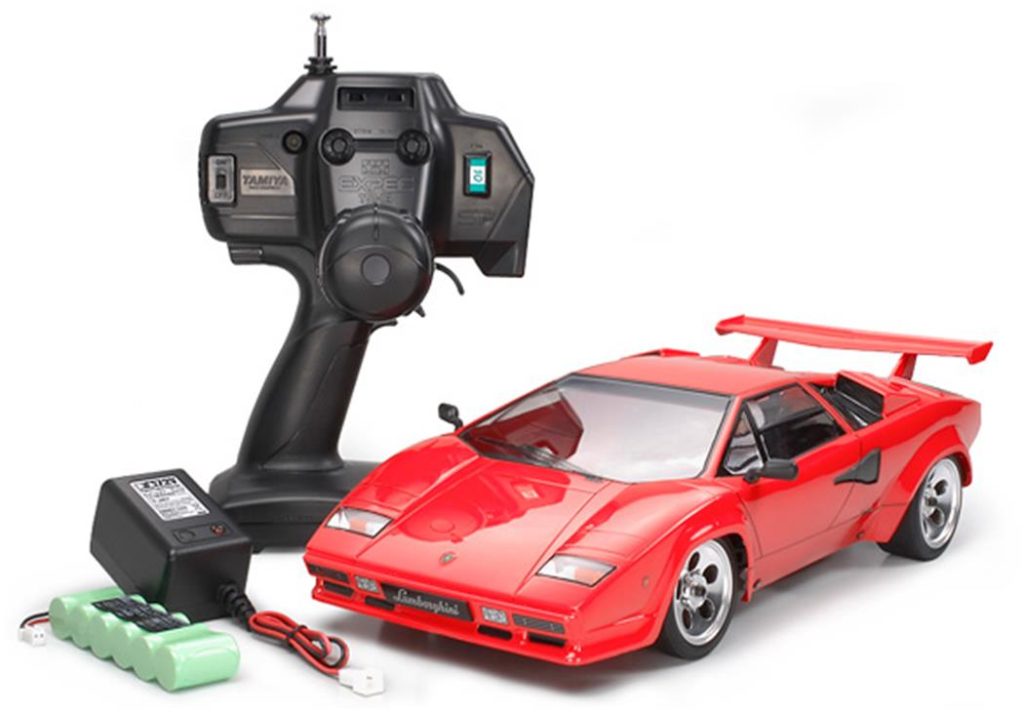
– Porsche Turbo RSR 934 Vaillant livery, model number 57101, released in 2006 and available on the market until 2007. The PS-54 color replicates the signature green of the first Tamiya model 58001 released for sale in the 1980s. Short wheelbase chassis. – Ferrari 288 GTO, model number 57103, released in 2007 and available until 2008, likely the first supercar released on the market that later evolved into the Ferrari F40. Long wheelbase chassis. – Porsche 935 Turbo Martini, model number 57104, released in 2008 and available until 2009. Comes with exclusive aerodynamic rims (40174 replacement code for 2 front rims and 40175 for 2 rear rims; front tires are code 40533 and rear tires are code 40534). Short wheelbase chassis. – Lamborghini Countach LP500S, model number 57105, released in 2008 and available until 2009. Comes with exclusive five-hole rims (40172 replacement code for 2 front rims and 40173 for 2 rear rims; front tires are code 40533 and rear tires are code 40534). Long wheelbase chassis. – Porsche 934 Turbo RSR 934 with black body, model number 84057, released in 2009 and available until 2010. It is a replica of model 58000, which was introduced to celebrate the first 100,000 units of model 58001.
It comes with a nameplate bearing the serial number, a black styrene body identical to that of model 58000 (on the left in the first image above), a Lexan body (on the right in the first image above), a technical carrying bag (image on the right above), a set of four six-spoke wheels replicating those of model 58000 and a set of four mesh-pattern metal-plated wheels (code 40555 described as “GT-01 Gold Mesh Wheels Rear,” 2 pieces and code 40554 described as “GT-01 Gold Mesh Wheels Front,” 2 pieces). It has a short wheelbase chassis. The front tires are code 40533 and the rear tires are code 40534.
The following factory-preassembled models, complete with electronics, battery and charger (the charger is mainly included for the US market and a few others worldwide), are part of the GT-01 Tamteck Gear By Tamiya family:
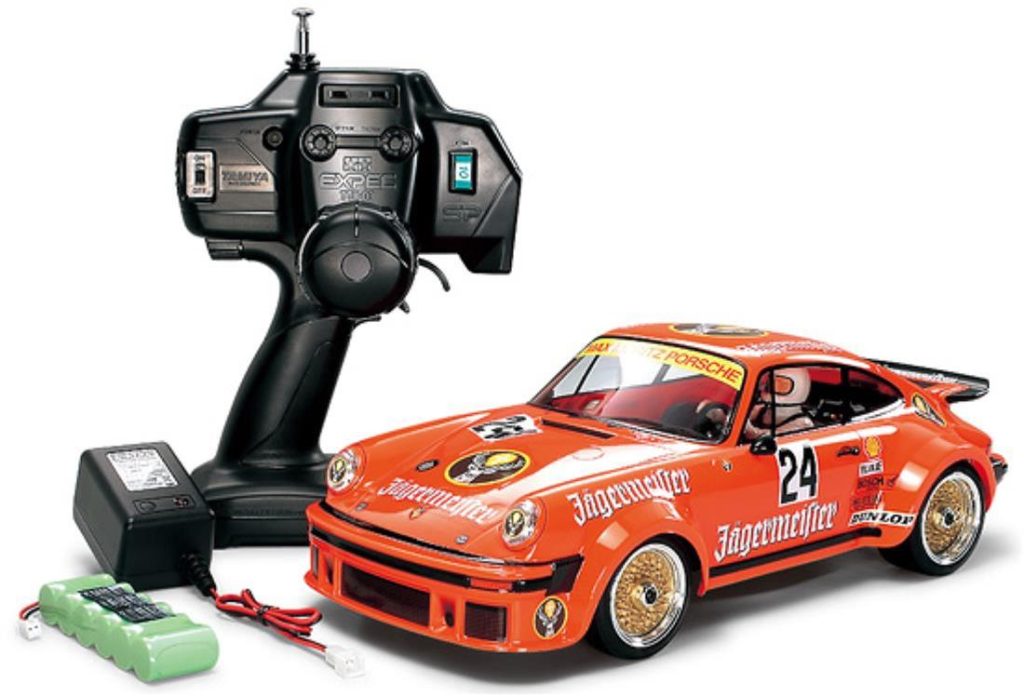
– Porsche Turbo RSR Type 934 Vaillant livery, model number 56706, released in 2007 and available on the market until 2008. Short-wheelbase chassis. – Porsche Turbo RSR Type 934 Jägermeister livery, model number 56708, released in 2007 and available on the market until 2007. The Porsche Turbo RSR Type 934 Jägermeister livery is the only model available exclusively preassembled from the factory. Short-wheelbase chassis. – Porsche 935 Turbo Martini, model number 56709, released in 2008 and available on the market until 2009. Short-wheelbase chassis. – Ferrari 288 GTO, model number 56710, released in 2008 and available on the market until 2009. Comes with a dual-LED lighting system on each side that replicates the two front headlights. Long-wheelbase chassis. – Lamborghini Countach LP500S, model number 56712, released in 2009 and available on the market until 2010. Comes with exclusive five-hole wheels. Long-wheelbase chassis.
The chassis in question is a completely new design in which all components are miniaturized to fit a 1/12 scale, making maintenance operations more time-consuming. It is only necessary to allocate the appropriate time to complete any task. The chassis consists of numerous parts and there are also many pieces that are not used in assembling the model. This suggests that Tamiya might have planned potential future developments that share castings with these first models featuring the GT-01 chassis. As of today (2025), no further developments have been made for the GT-01 on-road chassis.
Technically, the chassis has the following specifications, starting from the rear and moving towards the front:
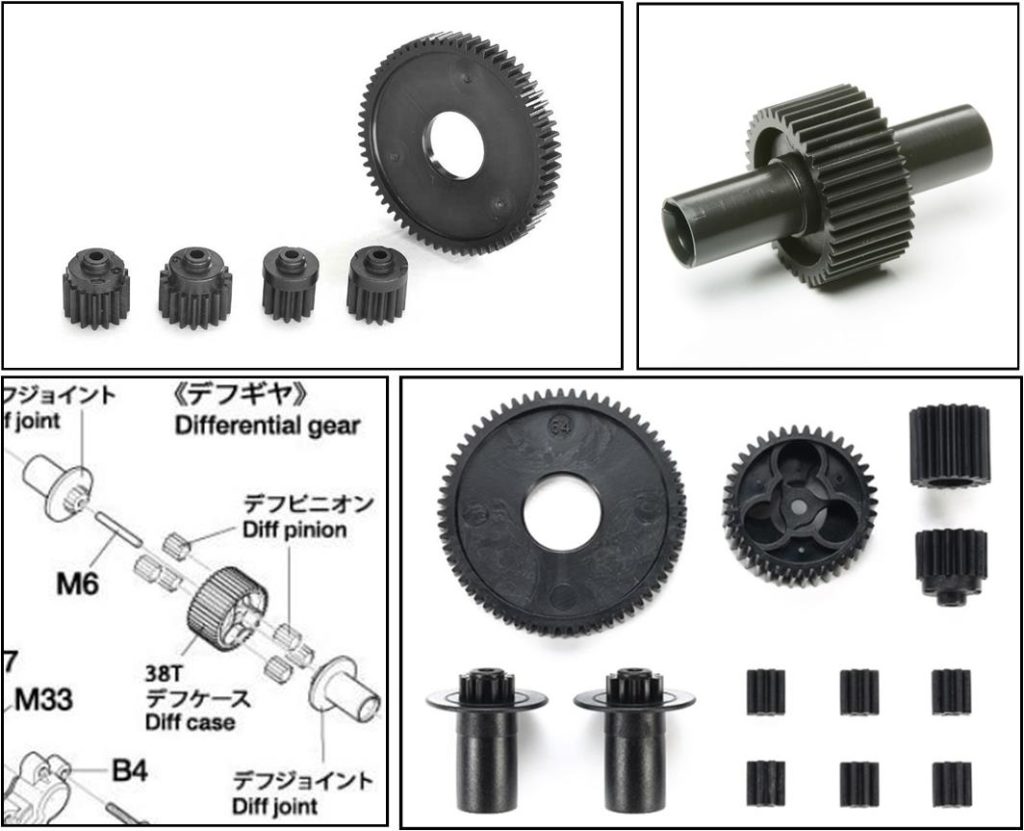
– Rear-wheel drive, powered by a type 370 motor with a Teflon pinion (see the four pinions with 12, 14, 16 and 18 teeth supplied by the factory, highlighted in the image below on the left in the first row). Technical data of the RK370 motor at maximum efficiency: 10,600 revolutions per minute, torque of 5.4 Nm and power consumption of 1.8 Amperes. To increase the performance look at 40537 “Tamtech-Gear Sports Tuned Motor SPT” – Factory-preassembled ball differential (code 40106, highlighted in the image below on the right in the first row); Tamiya chose to supply the differential already assembled due to its small dimensions. With the release of the GB-01S chassis, Tamiya made a more durable planetary gear differential available. This new differential is compatible with the GT-01 chassis (code SP-1685 or 51695, described as Tamtech Gear GB-01S Spare Gear, highlighted in the image below in the second row).
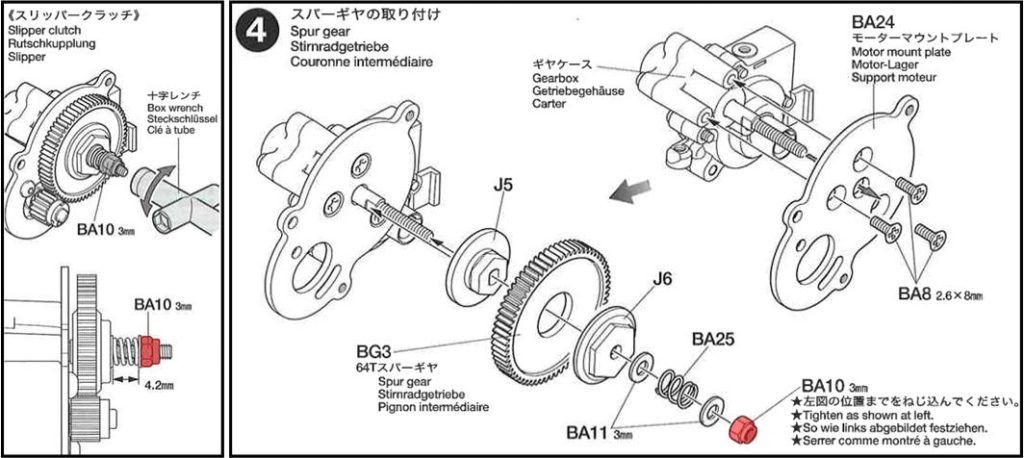
– Transmission equipped with an anti-hop clutch. The slip clutch consists mainly of two discs held in contact by a spring loaded by a bolt. The slip clutch has two functions that compensate for the lack of grip between the surface and the wheels. The first function is to preserve the mechanics during jumps. When the model is airborne, it does not touch the ground and the driven wheels rotate without ground resistance, causing them to increase their rotation speed. During long jumps, the motor’s rotational speed is modulated by the model controller to maintain balance and control the landing angle. In both cases, when the model touches the ground, the wheel rotation speed must suddenly adjust to match the model’s actual speed, putting stress on the transmission gears.
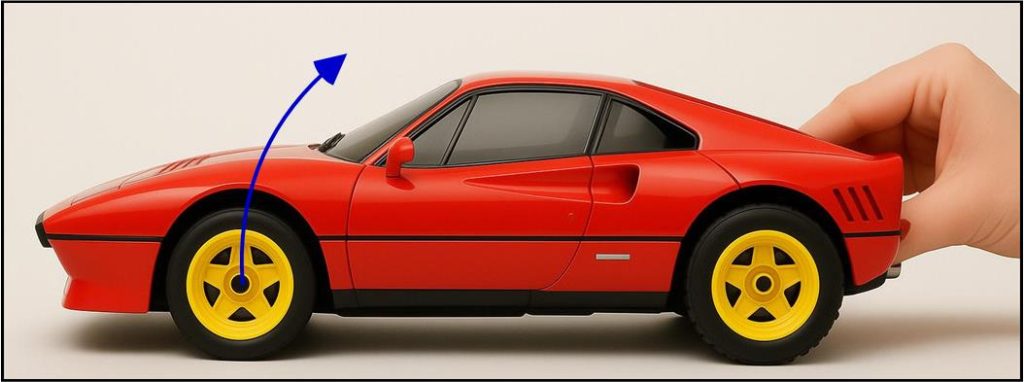
This situation occurs less frequently in track models, as they cannot perform jumps that are high and long enough to cause such a significant difference between wheel rotation speed and the actual speed of the model. However, the clutch remains efficient even in short jumps, though its effect is less noticeable. The second function of the clutch is to protect the gears from premature wear when, during sudden acceleration, the motor increases its rotation speed before the wheels can fully respond. The same happens during sudden deceleration. The clutch prevents the model from losing traction and ensures that the gears do not undergo unnecessary wear. The clutch plays a dual role in ultimately preserving the mechanics within the gearbox, where the motor pinion is the most stressed gear. To achieve optimal performance, it is necessary to adjust the slip by acting on the calibration setting (marked as “BA10” and highlighted in red in the image above). After following the instructions and compressing the spring to a total length of 4.2 mm, the first operating point of the anti-hop clutch can be tested by placing the model on a table or flat surface, turning on the electronics, holding the rear wheels with your hands and briefly accelerating. There are two possible outcomes: the model moves, lifting its front wheels off the surface (following the blue line indicated in the image below), or a noise from the gearbox indicates that the clutch has engaged, preventing the front of the model from lifting. The image shows the hand holding the rear wheels stationary and the expected movement of the front axle in response to the acceleration (highlighted by the red arrow).
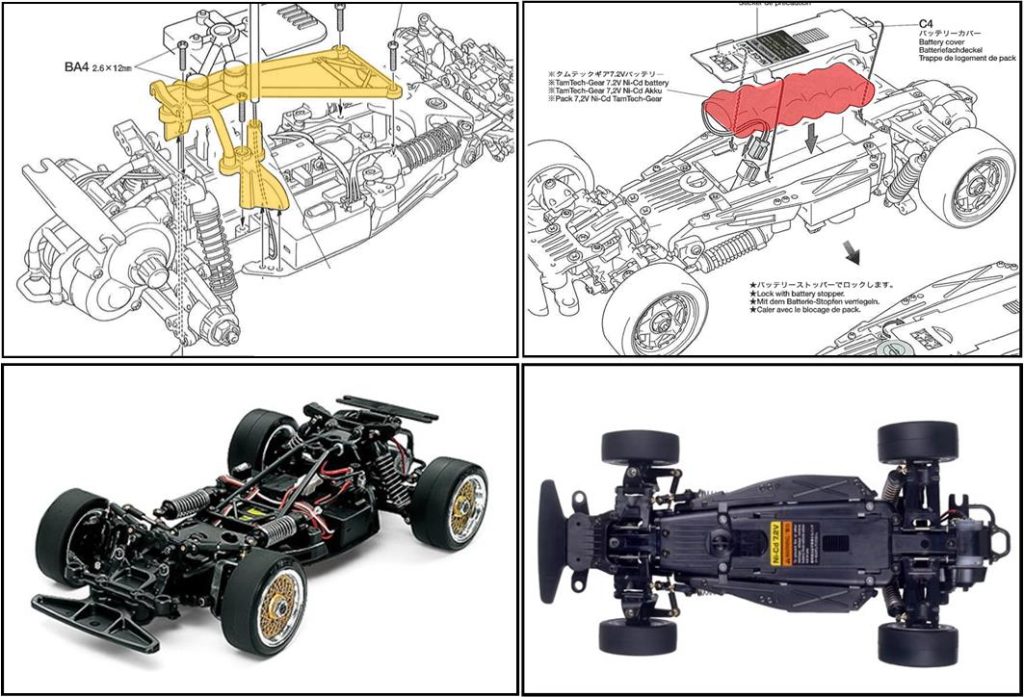
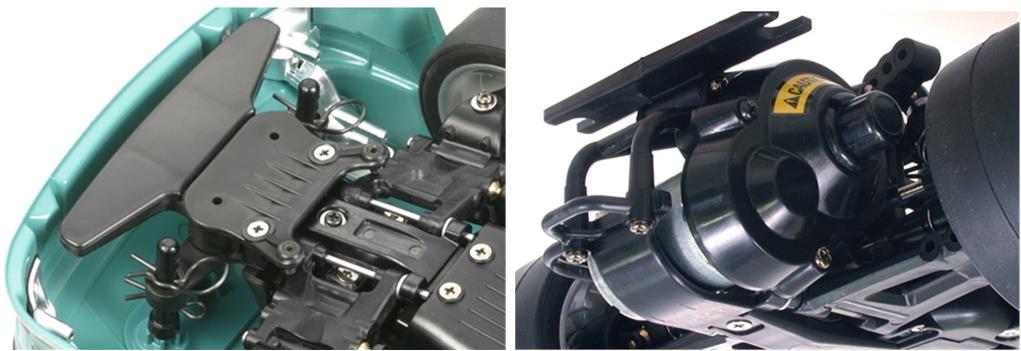
The best configuration is achieved when the front end and wheels lift slightly, losing contact with the surface; this is merely a starting point. The optimal setup depends on the track conditions and its grip level, requiring adjustments accordingly. The two worst configurations represent the extremes of adjustment: an overly compressed spring or an excessively loose spring. In the first case, the gears are directly and rigidly connected to the wheel axle, rendering the clutch ineffective. In the second case, the spring is so loose that it fails to transmit any movement to the wheels, preventing the model from moving altogether. In the Tamiya universe, the first slip clutch, named TTC (which stands for Tamiya Torque Control), was engineered for the Super Astute, which debuted on the market in 1991. – Drive shaft with complete ball bearings to reduce wear, thereby increasing system efficiency and extending operational time. – Central tub chassis that ensures a low total weight and lowers the model’s center of gravity. To enhance rigidity, the chassis is equipped with a roll bar (highlighted in orange in the image on the left). The chassis also features a battery compartment with access from the bottom (highlighted in red in the image on the right).
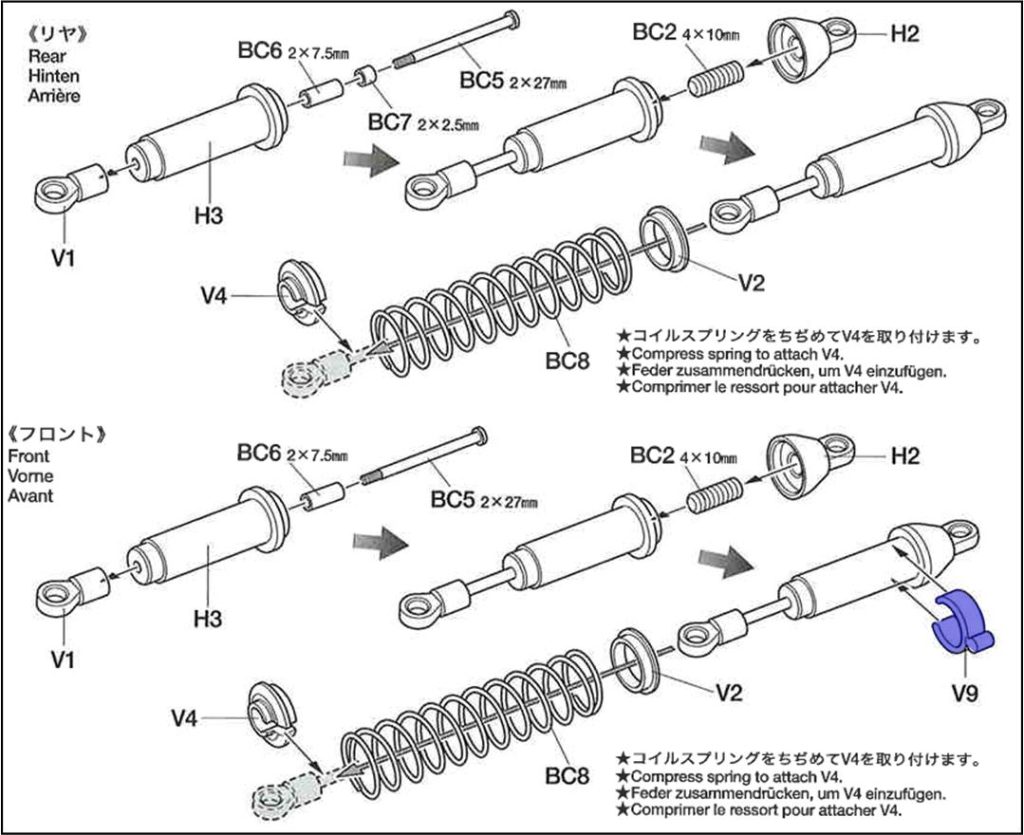
– Four independent suspensions. The two front and rear shock absorbers differ only in the V9 insert in the front shocks. It is possible to reduce the shock absorber travel using V8 and V7 inserts. This allows adjustment of the body height from the ground.
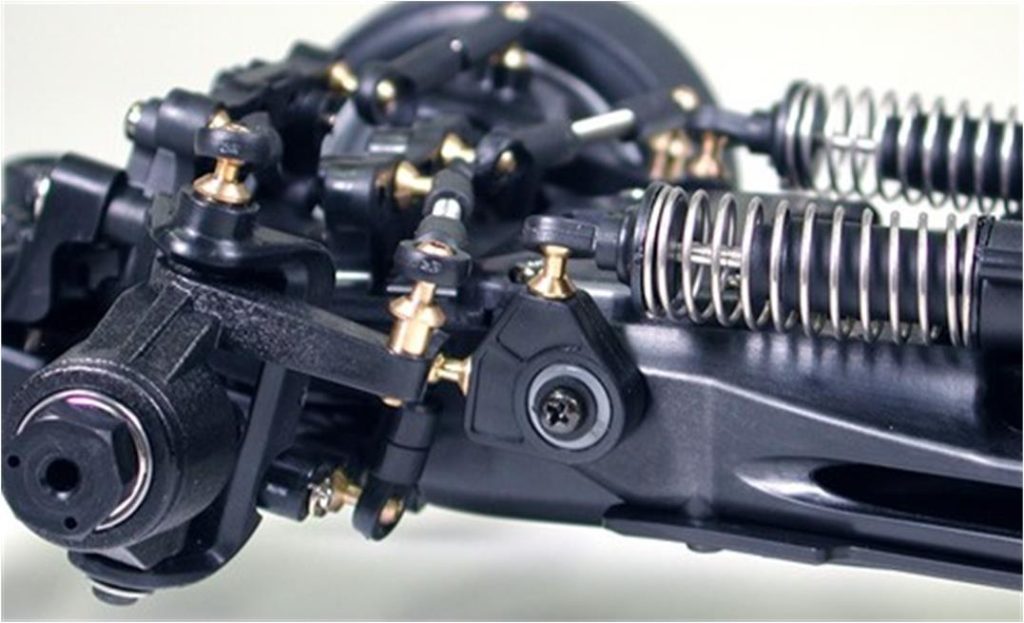
– Front shock absorbers installed horizontally to accommodate bodies with a very low nose. An efficient system of linkages and rocker arms converts vertical motion into horizontal movement, functioning flawlessly. Although this setup is less natural and direct than a vertical installation, the system designed by Tamiya delivers excellent performance.
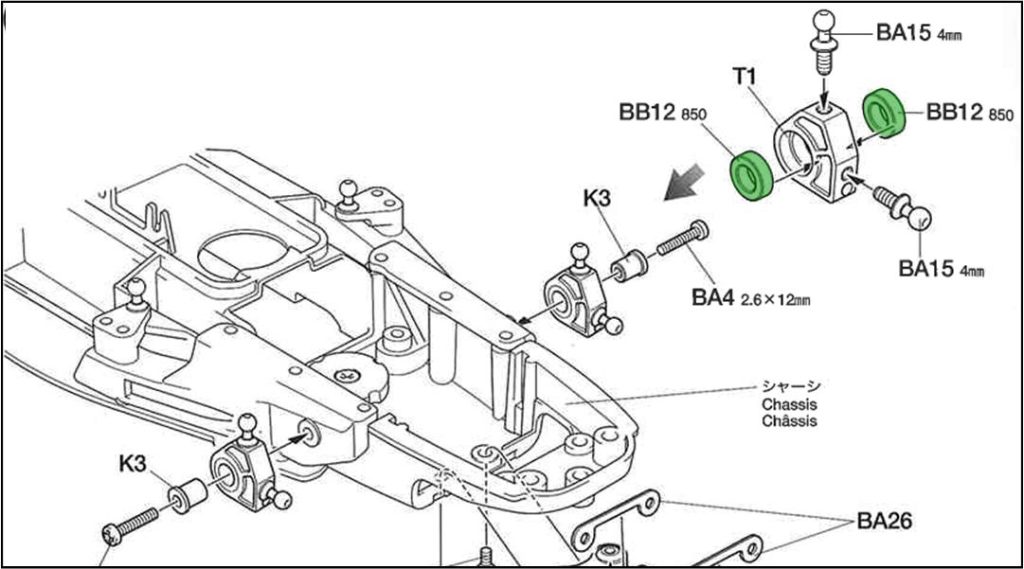
The two rocker arms are installed on the side of the tub chassis at the front. Each rocker arm is equipped with two Teflon bushings (highlighted in green in the image below) to facilitate movement; these bushings can be replaced with 850-size bearings.
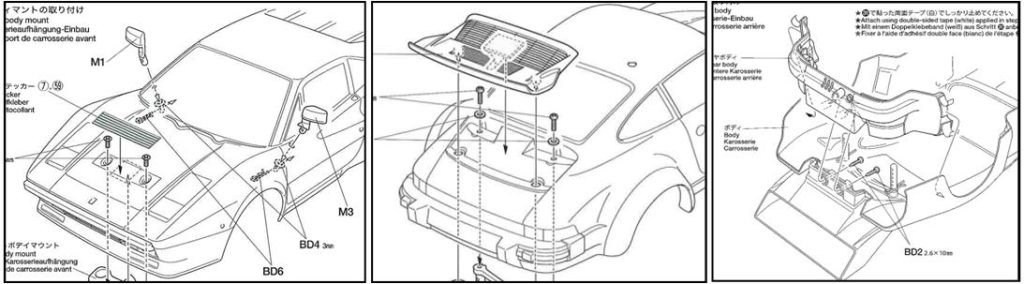
– Spring dampers that are a smaller-scale pair of those used on 1/10 scale models. There are two options to improve performance: replacing the dampers with set number 40529, described as “TamTech-Gear CVA Damper Set (4 Pcs.)”, or the higher-performance solution is to install set number 40513, GB-01 Aeration Oil Filled Damper (4 pcs). – Various transparent Lexan bodies, all perfectly crafted. Each model comes with decals and styrene-printed parts (such as mirrors, driver figure, rear wing…) to enhance the accuracy of the reproduction. The bodies replicate several high-performance sports models: Ferrari GTO (on the left in the images below), Porsche Turbo RSR Type 934 in various colors (center in the images below), Porsche Turbo Type 935 (on the right in the images below) and Lamborghini Countach LP500S.
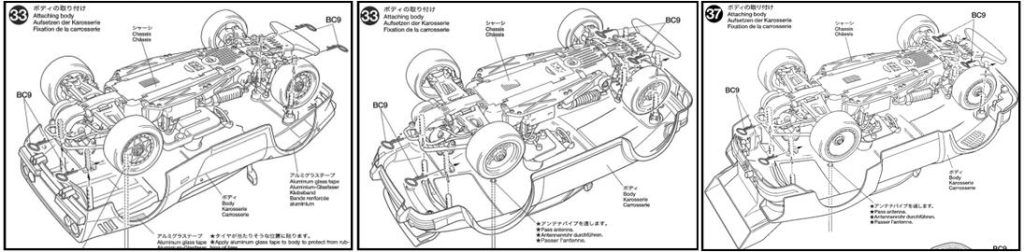
The body mounting system has been designed to maintain clean lines and prevent clips and towers from compromising the aesthetic appeal. The towers that connect the bodies to the chassis are fixed to the bodies and then inserted into the chassis, unlike what happens with 1/10 scale models. This way, the towers do not protrude from the body, which is the main reason the bodies appear more realistic.
The front mounting system for the Porsche 934 is highlighted in the image on the left, while the rear mounting system for the Porsche 934 is highlighted in the image on the right.
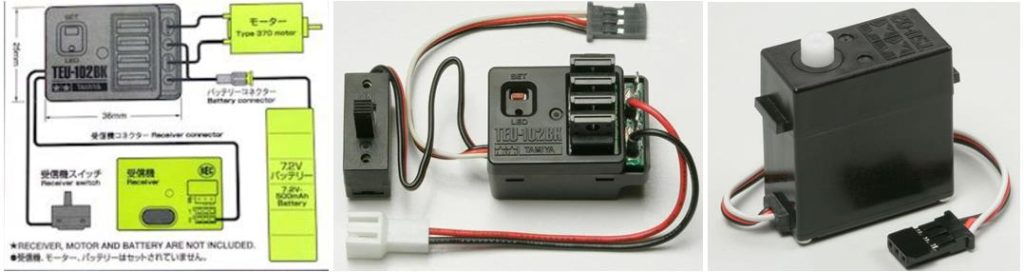
– Most of the screws used in models equipped with the Tamtech Gear GT-01 chassis have an M2.6 thread. – Tamiya recommends installing in assembly kits the same electronics found in the factory-assembled ready-to-run models. The remote control system is based on 27MHz AM technology and consists of the Expec SP TTU-03 transmitter (code 17254324 or 7254324) and the TRU-02 receiver (code 45036). The onboard electronics include the TSU-02 servo and the TEU-102 BK ESC (see image taken from the packaging). As of today (2025), they are no longer available on the market. Note that the TEU-102 BK does not have a “cut-off” function, so it cannot be used with LiPo batteries. Since LiPo batteries must not be fully discharged, it is advisable to replace the electronic speed controller if you intend to use next-generation batteries.
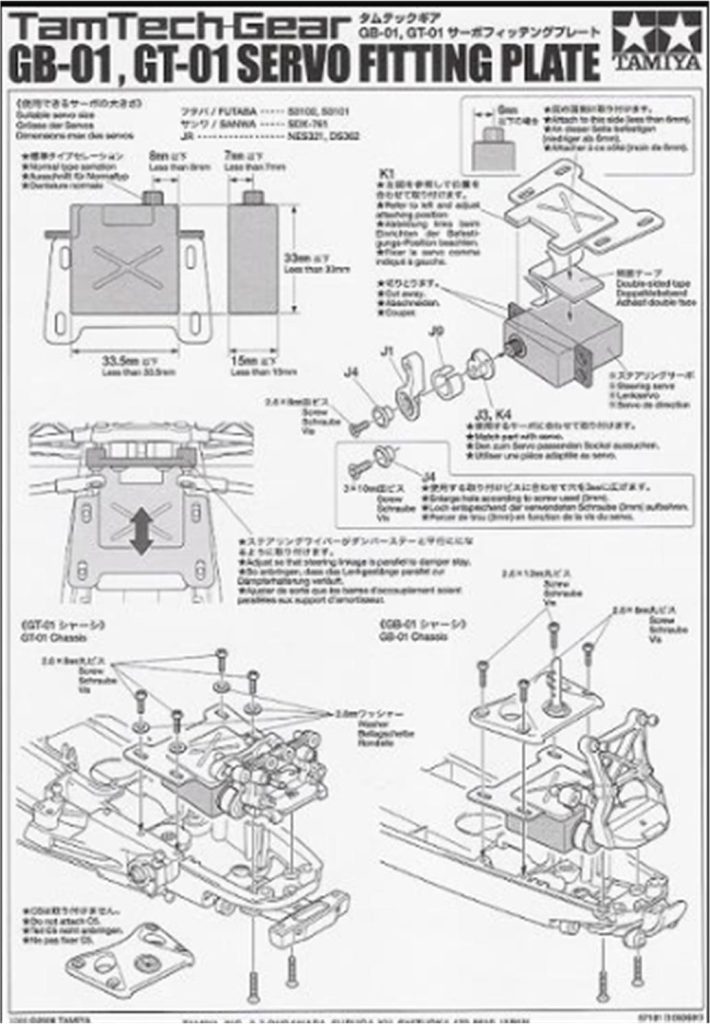
The manual includes a dedicated section showing how to install a different steering servo (see image below); this installation sheet is not always included with factory-assembled ready-to-run models, but it is always provided in assembly kits. Tamiya states that the servo must be a mini type, with a head less than 8 mm from the short side and less than 7 mm from the long side. It also provides a list of compatible alternative servos: Sanwa SDX-761; Futaba offers two options, the S3102 and S3101; and JR has two options available, the NES321 and DS362. Below is the image depicting the additional instruction sheet titled “Servo fitting plate” for the GT-01 and GB-01. This plate is not included in the factory-assembled models.
List of all accessory parts for performance improvement or items not included in the factory package; some accessories are shared with the GB-01x family:
40141 GT-01 Inner Sponge (Front wheels) 40142 GT-01 Inner Sponge (Rear wheels) 40147 GT-01 bumper set 40501 setting spring set 40502 GB-01 Aluminum Pinion Gear (12T) 40503 GB-01 Aluminum Pinion Gear (14T) 40504 GB-01 Aluminum Pinion Gear (16T) 40505 GB-01 Aluminum Pinion Gear (18T) 40508 2.6 x 29 mm Aluminium turnbuckle shaft (6 pcs Pink colour) 40509 GB-01 Aluminum Diff Cup 40510 GB-01 Aluminum Motor Plate (Pink color)
40511 GB-01 Aluminum Wheel Hub (Pink color) 40512 GB-01 Aluminum 4mm Ball Connectors (Pink color) 40513 GB-01 Aeration Oil Filled Damper (4 pcs) 40514 GB-01 Sport Tuned Motor, equivalent to RK-370-SD-3265; technical data at maximum efficiency: 15,000 revolutions per minute, torque of 6.8 Nm and power consumption of 2.1 Amperes. In addition to the code, it can be recognized by its black-colored rear shield. It is also available as set 54919 “Torque Tuned motor”.
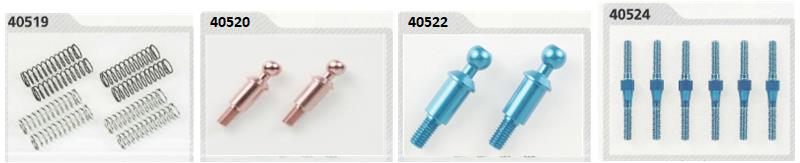
40516 GB-01 Aeration Oil Damper Maintenance Kit 40519 TamTech-Gear Setting Spring Set (Short) 40520 GB-01 Aluminum King Pins (Pink colour) 40522 GB-01 Aluminum King Pins (Blue colour) 40524 2.6 x 29 mm Aluminium turnbuckle shaft (6 pcs Blue colour)
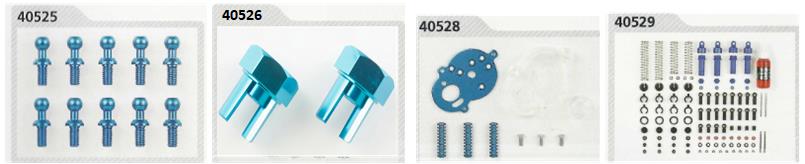
40525 GB-01 Aluminum 4mm Ball Connectors (Blue colour) 40526 GB-01 Aluminun Wheel Hub (Blue colour) 40528 GB-01 Aluminum Motor Plate (Blue colour) 40529 TamTech-Gear CVA Damper Set (4 Pcs.) 40530 TamTech-Gear Low Friction O-Ring Set for Oil-Filled Dampers
40531 GT-01 Reinforced Suspension Shaft Set 40532 GT-01 Wheel Bolt & Collar Set (Silver colour) 40533 GT-01 High Grip Slick Tire (Front wheels) 40534 GT-01 High Grip Slick Tire (Rear wheels) 40535 GT-01 Aluminum Turnbuckle Shaft (Blue colour)
40536 GT-01 Aluminum Rocker Arm Set (Blue color) 40537 Tamtech-Gear Sports Tuned Motor SPT, equivalent to RK-370-SD-4045; technical data at maximum efficiency: 21,000 revolutions per minute, torque of 7.7 Nm and power consumption of 3.3 Amperes. In addition to the code, it can be recognized by its red-colored rear shield. Among the motors in the catalog, this one has the best performance. It is also available as 54860 “Sport Tuned motor”. 40538 Aeration damper attachment bolt (4 pcs) 40539 Aeration oil-filled damper short case (2 pcs)
40540 4 x 3 mm Aluminium step ball connector (4 pcs Blue colour) 40541 4 x 10 mm Aluminium ball connector (2 pcs Blue colour) 40544 GT-01 Aluminium front damper stay (Blue Colour) 40545 GT-01 Aluminium rear damper Stay (Blue colour)
40548 Aluminium front Upper Plate (Blue colour) 40550 GT-01 Titanium screw set
There are specialized kits available on the market to transform this chassis:
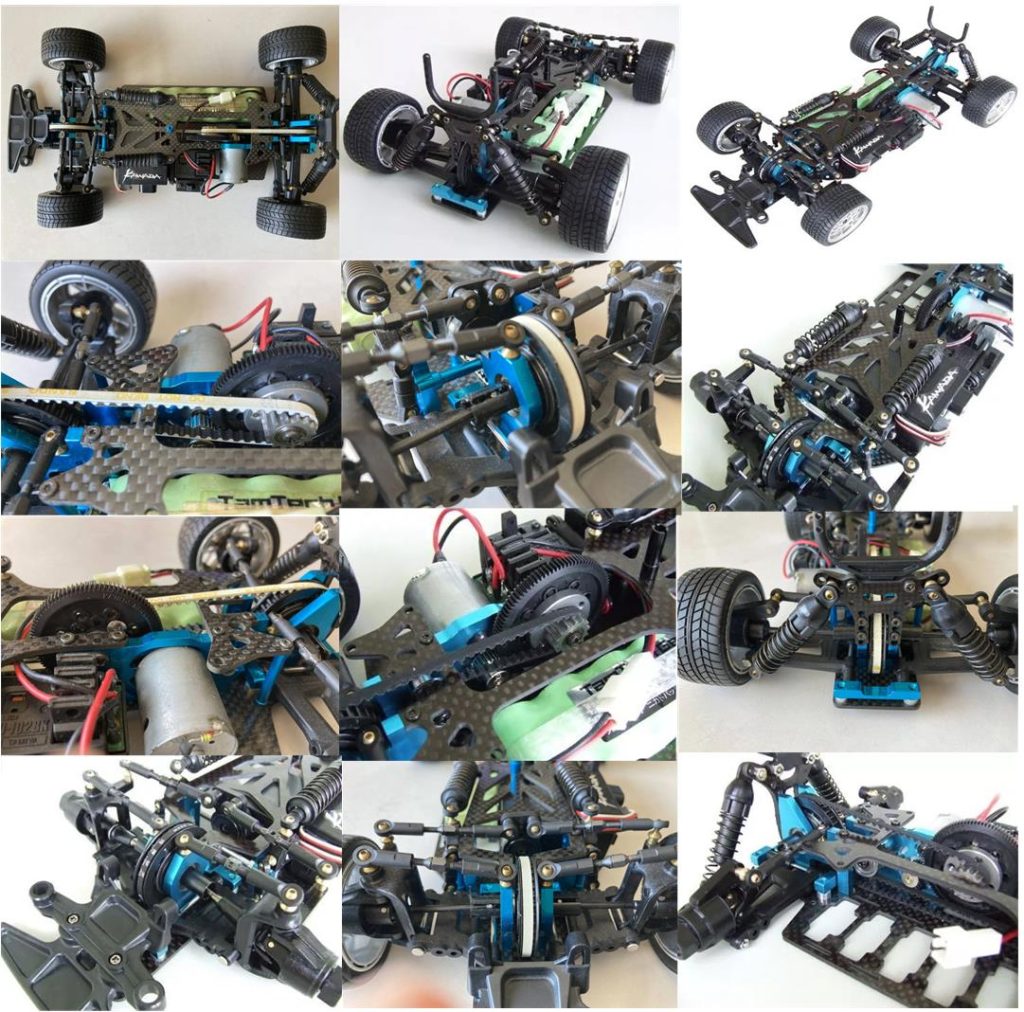
– From two-wheel drive to four-wheel drive, – From gear transmission to belt transmission and – From tub chassis to double plate carbon fiber chassis.
Tamiya, original figure, box art, guide book and catalogue are of TAMIYA INC, which does not endose or sponsor www.tamiyaclassic.com. Any brands, logos and trademarks represented on this website are the copyright of their respective owners.