Reproduction of Formula 1 cars always occupies an important place in Tamiya’s production.The F103 chassis represents a breakthrough in technical development, design and performance for radio-controlled track cars. The evolution of the chassis leads to having nine different versions of the F103 chassis to date (2024). Tamiya does not change the name of the chassis, it adds abbreviations to uniquely identify the various versions as happened with the F1 chassis (released in 1978) that evolved into the F1 CS (released in 1979). Today (2024) the F103 chassis exists in nine configurations:
– F103 released for sale in 1993, – F103L released for sale in 1994, – F103RX released for sale in 1997, – F103RS released for sale in 1998, – F103LM released for sale in 1999, – F103LM TRF released for sale in 1999, – F103 SIX released for sale in 2000, – F103 GT released for sale in 2006 and – F103RM released for sale in 2008.
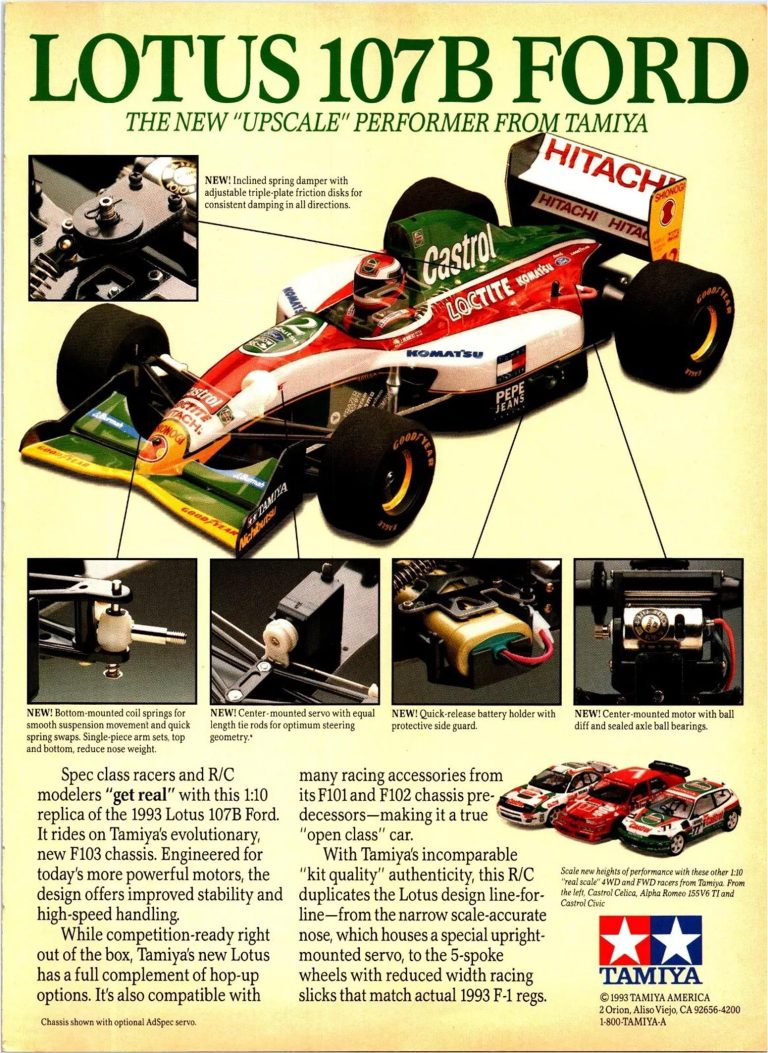
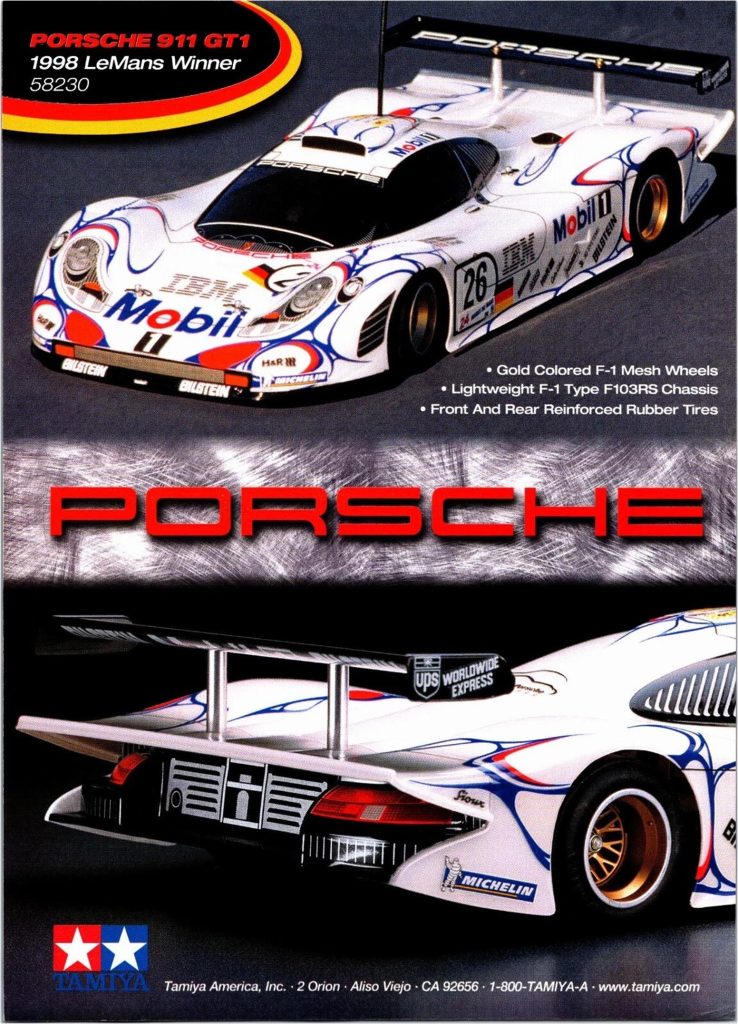
These models represent a very significant innovation for Tamiya. Various advertisements have been published by Tamiya or its importers worldwide in industry magazines; in the image below, we show advertisements that have appeared in various industry magazines.
F103
The models that are equipped with this chassis are:
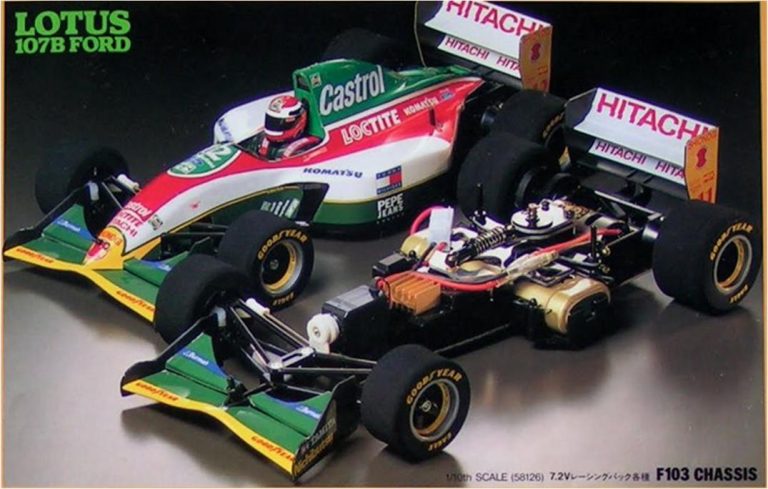
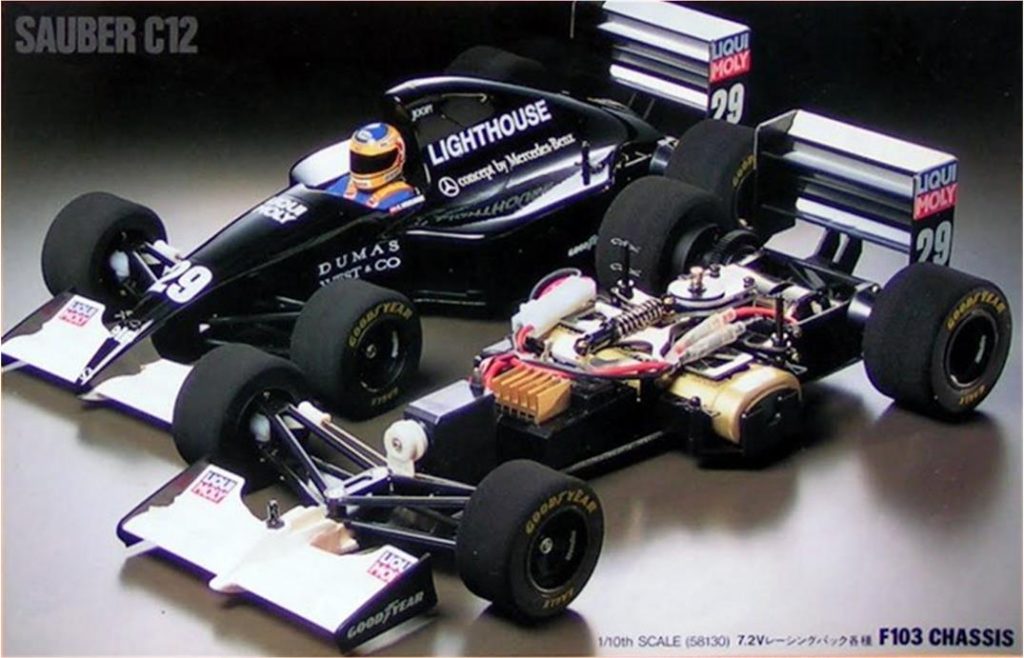
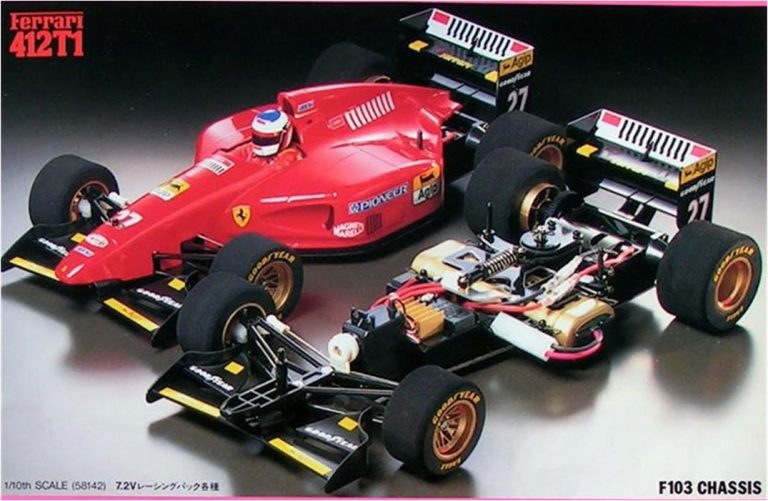
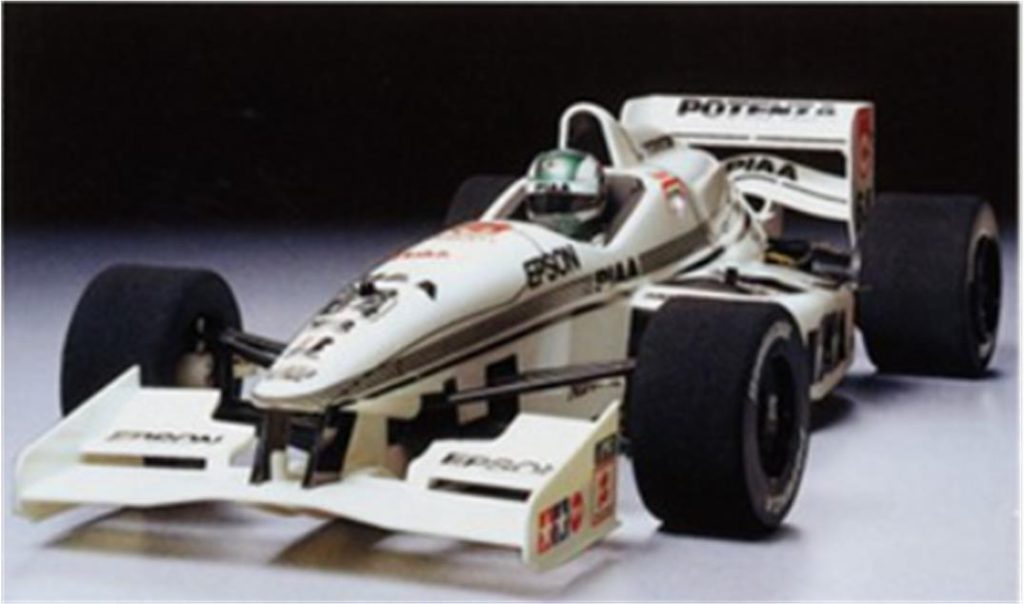
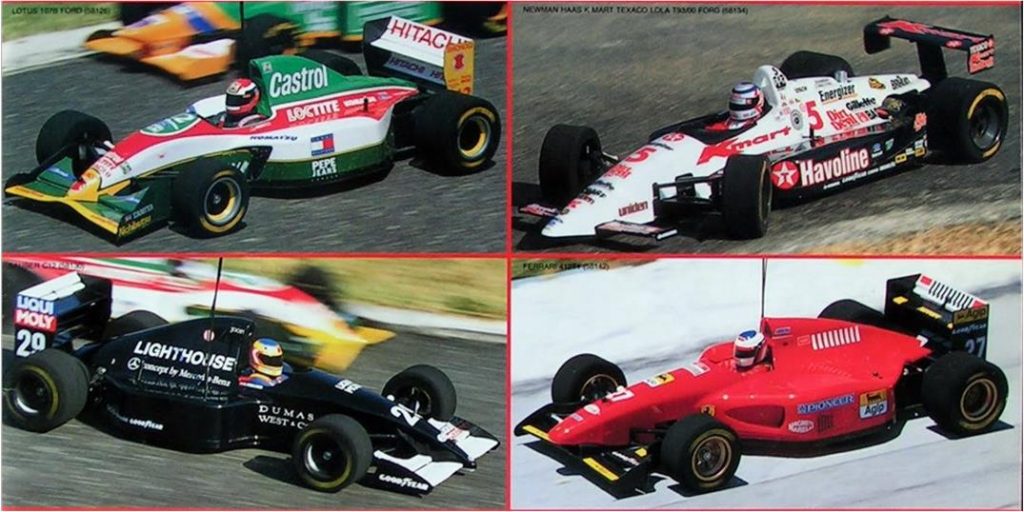
Lotus 107B Ford, model number 58126 released for sale in 1993 and available on the market until 1997, Sauber C12, model number 58130 put on sale in 1993 and available on the market until 1997, Ferrari 412T1, model number 58142 put on sale in 1994 and available on the market until 1999 and PIAA Nakajima Reynard 97D, model number 58198 put on sale in 1997 and available on the market until 2000.
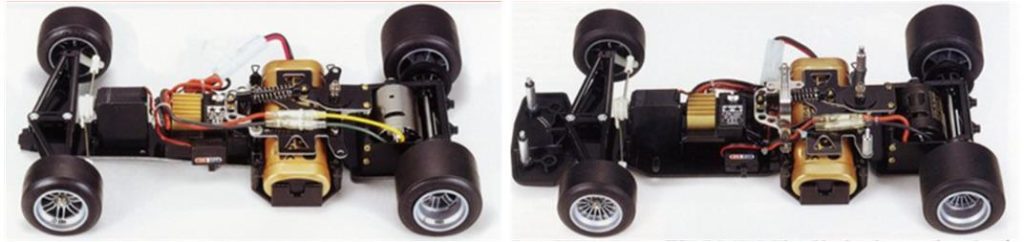
The F103 chassis is such an important innovation that it occupies several pages of catalogs and guide books of the time. This image shows three models equipped with the F103 chassis (the model on the left in the first row and the two in the second row) and an F103L (the model on the right in the first row) that is nothing more than the long-pitch F103 chassis (added 20 mm).
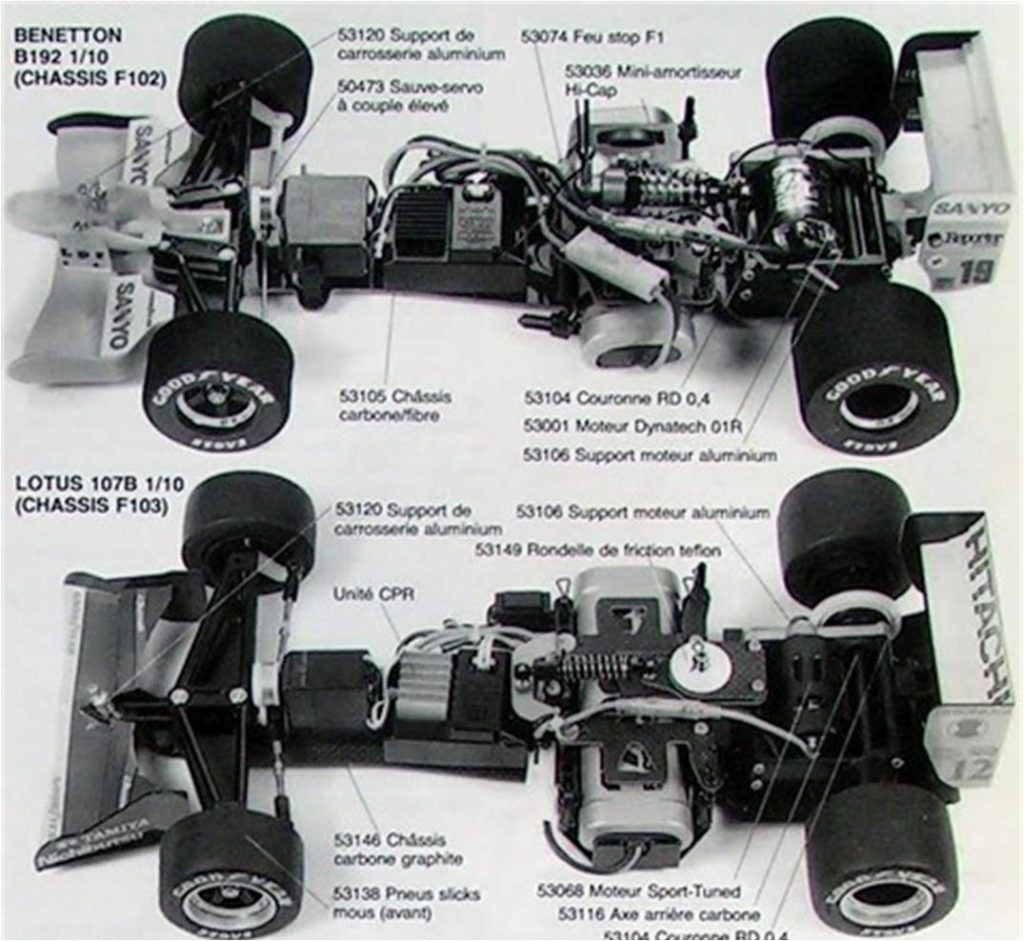
The F103 chassis serves as the basis for all other F103xx-branded designs; this chassis has very few parts in common with the previous F102; in the image below the main differences between the F103 and F102 chassis are evident; starting from the front going to the rear the main differences are:
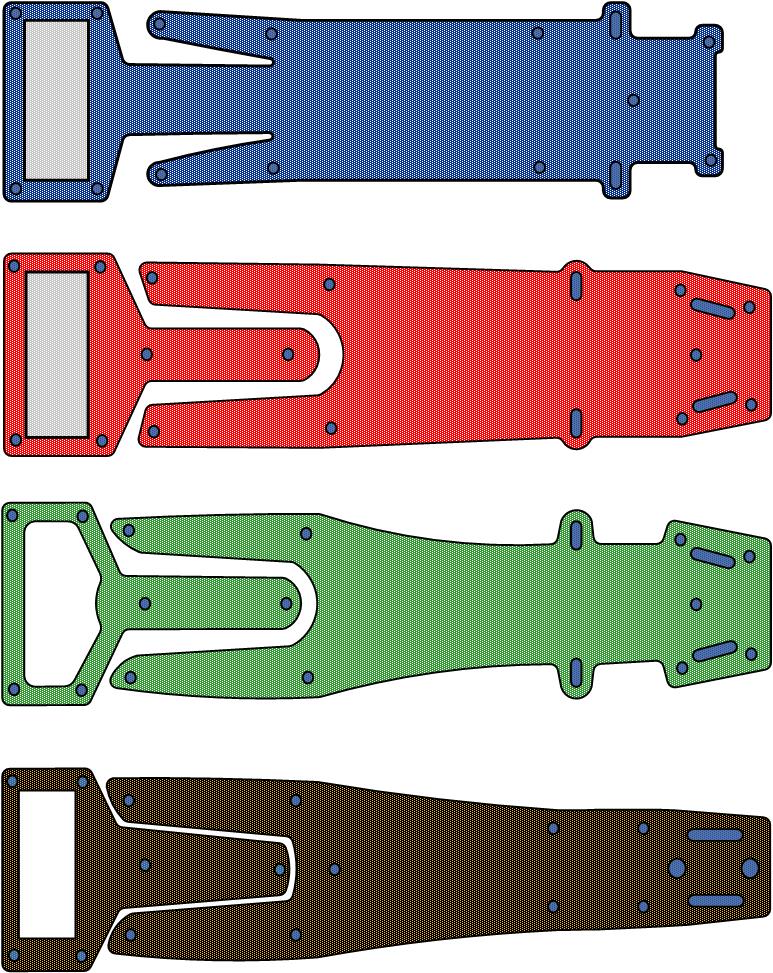
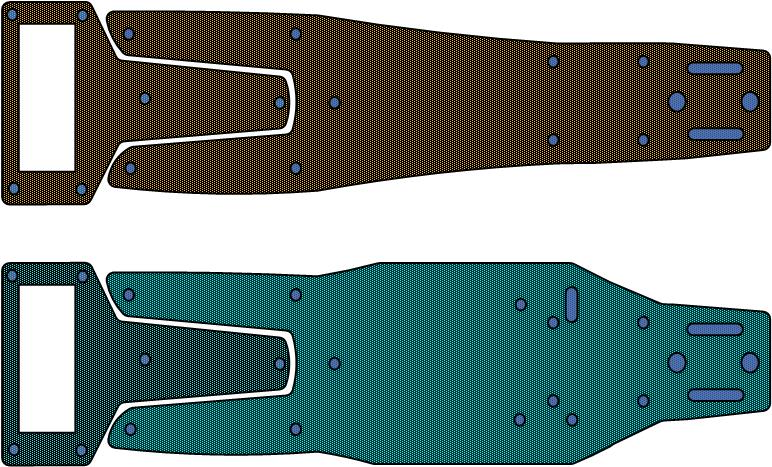
– stiffened suspension arms built in one piece. This solution also has the advantage that it reduces the parts from four to two making it easier to build and/or maintain, – centrally and vertically installed steering servo; this solution improves weight distribution and allows better control of the turning radius, which is equal in both directions. – the lower center-front main frame plate and the FRP rear T-plate have a different design. The shape of the frame and the one-piece solution of the front suspension increases the rigidity of the front, improving the driving precision. In the image below, the frame highlighted in blue is the Road Wizards, the frame highlighted in red is F101, the frame highlighted in green is F102 and the frame highlighted in brown is F103. In the front, the different arrangement of the holes for attaching the steering servo is evident, changing from the two side holes in the Road Wizards – F101 – F102 chassis to the four center holes in the F103 chassis. The all-carbon lower frame was introduced on the chassis celebrating 15 years since the first release of the F103 chassis (2008 model number 84056), accessory part number 54092. It can be installed on any model in the F103 family.
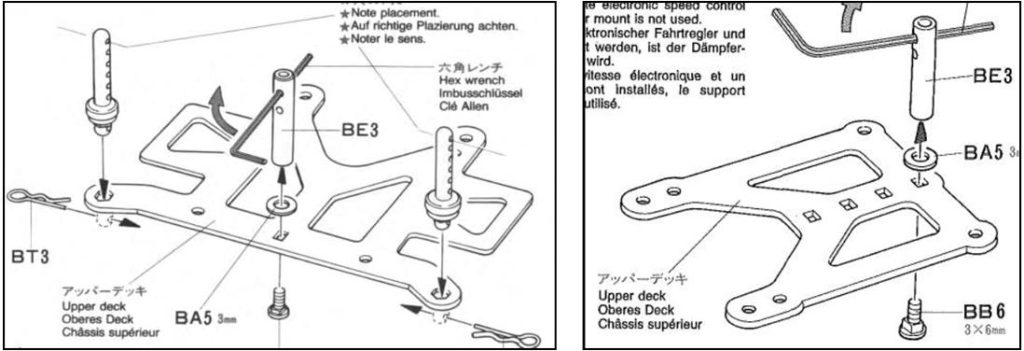
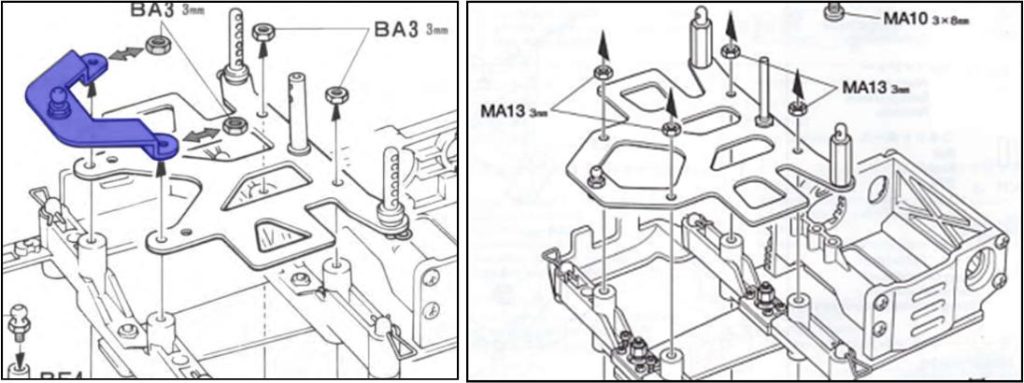
– the X-shaped rear top plate that houses the battery and mono-shock absorber has a different design. The battery changing system changes from two plastic bands to two removable plates attached with four clips to speed up battery changing and to better hold the battery itself locked to the frame. The top plate is enhanced with a double- or triple-disc clutch system that, with the T-shaped bottom plate, provides greater rear axle and traction control, – different chassis to accommodate motor and rear axle evolution of that of the F102. The F103 version has been evolved to be more durable, it retains the metal plate of the f102 chassis in the shape of a rhombus (“Motor plate” code number 4305259) to install the motor. – the differential is a direct evolution of the ball differential installed on the f102, they are interchangeable. – to make all these improvements, Tamiya worked on individual parts making them more complex. The overall weight of formula 1 chassis has grown as it has passed through the various generations. Considering the weight of the chassis in running order complete with electronics and motor, but without the battery; the weight of the Road Wizards chassis is 0.98 kg, the weight of the F101 chassis is 1.05 kg, the weight of the F102 chassis is 1.10 kg and the weight of the F103 chassis is 1.15 kg. As much as the chassis is composed of the same number of parts and as much as these parts are similar to each other and more thought out, the dynamic performance of the F103 chassis is better than that of previous chassis.
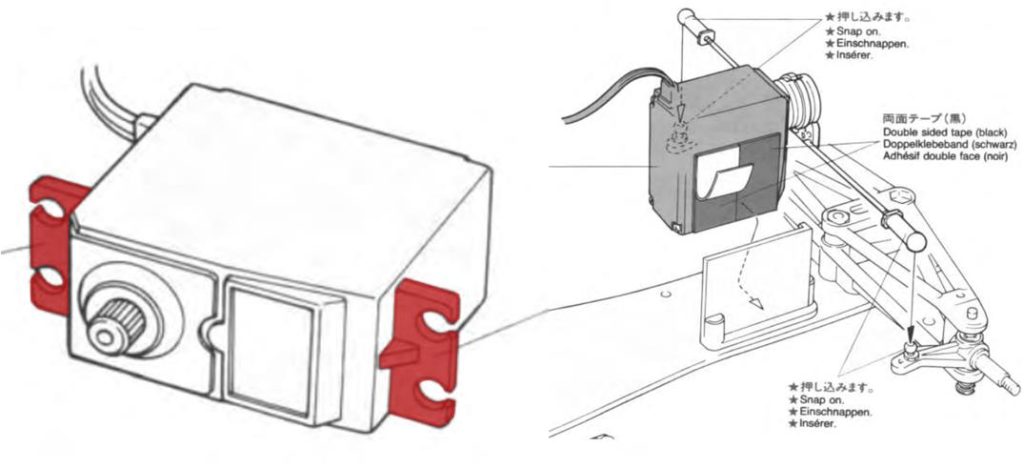
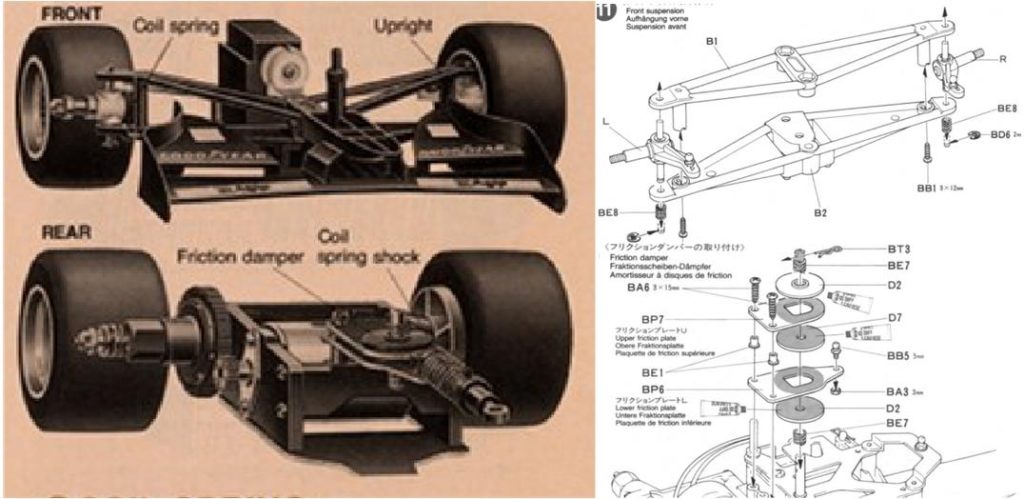
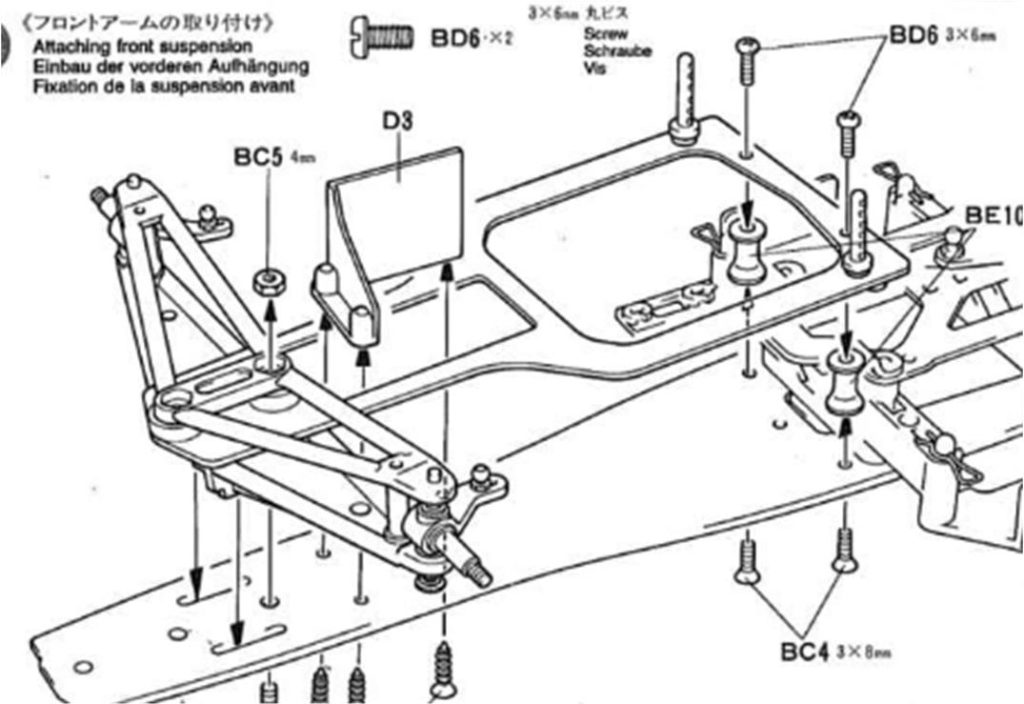
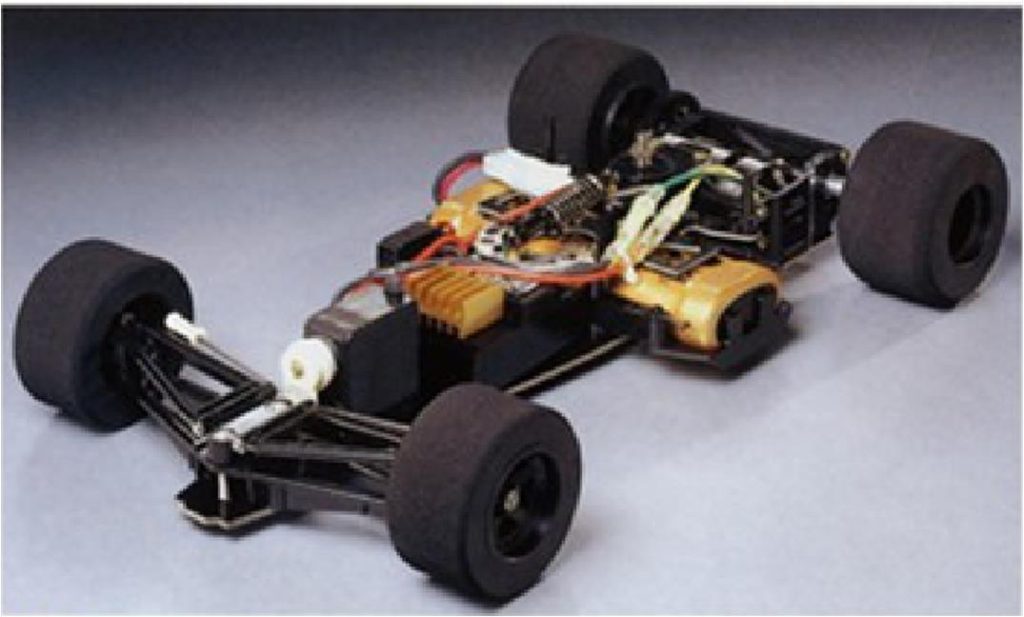
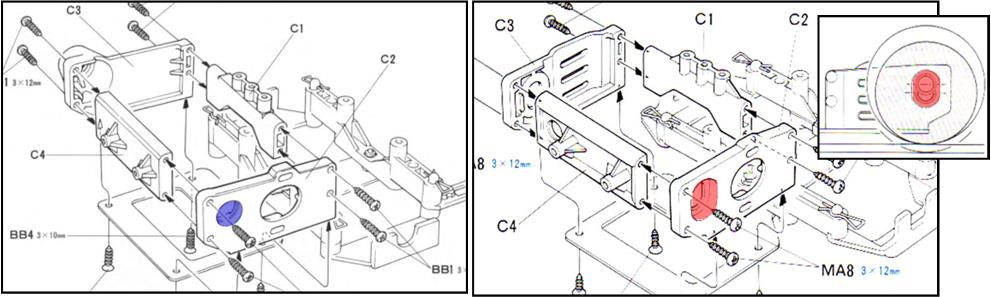
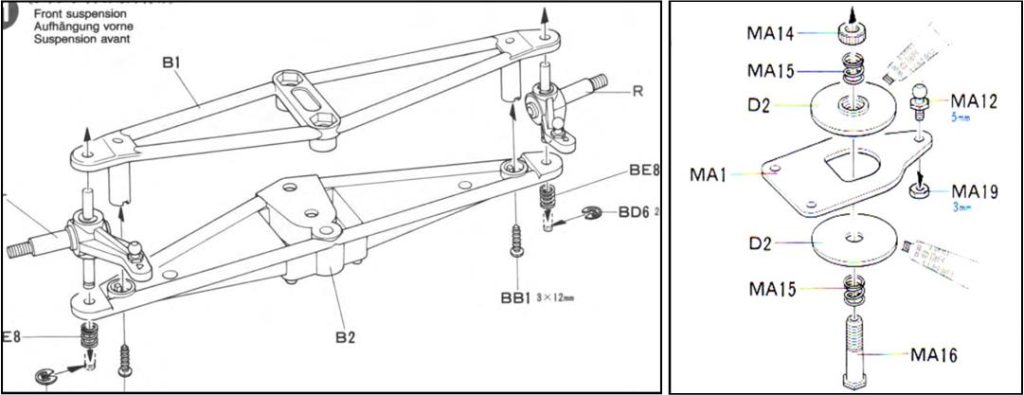
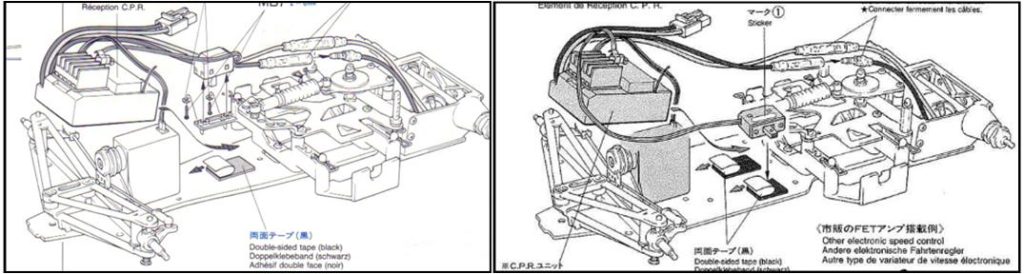
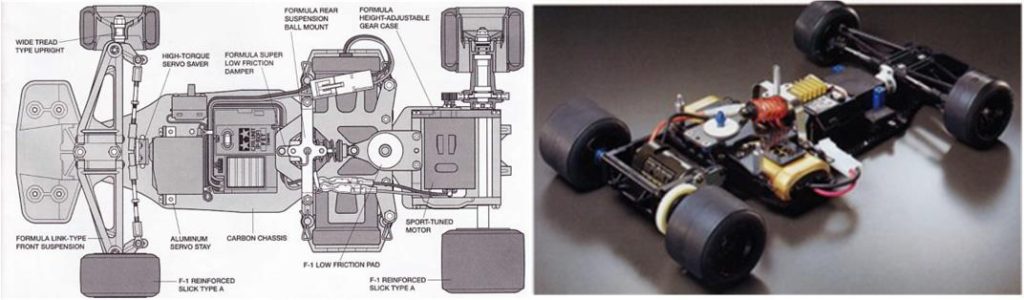
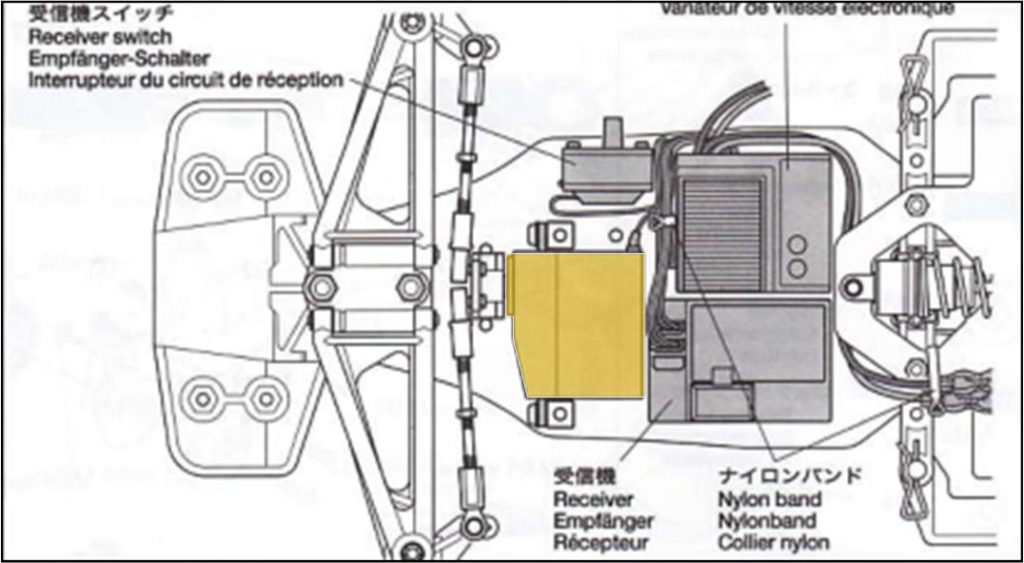
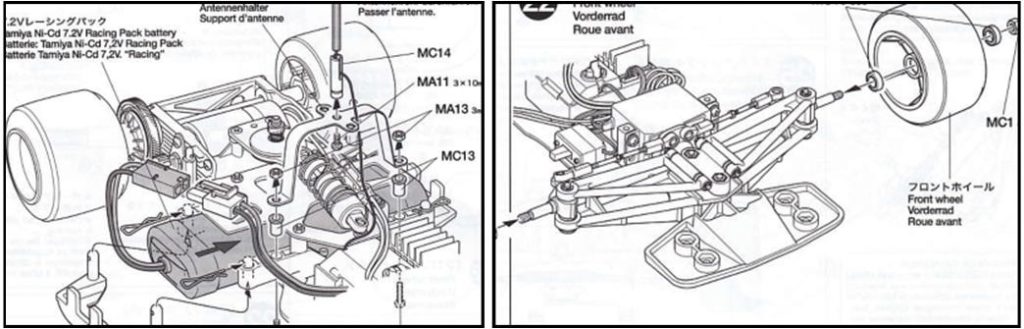
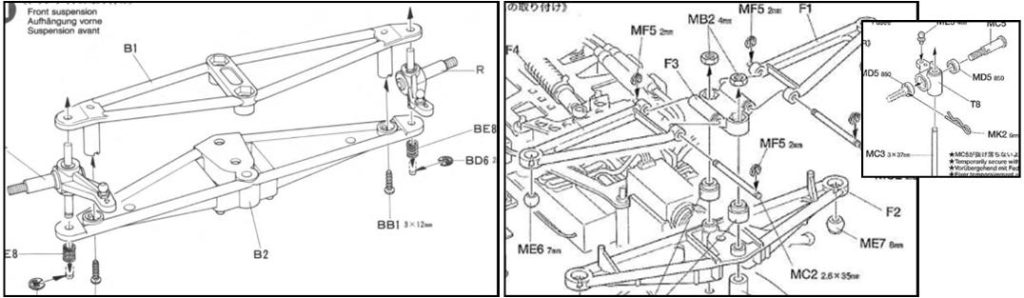
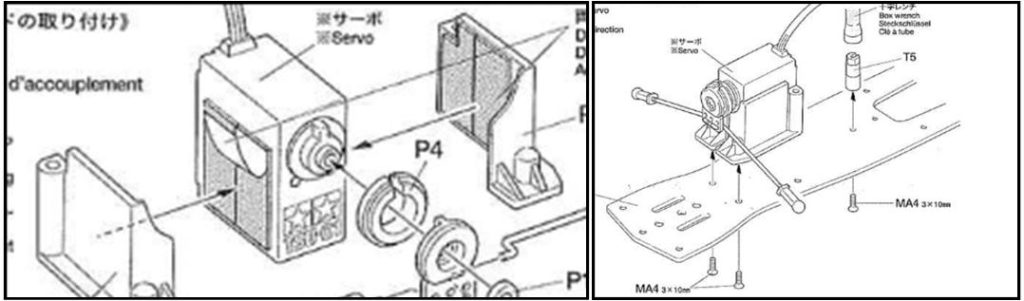
The major changes are included in the front and rear suspensions. As far as both are concerned, the geometries do not change from the F102 chassis; in the F103 chassis, the concept born with the Road Wizards chassis that had evolved to the F101 chassis, the F102 chassis and now the F103 chassis has been taken to extremes. At the front, the left and right suspension arms are a single thermo-cast plastic piece. The steering spindles can move vertically opposed by the action of a spring that cushions the roughness of the ground. The steering arms are the same length, which allows the steering radius on the right to be equal to the steering radius on the left. With this new geometry, it is easier to adjust toe-in and control the steering angle. The steering servo is installed vertically in the center of the chassis, an L-shaped plastic plate serves as a support and the servo is installed using double-sided tape (see image below right). The servo is modified by cutting the two installation slots with the four screws (see parts highlighted in red in the image below left).
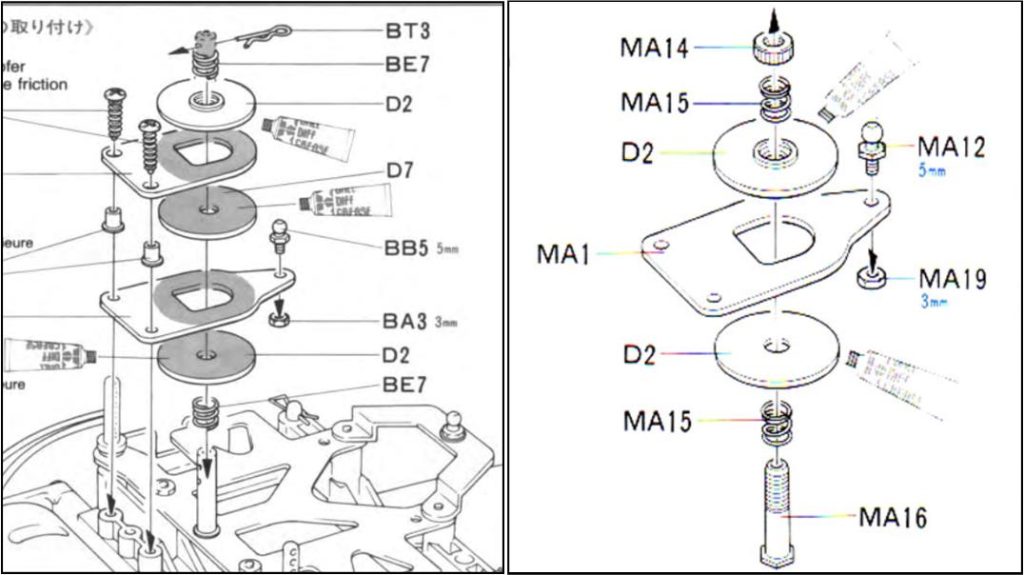
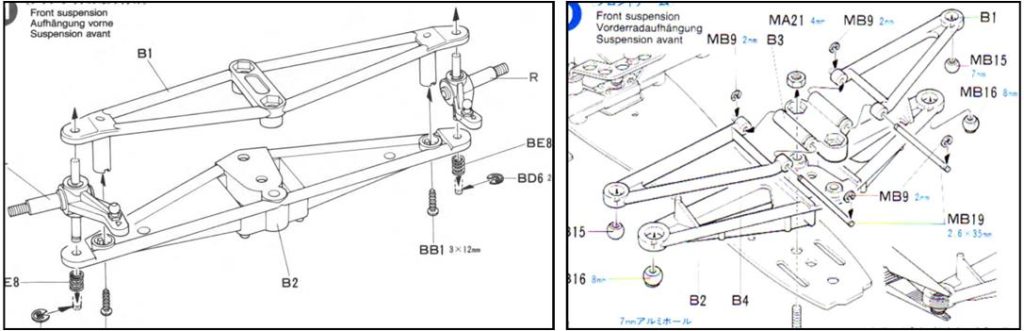
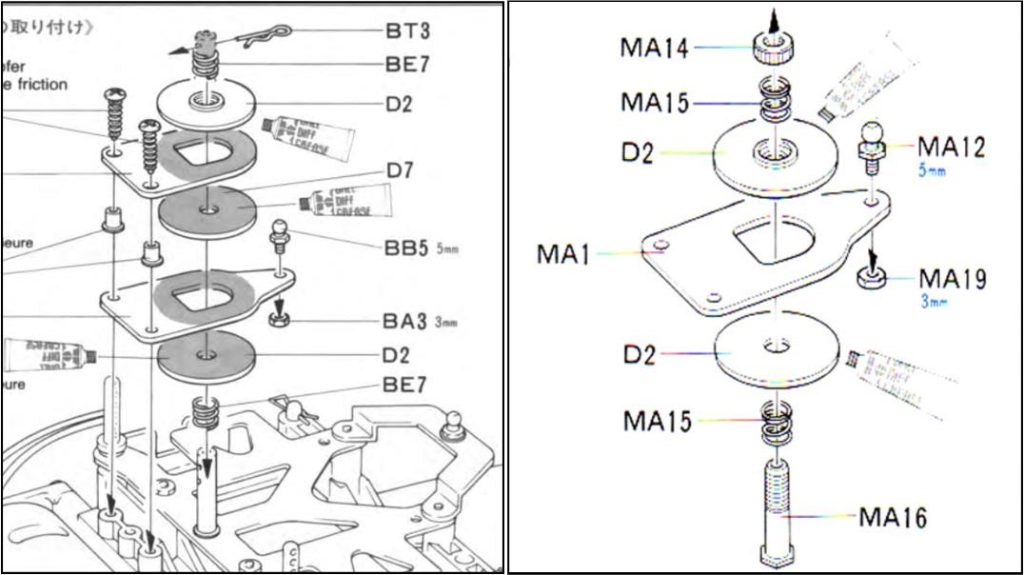
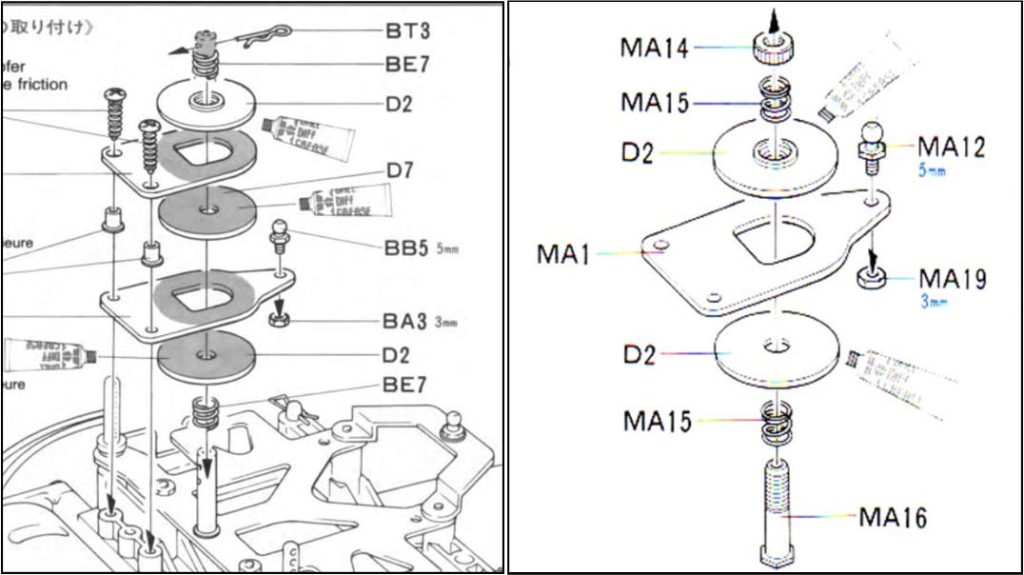
In the F103 chassis, the installation of the front suspension spring is different, which finds space below the lower suspension arm (see image below in the first row). This solution makes it more practical to change the spring to adapt the behavior of the suspension according to the road surface of the tracks. The rear system retains the basic layout inherited from the previous single-shock chassis; the single-shock rear suspension system remained unchanged in the Road Wizards, F101 and F102 chassis. The single rear shock absorber provides control of the vertical-longitudinal movement; it handles the roughness of the terrain. The clearance between the battery holder frame and the FRP T-plate allows control of lateral movement-tilt. This movement is what is triggered by facing curves. Up to the F103 frame, the adjustment is left to two o-rings and how much you tighten the two screws that join the T-plate to the battery holder frame. This solution is not easily adjustable and is left to the sensitivity of the person tightening the screws. In the F103 chassis this concept has been completely overturned by inserting a disc clutch system (see image below second line) made of plastic or Teflon giving greater freedom of movement to the rear axle which is able to adhere better to the road surface following its roughness. Changing the clutch response manages the model’s pitching motion. The adjustment of the clutch is left to the ring nut that increases or decreases the pressure of the two springs on the discs, the adjustment is very simple obtained by screwing or unscrewing the ring nut itself.
F103L
The models that are equipped with this chassis are:
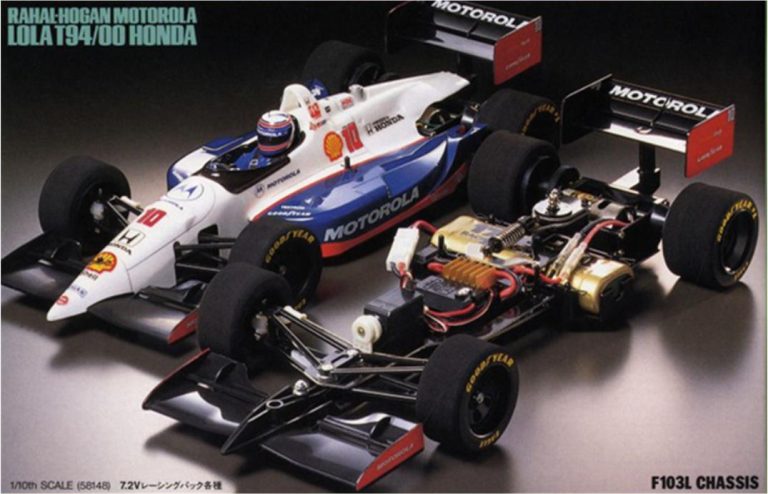
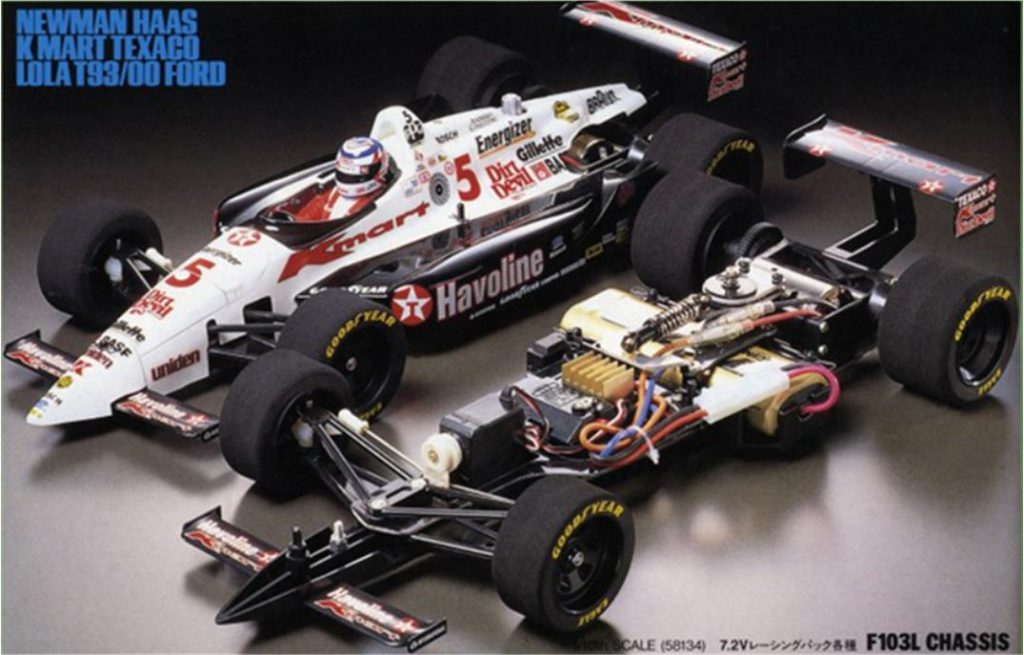
Newman Haas K Mart Texaco Lola T93/00 Ford, model number 58134 released in 1994 and available on the market until 1997 and Rahal-Hogan Motorola Lola T94/00 Honda, model number 58148 released in 1994 and available on the market until 1997.
The first modification introduced on the F103 chassis was to lengthen the wheelbase by 20 mm from 260 mm to 280 mm. This modification makes the F103 chassis suitable for bodies of the cars that run in American Indycar. The cars that run in the Indycar formula are designed to compete on American oval tracks with corners to back up by preferring to run in fast sections. The cars that perform best in these conditions are those with long wheelbases, which contrast with the shorter F1 cars that are more agile and responsive. The modification of the wheelbase is achieved by modifying the front center plate which becomes longer and to stiffen it is enriched with a second upper frame also made of FRP (see image below).
The X-shaped FRP top plate for installing the battery also changes shape; on the right is the F103L version and on the left is the F103 version.
The solution of the second upper plate in FRP allows for a stiffer and more reactive front. The front steering system, the front suspension, the steering servo installation system, the rear T-plate, the mono shock absorber battery holder system and the rear axle-motor support frame have not received any changes and are interchangeable between the F103 and F103L chassis.
F103RX
Only one model is equipped with this chassis:
Formula 1 Racing Car F103RX Chassis Kit, model number 58194 released for sale in 1997 and available on the market until 2002.
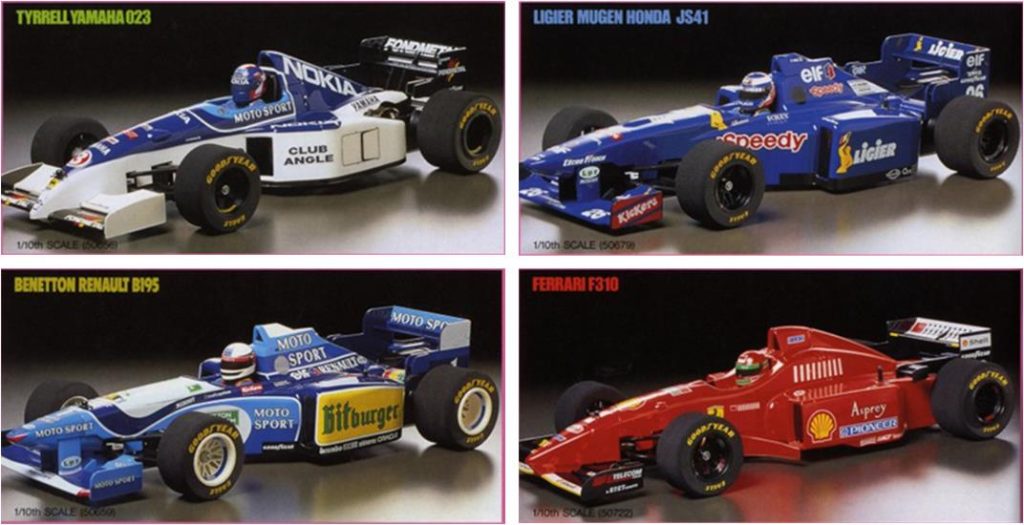
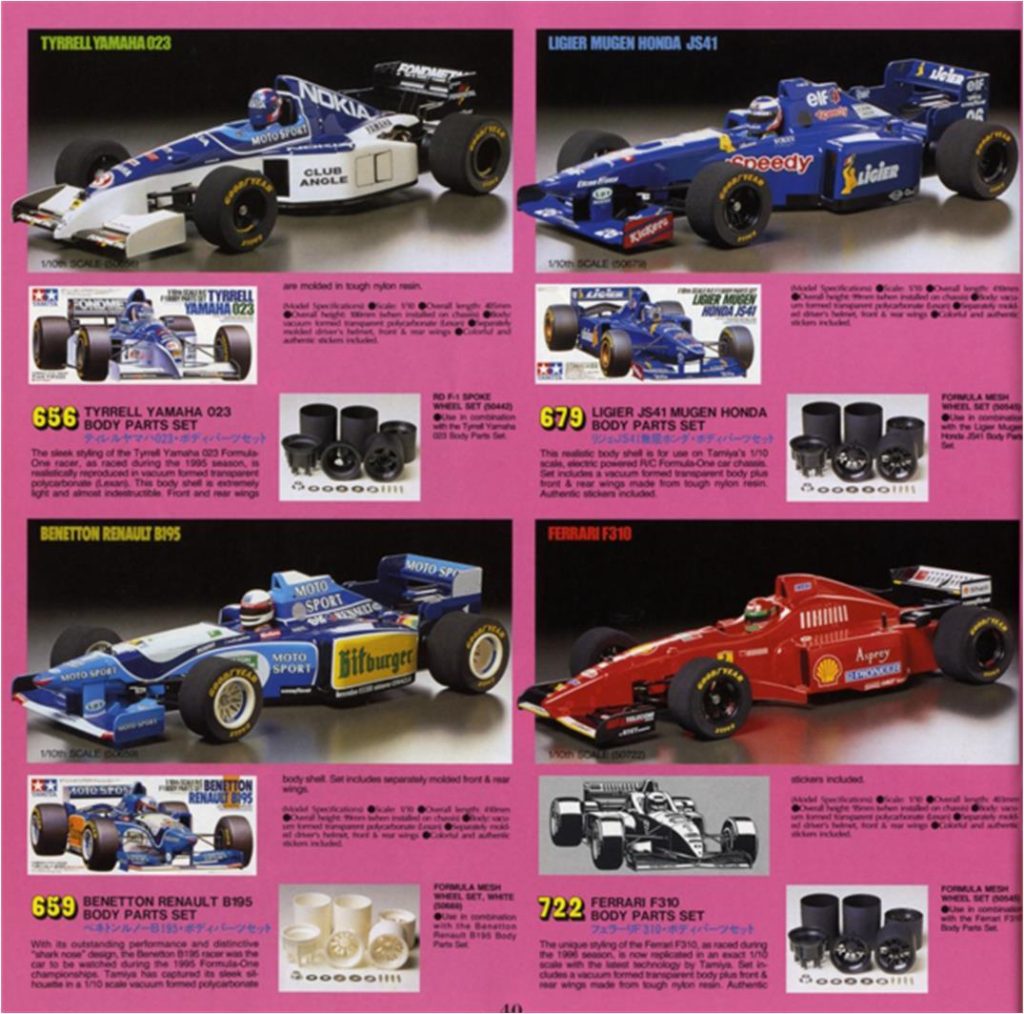
In 1997, Tamiya introduced the F103RX chassis designed to revive the brand in track racing. This chassis is the first in the F103 family that is released without bodywork to allow free use of 1/10 scale bodies available on the market. Tamiya releases as an accessory for sale four bodies complete with rims and tires for
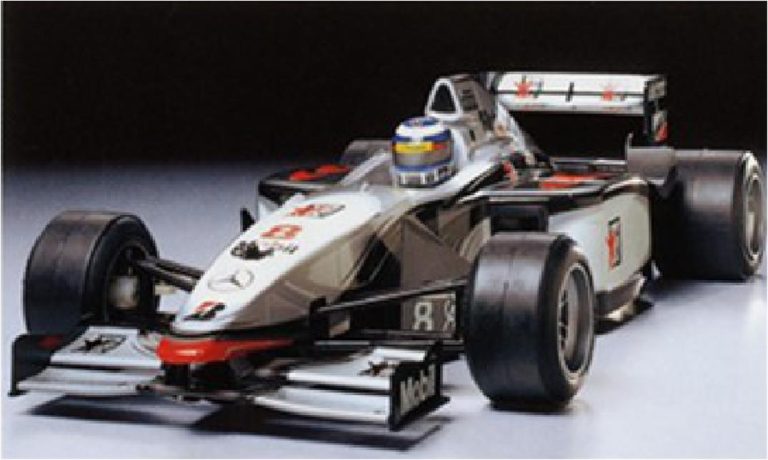
Tyrrell Yamaha 023, model number 50656 offered for sale in 1997, left first row image. Ligier JS41 Mugen Honda, model number 50679 offered for sale in 1997, image first row on right. Benetton B195 Renault, model number 50659 put up for sale in 1997, image second row on left. Ferrari F310, model number 50679 put up for sale in 1997, image second line right.
The differences between the F103 and F103RX chassis are as follows starting from the front and moving to the rear:
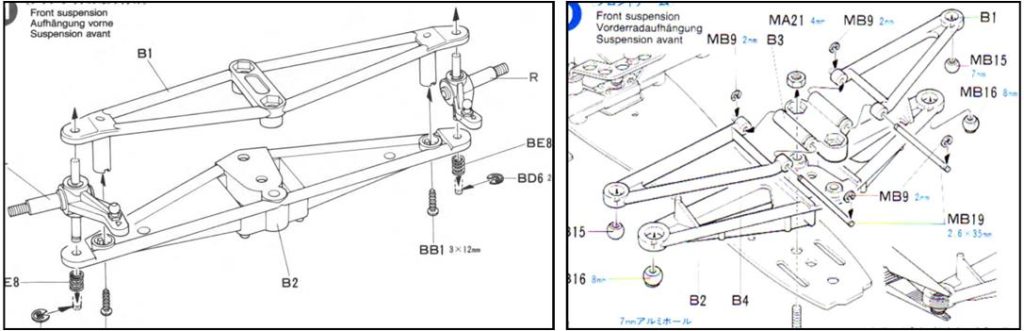
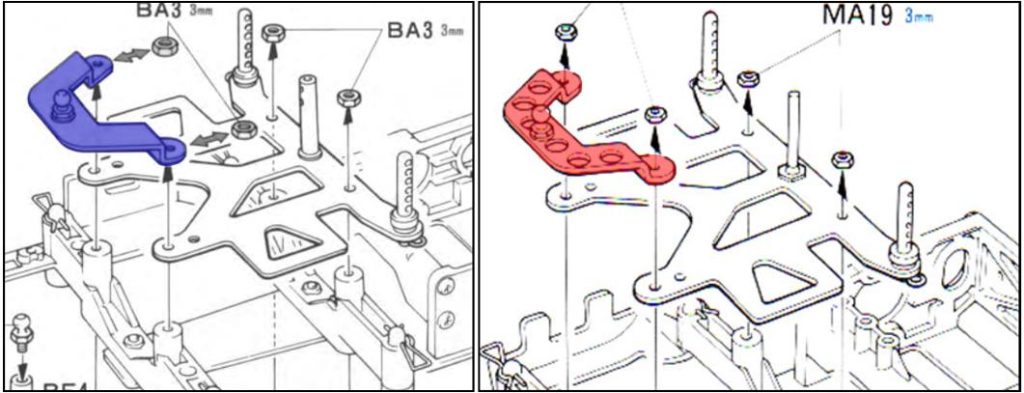
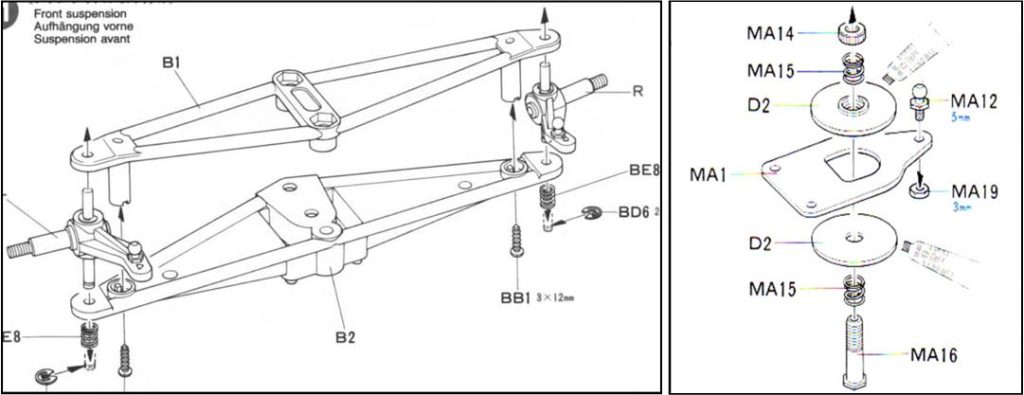
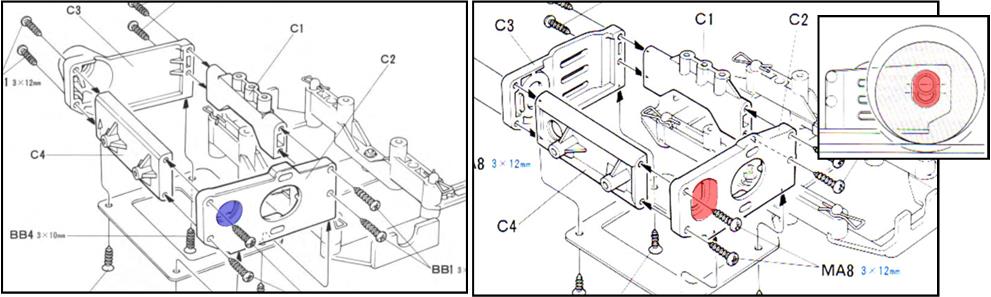
– the front suspension arm system in the F103 and F103L chassis is an evolution of that found in the F102 chassis by reducing the front suspension of the F103 chassis to only two pieces (left image below). The front suspension arm system in the F103RX chassis is an evolution of the F103 chassis, the left and right upper arms become articulated relative to the center frame to allow for better absorption of bumps (right image below).
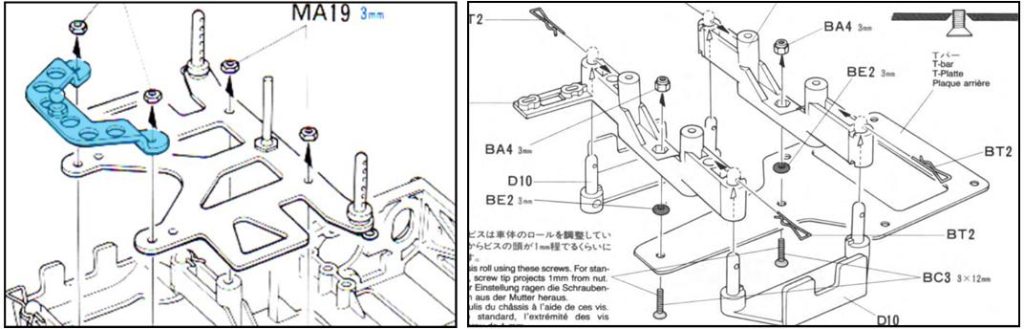
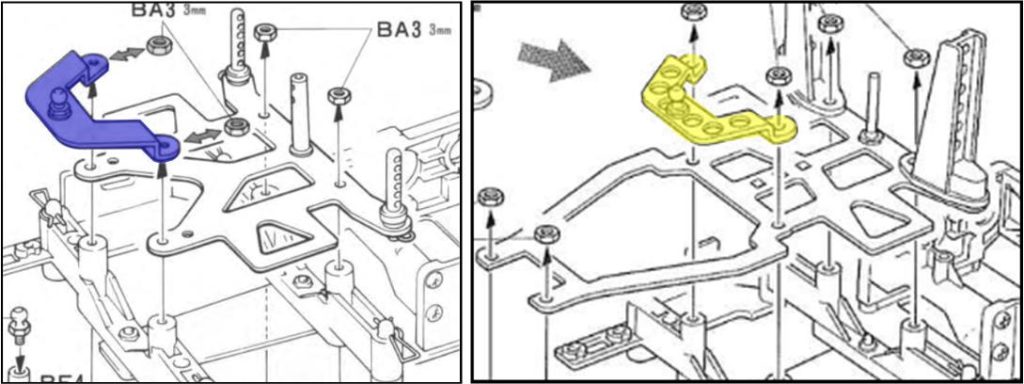
– the U-shaped plate for front installation of the center-rear mono-shock absorber is made of metal in both models. The shape is the same, but the version for the F103RX model is relieved by six holes (see in the image on the right the detail highlighted in red). This solution allows better steering control and improves the drivability of the model.This is an accessory that can be bought later and can be installed on any chassis of the F103 family: “F103 link-type front suspension” part number 53258
– The friction rear damping system consists of three black plastic discs and two FRP plates in model F103 and F103L (left image below). The friction rear damping system consists of two white Teflon discs and one FRP plate in the F103RX model (right image below),
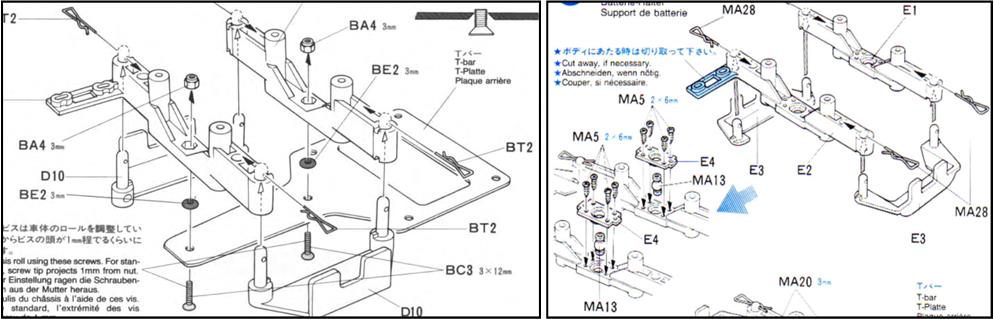
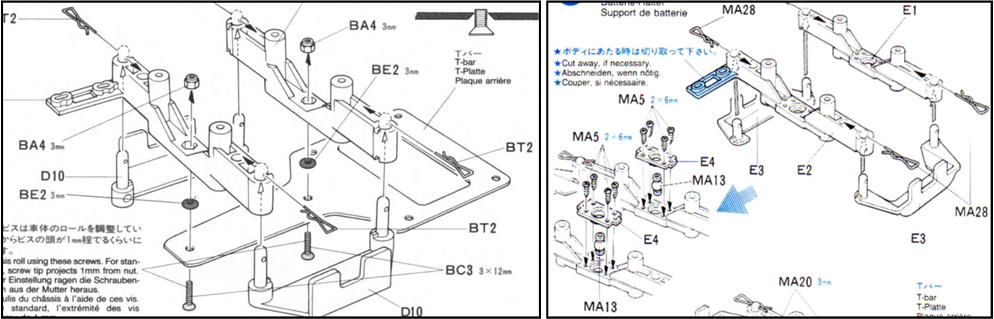
– the battery installation system that includes the T-plate joint for the F103RX chassis (pictured below right) is an evolution of the system found on previous F103 and F103L chassis (pictured below left). The connection of the two plastic cross-members to the T-plate is a ball-and-socket joint that provides more movement by allowing the chassis to better absorb bumps when going around corners. The two crossbars share the shape, but differ in the screw housing allowing in the F103RX version (right image) the installation of the ball joint that replaces the rubber o-ring of the F103 and F103L versions (left image). This solution allows better traction control, is an accessory that can be bought later and can be installed on any chassis of the F103 family: “F103 rear suspension ball mount” part number 53273.
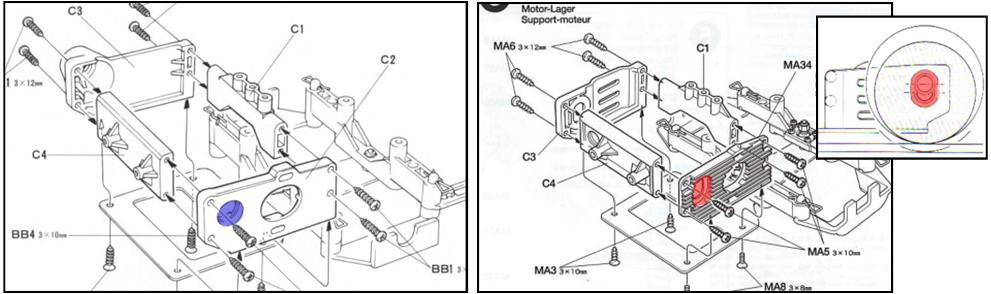
– the ground clearance of the rear of model F103 and F103L is not adjustable; the ball bearing that locks the rear axle is installed in the slot highlighted in blue in the left image. The rear structure of model F103RX that houses the electric motor and axle allows the ground clearance to be adjusted by changing the insert that fits into the slot highlighted in red in the center image below. Included in the package are three pairs of inserts that allow the rear height to be adjusted to three different positions. Highlighted in the right image is the insert for the F103RX chassis that allows the rear height to be minimized.
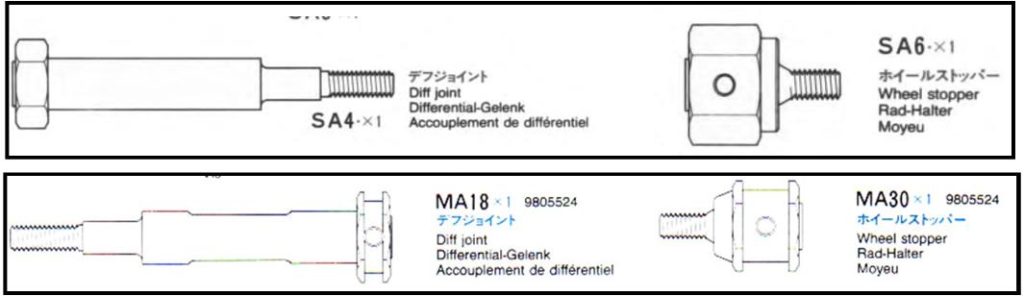
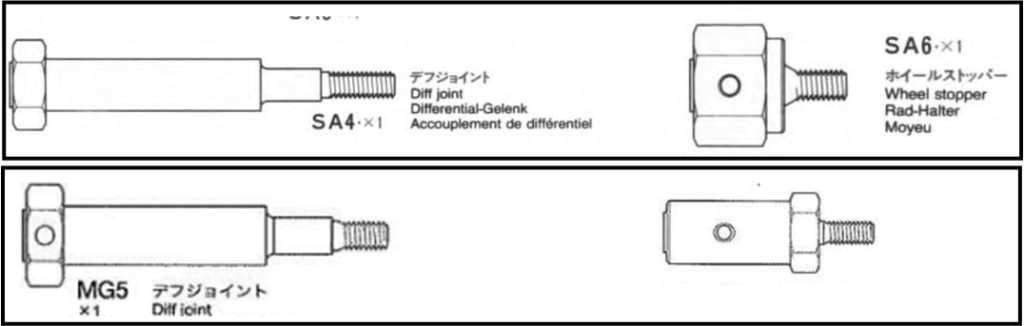
– rear axle metal joints for wheel installation are lightened in the F103RX chassis (the second row of the image below) compared to those installed on the F103 chassis (the first row of the image below). This solution allows a reduction in the weight of the model, is an accessory that can be bought later and can be installed on any chassis of the F103 family: “F103 light weight differential joint” part number 53248.
F103RS
The models that are equipped with this chassis are:
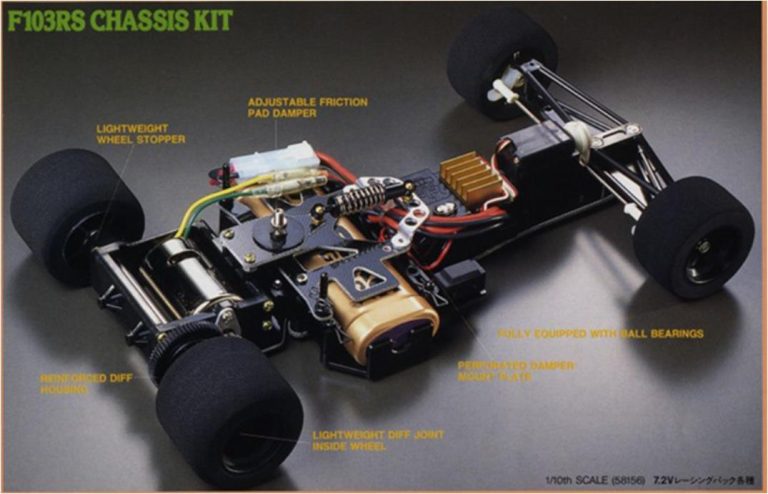
F103RS Chassis Kit, model number 58156 released for sale in 1995 and available on the market until 1999. This is the second chassis released without bodywork on which the bodies released for the F103RX chassis can be installed.
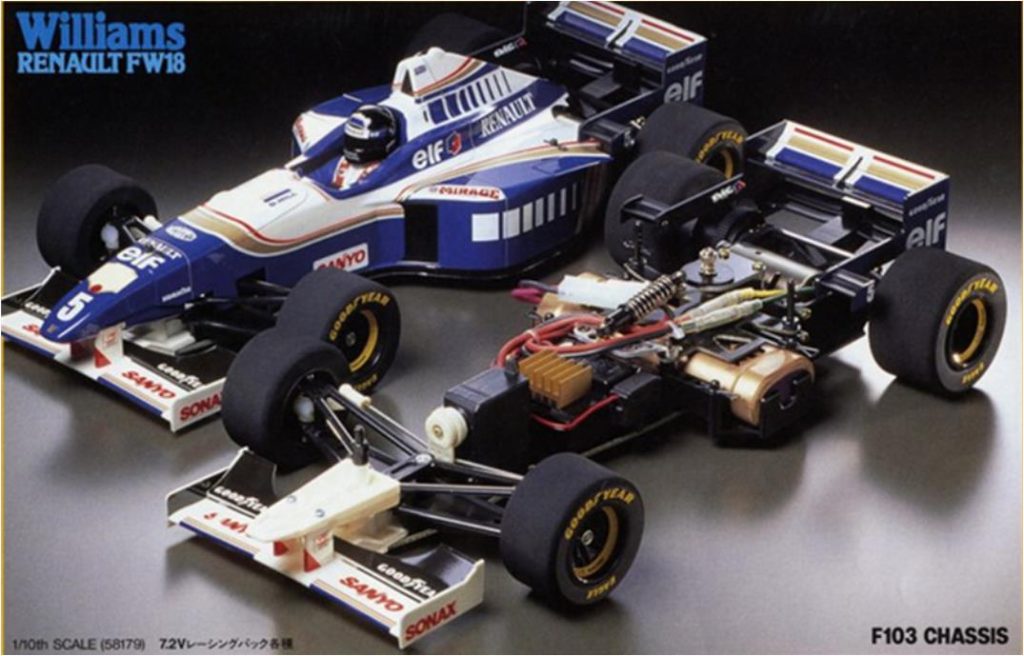
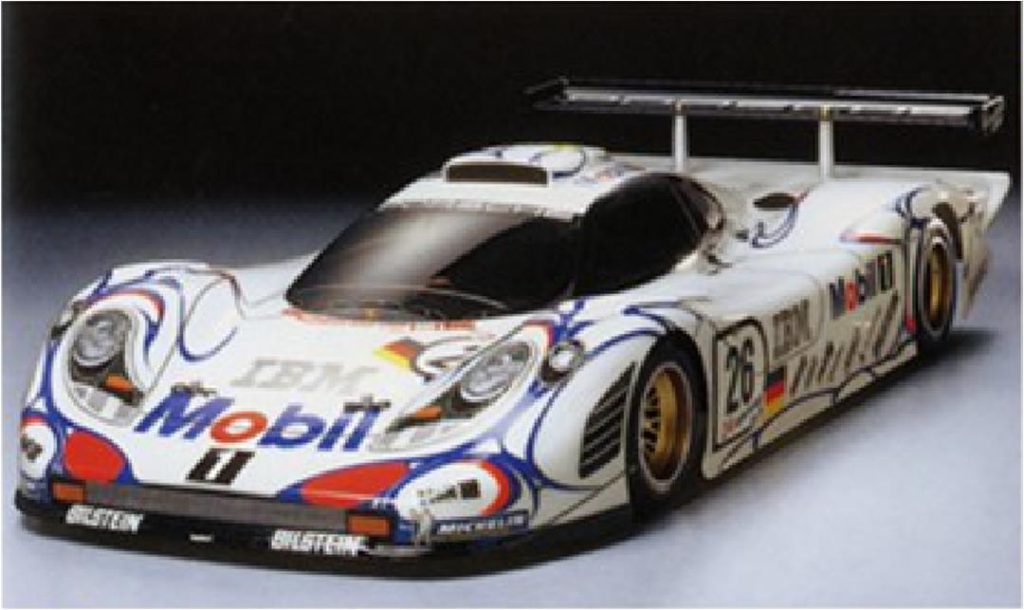
Williams Renault FW18, model number 58179 put on sale in 1996 and available on the market until 2002, Ferrari F310B, model number 58213 put on sale in 1998 and available on the market until 1999, Toyota GT-One TS020, model number 58129 put on sale in 1998 and available on the market until 1999, Porsche 911 GT1 98 LM Winner, model number 58230 put on sale in 1999 and available on the market until 2002, McLaren Mercedes MP4/13, model number 58235 put on sale in 1999 and available on the market until 2000 and Toyota GT-One TS020 99, model number 58253 put on sale in 1999 and available on the market until 2000.
The F103RS chassis is closely related to the F103RX chassis that is released for sale in the same year and is a mix of technical solutions adopted in the F103RX chassis and the F103 chassis. Most of the components are interchangeable between the three models, but they are not identical. The features of the F103RS chassis are as follows starting from the front and moving to the rear:
– retains the two-part fixed plastic front suspension system of the F103 chassis, which does not allow the front suspension to be adjusted. – adopts the two-disc single-plate system of the rear friction shock absorber system first installed on the F103RX chassis.
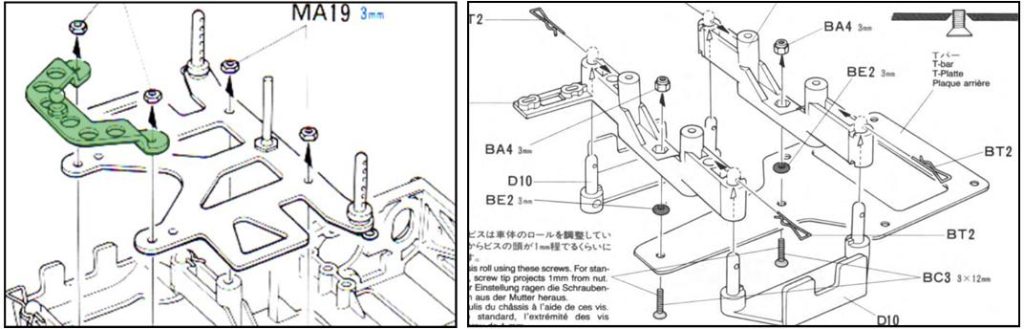
– adopts the lightened metal plate to secure the rear mono-shock absorber at the front highlighted in green in the image below. – retains the F103 chassis battery lock anchor system that reduces the degree of freedom of the rear axle with respect to lateral movement.
– maintains the rear axle system of the F103 chassis that does not allow ground clearance adjustment. The circular slot (highlighted in yellow in the image below) allows the ball bearing to be installed without adjusting ground clearance. – adopts the metal rear axle joints for lightened wheel installation of the F103RX chassis (the second row of the image on the right below) compared to those installed on the F103 chassis (the first row of the image on the right below).
F103LM
Only one model is equipped with this chassis:
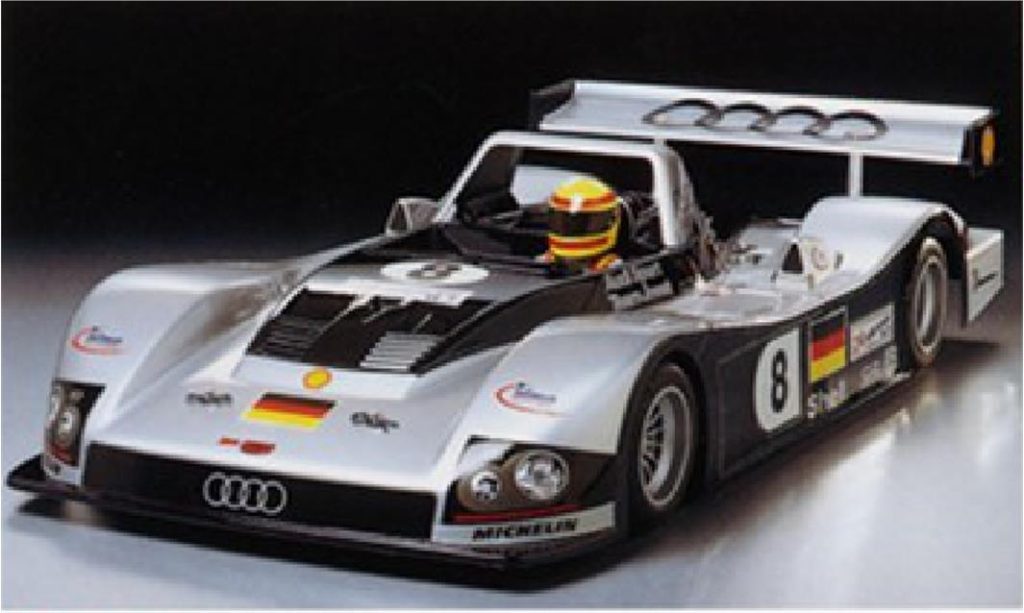
Audi R8R, model number 58247 offered for sale in 1999 and available on the market until 2002.
The F103LM chassis is closely related to the F103RS chassis that is released for sale in 1995. Most of the components are interchangeable between the F103 – F103RS – F103LM – F103RM models, but they are not identical. The features of the F103LM chassis are as follows starting from the front and moving to the rear:
– retains the two-part fixed plastic front suspension system of the F103 chassis that does not allow the front suspension to be adjusted. – adopts the two-disc single-plate system of the rear friction shock absorber system first installed on the F103RX chassis.
– adopts the lightened metal plate to secure the rear mono-shock absorber at the front highlighted in light blue in the image below. – retains the F103 chassis battery lock anchor system that reduces the degree of freedom of the rear axle with respect to lateral movement.
– maintains the rear axle system of the F103 chassis that does not allow ground clearance adjustment. The circular slot (highlighted in purple in the image below) allows the ball bearing to be installed without adjusting ground clearance. – adopts the metal rear axle joints for lightened wheel installation of the F103RX chassis (the second row of the image on the right below) compared to those installed on the F103 chassis (the first row of the image on the right below).
The main difference is the shape of the front bottom plate, which becomes wider to accommodate the electronics. In the image below, on the left is the inner plate of the F103 chassis and on the right is the lower plate of the F103LM chassis.
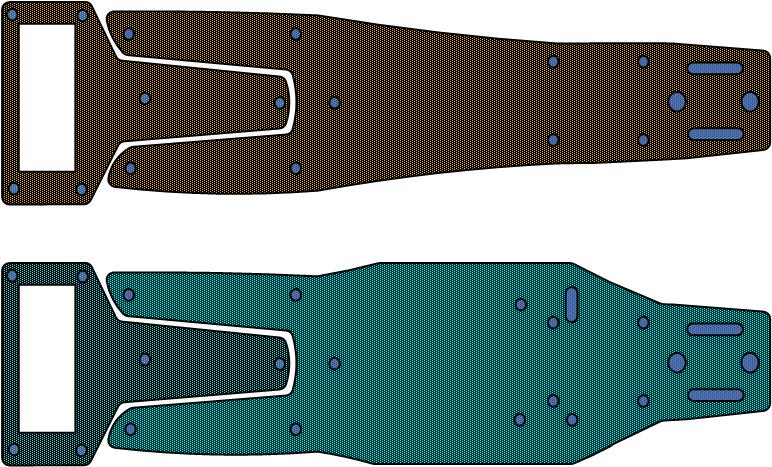
In the picture below, the chassis in dark brown color is the standard F103, the chassis in dark blue is the F103LM. In the F103LM chassis, the number of holes hints at the provision for different types of front center servo installation for steering. The rear T-plate is the same in the two chassis F103 and F103LM
In the picture below on the left is the F103RS chassis and on the right is the F103LM chassis, The front part that serves as a bumper is different between the two models: in the F103RS chassis is front wing of the F1 car while in the F103LM chassis is a plastic plate that houses the two towers to attach the body to the chassis.
F103LM TRF
Only one model is equipped with this chassis:
F103LM-TRF Special Cassis Kit (for GT), model number 58258 put on sale in 1999 and available on the market until 2000. This is the third chassis in the F103 family released without bodywork on which prototype or Grand Touring bodies can be installed.
This chassis is an evolution of the F103LM chassis that has been integrated of all the solutions released on the F103RX chassis and 19 Hop up including shielded ball bearings, oil bath adjustable mono rear shock and a carbon fiber main frame and not FRP. The features of the F103LM TRF chassis are as follows starting from the front and moving to the rear:
– the front suspension arm system in the F103LM TRF chassis is an evolution of the F103 chassis, the left and right upper arms become articulated with respect to the center frame to allow for better roughness absorption (right image below).
– On the F103 LM TRF chassis, the steering servo (highlighted in orange in the image below) is installed horizontally instead of vertically as on the rest of the F103 family. The suspension arms are the same length; they retain the ease of adjustment that is one of the main technical evolutions that characterize the transition from the F102 to the F103.
– On the F103 chassis, the U-shaped plate for front installation of the center-rear single shock absorber is made of metal (detail highlighted in blue in the left image). The FRP top plate of the F103LM TRF is an evolution of that of the F103 chassis: the evolved plate integrates the shock absorber mount. This solution of the F103LM TRF frame saves 2..4 grams compared to the version installed on the F103 frame. The plate is available as accessory part number 53394 (“F103 LM Carbon Upper Deck”), so, there are many models on sale today (2024) that adopt it.
– The friction rear damping system consists of three black plastic discs and two FRP plates in model F103 and F103L (left image below). The friction rear damping system consists of two white Teflon discs and one FRP plate in the F103RX model (left image below),
– the battery installation system that includes the T-plate joint for the F103LM-TRF chassis (pictured below right) is an evolution of the system found on the earlier F103 and F103L chassis (pictured below left). This is an evolution introduced in the F103RX chassis. The connection of the two plastic cross-members to the T-plate is a ball-and-socket joint that provides more movement by allowing the chassis to better absorb bumps during cornering. The two crossbars share the shape, but differ in the screw housing allowing in the F103LM TRF version installation of the ball joint that replaces the rubber o-ring of the F103 and F103L versions.
– the ground clearance of the rear of model F103 and F103L is not adjustable; the ball bearing that locks the rear axle is installed in the slot highlighted in blue in the left image. The rear structure of the F103LM TRF model that houses the electric motor and axle allows the ground clearance to be adjusted by changing the insert that fits into the slot highlighted in red in the image below center. Included in the package are three pairs of inserts that allow the rear height to be adjusted to three different positions. Highlighted in the right image is the insert in the F103LM TRF chassis that allows the rear height to be minimized. This is an evolution introduced in the F103RX chassis.
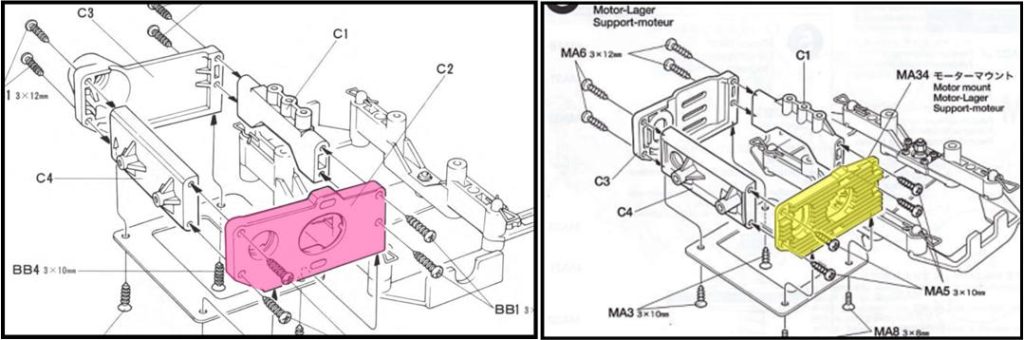
– The motor carrier plate is black plastic in the F103 chassis, see image on left detail highlighted in pink. The motor carrier plate is finned aluminum in the F103 LM TRF chassis, see image at right detail highlighted in yellow. This solution allows better traction control, is an accessory that can be bought later and can be installed on any chassis in the F103 family: “F103 height adjustable aluminum heat sink motor mount” part number 53277.
– the rear axle metal joints for wheel installation are lightened in the F103LM TRF chassis (the second row of the image below) compared to those installed on the F103 chassis (the first row of the image below). This is an evolution introduced in the F103RX and F103RS chassis.
– the F103 LM TRF frame is the wide one in the image highlighted in light blue, the frame highlighted in brown is that of the F103 frame
– the F103LM TRF chassis has a metal arc frame to support antenna and the front plastic bumper.
F103 SIX
There are no models in the 58xxx series equipped with this six-wheel chassis, which was used in the 48xxx, 57xxx and 84xxx series to bring some versions of the 6-wheel Tyrrell P34 F1 car to market
F103 GT
The models that are equipped with this chassis are:
F103GT Chassis Kit, model number 58367 put on sale in 2006 and available on the market until 2011, Advan Courage LC70 Mugen, model number 58376 put on sale in 2006 and available on the market until 2010, NISSAN GT-R LM NISMO Launch version, model number 58617 put on sale in 2015 and available on the market until 2016, Toyota Gazoo Racing TS050 HYBRID, model number 58665 put on sale in 2018 and available on the market until 2019, Toyota Gazoo Racing TS050 HYBRID 2019, model number 58680 put on sale in 2020 and available on the market until 2021 and
F103GT incorporated several updates that were released over time on the F103RS and F103RX, the features of the F103GT chassis are as follows starting from the front and moving to the rear:
– the front suspension arm system in the F103GT chassis is an evolution of the F103 chassis, the left and right upper arms become articulated with respect to the center frame to allow for better absorption of bumps (right image below). The steering spindle of the FF103GT chassis is different from that of the F103 chassis, the ball bearings are no longer installed in the rim; instead, they are installed inside the spindle (see image at right).
– the servo that controls the steering has a new mounting system developed specifically for the F103GT chassis. It consists of two L-shaped brackets surrounding the servo.
– the FRP top plate has a different shape than that of the F103 chassis (left image below). The top plate of the F103GT (right image below) reaches up to the two L-shaped servo plates cooperating to stiffen the chassis. The U-shaped metal plate for attaching the monoshock is the lightened 6-hole plate (part highlighted in yellow in the image on the right below) introduced on the F103RS, F103RX and F103LM chassis. This solution is lighter than the one installed as standard on the F103 and F103L chassis (part highlighted in blue in the image on the left below).
– the rear friction damping system consists of three black plastic discs and two FRP plates in the F103 and F103L models (left image below). The rear friction damping system consists of two white Teflon discs and one FRP plate in the F103GT model (left image below), a system already installed on the F103RX, F103LM and F103LM TRF chassis.
– the rear structure of the F103GT model that houses the electric motor and axle allows you to adjust the height from the ground by changing the insert that fits into the slot highlighted in red in the central image below. The package includes three pairs of inserts that allow you to adjust the rear height in three different positions. The image on the right highlights the insert of the F103GT frame that allows you to reduce the rear height to a minimum. This is an evolution introduced in the F103RX and F103LM TRF frames.
– the two right and left joints of the rear axle of the F103GT chassis (see image below in the second row) are an evolution of the two joints of the F103 chassis (see image below in the first row)
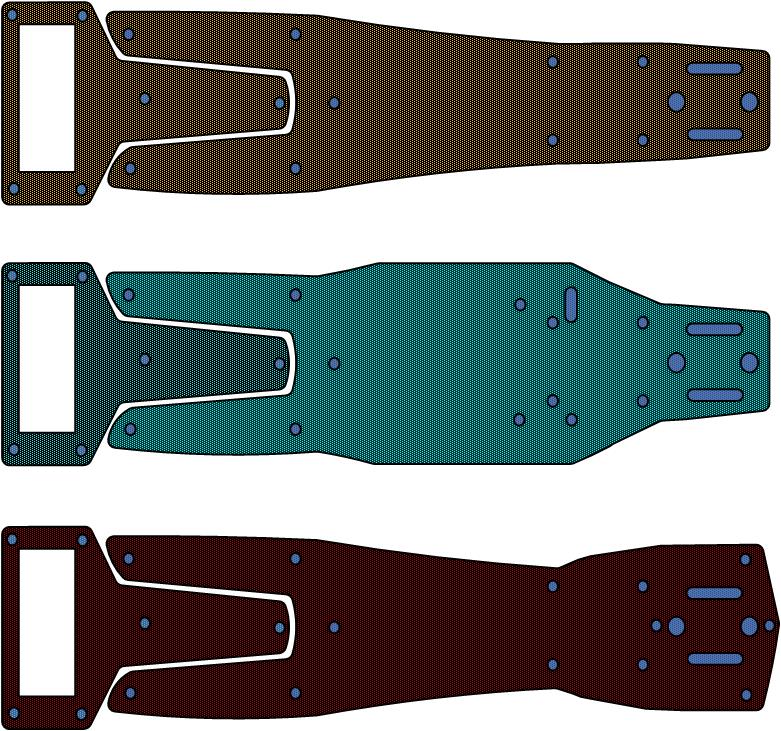
– the bottom plate of the F103GT frame (part highlighted in dark red in the image below) has a slightly different shape than the standard F103 frame, it is an intermediate solution between the F103 frame (part highlighted in dark brown in the image below) and F103LM (part highlighted in dark blue in the image below).
F103RM
There are no 58xxx series models with this frame which was used in the 48xxx and 84xxx series.
Tamiya, original figure, box art, guide book and catalogue are of TAMIYA INC, which does not endose or sponsor www.tamiyaclassic.com. Any brands, logos and trademarks represented on this website are the copyright of their respective owners.